

Learn how to measure marketing attribution with a step-by-step framework covering models, tools, and real examples from Sprints & Sneakers.
A B2B marketing team reviews its monthly dashboard and finds a reassuring result: paid search generated most of the reported conversions. The budget discussion seems simple. Increase paid search, reduce channels that appear less productive, and move on.
Then sales reviews the same accounts. Several buyers first discovered the company through an organic article, returned after seeing a social campaign, attended a webinar, spoke with a sales representative, and finally searched the brand before submitting a form. The last click captured the conversion, but it didn't necessarily create the demand.
That gap explains why how to measure marketing attribution matters. Attribution can help teams allocate spend and improve campaigns, but only when they distinguish credit allocation from causal impact. For B2B scale-ups with longer sales cycles, the most practical system combines continuous user-level attribution with periodic incrementality experiments.
The finance team asks why marketing spend was wasted last month. The analytics dashboard shows a surge in conversions from paid search, so the marketing manager opens the last-click report and finds a green row of successful campaigns.
That conclusion feels useful because it has a clean answer. It may also be wrong. A buyer could have discovered the company through an organic article weeks earlier, interacted with a social advertisement, returned through a retargeting impression, and converted after searching for the brand. Last click identifies the final qualifying interaction, not necessarily the interaction that created demand.

Last-touch attribution assigns 100% of conversion value to the most recent qualifying interaction. That makes it easy to report and easy to explain, but it also rewards channels that appear late in the journey, including branded search, retargeting, and direct-response campaigns.
The problem becomes sharper in B2B. A company may spend months educating a buying committee before one stakeholder submits a demo request. If the reporting system credits only the final form interaction, the earlier work can look unproductive even though it helped the account become ready.
Practical rule: Treat a last-click report as a closing signal, not a complete record of demand creation.
Attribution also depends on a defined conversion window. The IAB Australia marketing measurement framework describes a 30-day lookback window for last-interaction attribution. A window that's too short can exclude meaningful earlier interactions, while a window that's too broad can attach credit to activity with little connection to the outcome.
User-level attribution can compare channels and campaigns, but it remains observational. Reliable identity resolution, complete event collection, consistent campaign tagging, and agreed conversion definitions are all required before the output becomes useful. Privacy changes and fragmented journeys make those conditions harder to maintain, especially when buyers move between devices, browsers, accounts, sales conversations, and offline events.
A helpful introduction to the commercial tension is this overview of attribution in retail media from Million Dollar Sellers. The same principle applies to B2B: a channel can receive credit because it was visible near conversion, while another channel created the familiarity that made the conversion possible.
The answer isn't to abandon attribution. It is to stop treating one model as objective truth. Continuous attribution is valuable for directional optimization, but larger budget decisions need validation against outcomes that reveal what would have happened without the marketing activity.
Marketing attribution measures how much credit each advertising or marketing touchpoint receives for a defined outcome, such as a lead, purchase, subscription, or revenue event. The model determines how that credit is distributed across the buyer's path.
Single-touch models choose one interaction. First-touch gives all credit to the first recorded interaction, which helps assess discovery. Last-touch gives all credit to the final qualifying interaction, which helps assess the conversion moment. Both are simple, but each removes most of the journey from the decision.
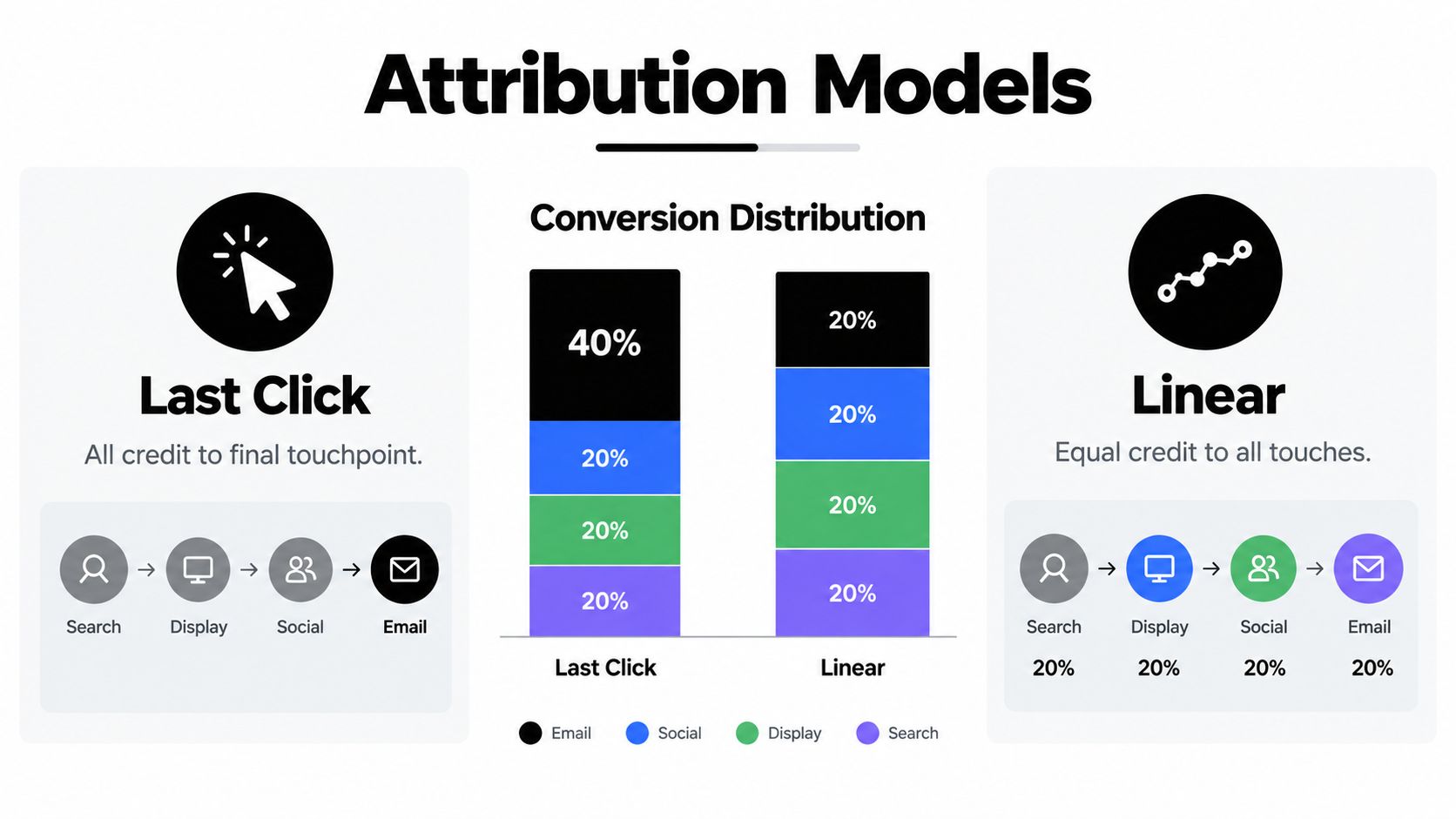
Assume a customer has four qualifying interactions before converting:
| Model | Credit distribution | What it emphasizes |
|---|---|---|
| First touch | All credit to interaction one | Initial discovery |
| Last touch | All credit to interaction four | Final conversion step |
| Linear | Equal credit across all four | Complete recorded path |
| Time decay | More credit to later interactions | Proximity to conversion |
| Position based | More credit to first and last | Discovery and close |
With a linear model, each of the four touches receives 25% of conversion credit. If the conversion represents €1,000 in revenue, each touch receives €250 before any additional weighting. Those calculations are useful for comparing channel-level reporting, but they don't prove that any individual touch caused the sale. The model definitions and examples are outlined in the IAB Australia attribution framework.
U-shaped or position-based attribution emphasizes the first and last interactions, while time decay assigns progressively more credit to interactions closer to conversion. A multi-touch attribution guide from Arlo Inc. offers additional context for teams comparing these rule-based approaches.
The right model depends on the question. First-touch reporting can help a team understand which channels introduce accounts to the brand. Last-touch reporting can help identify what tends to complete a conversion. Linear reporting provides a neutral baseline when the team doesn't yet have a defensible reason to weight one interaction more heavily.
A B2B scale-up shouldn't ask which model is universally correct. It should ask which model produces a useful signal for a specific decision, then compare that signal with incremental outcomes. The multi-touch attribution modeling resource can support that assessment.
<iframe width="100%" style="aspect-ratio: 16 / 9;" src="https://www.youtube.com/embed/BfnJwYuFWVM" frameborder="0" allow="autoplay; encrypted-media" allowfullscreen></iframe>A practical attribution system has two layers. The first supports frequent optimization. The second tests whether the decisions produced incremental business value.
The first layer is continuous user-level attribution. It brings together analytics events, campaign tags, advertising interactions, CRM milestones, and revenue outcomes so a team can inspect journeys and compare models. This layer is fast enough for weekly campaign decisions, but it should be treated as directional because identity loss, consent limits, missing touchpoints, and offline influence can create gaps.
The second layer is periodic incrementality validation. It uses controlled experiments to test whether marketing caused additional conversions or revenue. The distinction matters because a conversion can occur after a marketing interaction without being caused by that interaction.
A credible system starts by defining one primary business outcome, such as qualified pipeline, revenue, or contribution margin. That definition must stay consistent across the CRM, advertising systems, analytics, and finance.
The measurement design should align:
This two-layer approach is also recommended in guidance on measuring what matters most, which separates continuous attribution from periodic incrementality experiments.
The user-level layer can use GA4 and a documented UTM standard. Every campaign should follow the same rules for source, medium, campaign, content, and term. The CRM should record offline activity, sales stages, opportunity value, and the dates those stages changed.
A useful weekly dashboard can show channel-attributed revenue, cost per attributed conversion, return on ad spend, and customer lifetime value under at least two models. A periodic experiment then tests the channels where model disagreement is material or where a budget decision carries significant financial risk.
Decision principle: Use attribution to decide what deserves investigation. Use incrementality to decide what deserves more budget.
Attribution tells a team which touchpoints received credit. Incrementality asks whether the outcome would have happened without the marketing. That question matters in B2B because branded search, retargeting, partner referrals, and sales activity can all appear in the path to a deal without creating additional pipeline.
A geo-based holdout is a practical starting point when audience-level randomization isn't feasible. The team selects markets that are sufficiently similar, then matches them on historical conversions, revenue, seasonality, media exposure, customer mix, and macroeconomic conditions.
Where feasible, markets should be randomly assigned to treatment and control. If random assignment isn't practical, the team should use a pre-registered matched-market design and document the matching method.
The pre-period checks whether treatment and control markets move in parallel before the test begins. The team should lock the test duration before launch and avoid changing bids, budgets, creative, promotions, pricing, or sales coverage during the measurement window.
A credible test plan records:
The incrementality and attribution decision framework highlights why matched markets, controlled tests, and aggregate measurement need to work together.
The basic calculation compares the treatment outcome with the control baseline. If the exposed group converts at 8% and the control group converts at 6%, incremental lift is 2 percentage points, or 33.3% relative to the control rate. The calculation and example are documented in the IAB Measurement 360 whitepaper.
For B2B, the team shouldn't stop at lead volume. The test should connect lift to incremental conversions, incremental revenue, incremental profit, and incremental return on ad spend. A channel that receives substantial platform credit but produces little incremental pipeline should not retain budget merely because its dashboard looks efficient.
Audience split tests and temporary channel pauses can provide another route, provided the control group is protected from contamination. The marketing experimentation guide can help teams structure the test and interpret the result without confusing correlation with causation.
Advanced attribution cannot rescue inconsistent data. If one team labels a campaign source as “paid-social,” another uses “paid_social,” and a third leaves the field blank, the reporting layer has no reliable way to group those interactions.
Google Analytics defines an attribution model as a rule, set of rules, or data-driven algorithm that assigns credit to touchpoints along a user's path to an important action. Its reporting has included data-driven attribution as well as paid-and-organic and Google-paid-channel last-click options. The practical implication is straightforward: model comparison should be a normal operating practice, not a one-time audit.
The campaign taxonomy should be written down before launch and enforced across teams. A minimum standard covers:
Conversion events need equal discipline. A form submission, qualified opportunity, and closed-won deal are different outcomes. Each event should have an owner, a definition, a timestamp, and a documented relationship to the business result.
A next-day exercise is to compare a channel's reported conversions with the conversions it receives under a data-driven model. Sharp changes deserve investigation, especially when the channel sits late in the funnel or benefits from high-intent traffic. The Google Analytics attribution model documentation explains how data-driven attribution can use converting and non-converting paths to estimate how interactions change the probability of an important event.
User-level attribution is useful for campaign optimization, but it has blind spots. Anonymous research, dark social, offline influence, consent-limited interactions, and fragmented identities can prevent a complete journey from appearing in the data.
Marketing-mix modeling provides an aggregate supplement for decisions across longer periods, channels, and offline activity. It doesn't replace experiments or user-level reporting. It helps answer a different question, especially when individual paths are incomplete.
The first-party data strategy guide is a useful reference for reducing dependence on fragile identifiers and improving the quality of owned customer signals. Clean first-party data still won't reveal every influence, but it gives finance, sales, and marketing a more consistent foundation for reconciliation.
Attribution fails less often because a team chose the wrong formula than because the underlying comparison is biased. The most dangerous error is comparing people who saw an advertisement with people who didn't, when the two groups were never comparable in the first place.
People who click ads may already be more interested, more active, or closer to a buying decision. Their higher conversion rate can reflect pre-existing intent rather than the incremental effect of the campaign.
A practical review should cover five risks:
The attribution window is a measurement rule, not proof of causation. Google Ads reporting allows lookback windows of 30, 60, or 90 days. A B2B company with a typical six-week sales cycle could compare a 60-day window with a 30-day window, provided it keeps the conversion definition and reporting period consistent. The Google Ads lookback window documentation explains how the setting changes which interactions remain eligible for credit.
Multi-touch attribution depends on reliable identity resolution, complete event collection, consistent tagging, and agreed conversion definitions. Even with those controls, it remains correlational. A conversion may have happened without marketing.
When an incrementality experiment and an attribution model disagree materially, the experiment should guide the budget decision. The experiment has a control group and therefore provides a counterfactual that the observed user journey cannot provide.
For a wider operating view, teams can use this cross-channel marketing attribution framework to document touchpoints, model assumptions, and reporting rules. The aim isn't perfect measurement. It is a repeatable process that exposes uncertainty before the team makes an expensive decision.
A measurement program becomes useful when the team can act on it the next day. The first task is not selecting an advanced model. It is checking whether the business agrees on what counts as a conversion.
Review the current definitions across GA4, the CRM, advertising platforms, and finance. Confirm whether the reported outcome is a lead, qualified pipeline, opportunity, closed revenue, or contribution margin. If each system uses a different definition, the team should fix that mismatch before interpreting channel performance.
Next, create a single UTM taxonomy and document it where campaign managers, agencies, sales teams, and analysts can use it. Check historical campaign names for inconsistent capitalization, missing values, and duplicated conventions.
Then map the main touchpoints that the current system misses. Sales calls, partner referrals, events, anonymous research, and account-level activity may not fit neatly into a person-level path, but they still belong in the measurement discussion.
The first incrementality test doesn't need to cover every channel. Select one region, audience, or campaign where the budget decision matters and where treatment and control can remain distinct.
Before launch, define the primary outcome, pre-period, test duration, exposure rules, contamination checks, and reporting method. After the test, compare total business outcomes, not only platform-reported conversions, and record the uncertainty around the result.
The marketing performance reporting resource can help turn these outputs into a recurring management view rather than a one-off analysis. A strong report shows model-based credit, experimental lift, commercial outcomes, and the decision that follows.
Privacy constraints will continue to limit person-level visibility. Teams that build around ranges, confidence intervals, decision thresholds, and transparent assumptions will make better choices than teams presenting modeled revenue as precise fact. Attribution should remain one input into budget decisions, while experiments provide the evidence needed to validate the most consequential choices.
Sprints & Sneakers offers tracking and attribution audits that identify measurement gaps, connect marketing touchpoints to pipeline and revenue, and help teams structure cross-channel reporting. Visit Sprints & Sneakers to assess the current measurement system and plan a practical attribution and incrementality program.
Growth marketing, AI and automation, SEO, performance marketing, retention strategies, and sustainable business practices.
Weekly. Subscribe to our newsletter to get new articles straight to your inbox.
Absolutely. Everything we publish is designed to be actionable. Take it, test it, and make it your own.
Yes. We publish experiments with real numbers. What worked, what didn't, and what we learned.
Our growth team — strategists, performance marketers, data specialists, and AI builders who work on client campaigns every day.
We're open to it. Reach out via our contact page with your topic and we'll take a look.