
Build a predictable pipeline with this inbound lead generation strategy playbook. Master SEO, interactive assets, and fast follow-up to scale B2B growth.
Most inbound advice starts with the wrong prescription: publish more content. That approach fills calendars, not necessarily pipelines. Modern buyers scan quickly, compare vendors across search, social, communities, and AI-mediated discovery, then expect proof that speaks directly to a live commercial problem. A broad library can attract attention while failing to reveal who has urgency, fit, budget, or a reason to talk.
A stronger inbound lead generation strategy treats content, capture, qualification, and sales response as one operating system. The objective isn't maximum traffic. It's a reliable path from useful discovery to measurable pipeline, with interactive experiences that expose intent and a response process that acts before interest fades.
The “publish more content” rule made sense when search visibility depended largely on building a larger editorial footprint. It breaks down when buyers can summarize several pages in seconds and move between search results, social discussions, reviews, and vendor pages without following a neat funnel. Generic educational posts still have a role, but they shouldn't consume the resources required for assets that help a prospect evaluate a solution.
The better question is simple: which assets create qualified pipeline, not just visits? HubSpot's 2026 marketing data identifies website, blog, and SEO as the single highest-ROI channel for marketers, named by 27% of respondents in its global survey of more than 1,500 marketers, as reported in its 2026 marketing industry trends report. That supports continued investment in owned content, but it doesn't justify publishing without a commercial measurement plan.

A practical audit starts with every important page and asks what the visitor can do next. A post that attracts search traffic but produces no meaningful engagement may need a stronger next step, while a smaller comparison guide may deserve more internal links, paid distribution, and sales enablement because it attracts evaluation-stage buyers.
Score each asset against four signals:
A useful asset doesn't need to be gated. Ungated pages can establish authority and earn discovery, while mid-funnel resources can capture information once the visitor has a clear reason to exchange it. The mistake is treating every page as either a traffic vehicle or a lead form. Strong programs use both roles deliberately.
For a B2B scale-up, a focused cluster might include one commercial-intent pillar, several problem-specific pages, a calculator that reflects the buyer's economics, and a short implementation guide for stakeholders who need internal approval. That package can outperform a stream of disconnected posts because each asset answers a different evaluation question and passes context to the next interaction.
A content strategy should also reflect the way prospects buy. Short-form content can earn attention, but proof-oriented pages, product demonstrations, implementation checklists, and interactive assessments help buyers decide whether a conversation is worthwhile. Teams building that system can use this B2B content marketing strategy resource to connect authority-building content with lead capture instead of managing them as separate programs.
Practical rule: Keep publishing only when a new asset adds a distinct buying signal, answers an unresolved objection, or creates a measurable route to revenue.
Traffic and closed-won revenue are useful endpoints, but they hide the decisions that determine performance in between. A visitor may fail to become a lead because the offer is weak. A lead may fail to become an MQL because qualification is vague. An MQL may stall because sales receives poor context or responds too slowly.
A B2B funnel needs separate instrumentation for visitor-to-lead, lead-to-MQL, MQL-to-SQL, and SQL-to-opportunity. A 2025 benchmark cited a median B2B visitor-to-lead conversion rate of 2.3%, with top-quartile programs reaching 4.7% or higher, according to the B2B inbound demand generation benchmarks. The same benchmark reported a median organic-search visitor-to-lead conversion rate of 1.6%, which makes source quality and landing-page intent important parts of the diagnosis.
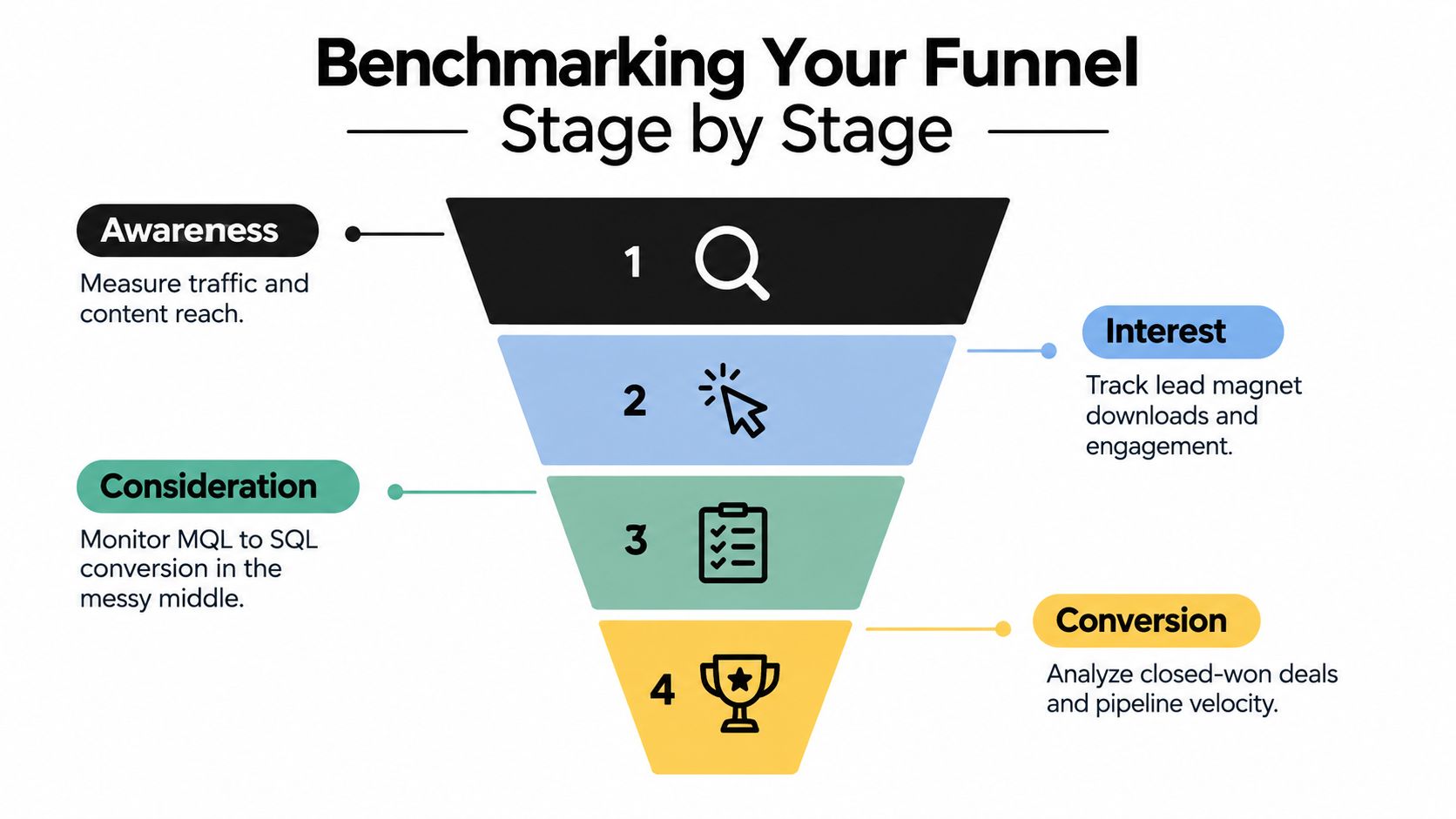
At the visitor-to-lead stage, separate branded and non-branded traffic, landing-page intent, device experience, and offer type. A high-traffic article with a generic newsletter form shouldn't be judged against a page targeting an active solution search. The page needs a call to action that matches the visitor's problem and readiness.
Then examine lead quality. The benchmark data places average lead-to-MQL conversion at about 31%, while MQL-to-SQL conversion commonly sits between 15% and 35%, as detailed in the same funnel benchmark report. If lead-to-MQL is weak, the offer may attract the wrong audience or the scoring model may be too restrictive. If MQL-to-SQL is weak, marketing may be passing engagement without enough fit or sales may lack a useful reason to act.
Teams often respond to a weak middle funnel by buying more traffic. That multiplies the number of poorly qualified records and increases the workload for sales. Average inbound lead-to-customer rates sit around 2% to 5%, so capture without scoring, routing, and follow-up can create the appearance of activity without dependable revenue, according to the 2025 B2B benchmark analysis.
Use a weekly diagnostic:
A funnel review should end with an owner, a hypothesis, and a date for reassessment. The conversion funnel optimization guide can help teams translate that review into page, form, and handoff experiments.
A generic gated PDF asks for contact information before giving the visitor much evidence that the exchange will be worthwhile. Interactive assets reverse that sequence. They let the prospect answer relevant questions, receive a customized output, and reveal useful buying signals during the experience.
The format itself can materially affect conversion. A 2025 benchmark reported average conversion rates of 3.8% for gated PDFs, 4.1% for webinars and video, 6.2% for interactive assessment tools, 8.3% for interactive calculators, and 5.7% for free trials and demos, as shown in the B2B lead magnet comparison. These figures aren't a guarantee for every audience, but they provide a strong reason to test mechanics rather than assume the asset topic does all the work.
A calculator works when the buyer already understands the problem and wants an estimate, scenario, or business case. An assessment fits a prospect who needs to identify gaps before choosing a solution. A trial or demo suits visitors ready to experience the product. A PDF remains useful when the subject requires careful reading or internal circulation, but it should earn its place through depth and relevance.
| Asset Format | Average Conversion Rate |
|---|---|
| Gated PDF | **3.8%** |
| Webinar or video | **4.1%** |
| Interactive assessment tool | **6.2%** |
| Interactive calculator | **8.3%** |
| Free trial or demo | **5.7%** |
The strongest interactive lead magnets don't hide a long form at the beginning. They ask low-friction questions first, provide enough interaction to demonstrate value, then request contact details when the visitor wants the result. Progressive profiling can collect additional information later, so the first exchange doesn't demand everything at once.
A practical build sequence looks like this:
Multi-step forms have been reported to increase conversions by 300%, while live chat can lift leads by 50%, according to B2B conversion rate benchmarks. Those mechanics work only when the experience remains coherent. Splitting a bad form into multiple screens won't repair weak positioning, irrelevant questions, or an unconvincing result.
Lead capture creates an obligation. A prospect who completes an assessment, requests a demo, or signals a pressing problem expects the company to understand that action and respond accordingly. Yet one 2026 lead-generation compilation reported that only 0.1% of inbound leads are engaged within five minutes, highlighting a serious operational gap after conversion, as reported in inbound versus outbound marketing statistics.
The fix isn't an enormous sequence sent to everyone. It's a coordinated system that distinguishes fit from curiosity, urgency from research, and a sales-ready action from a casual download.
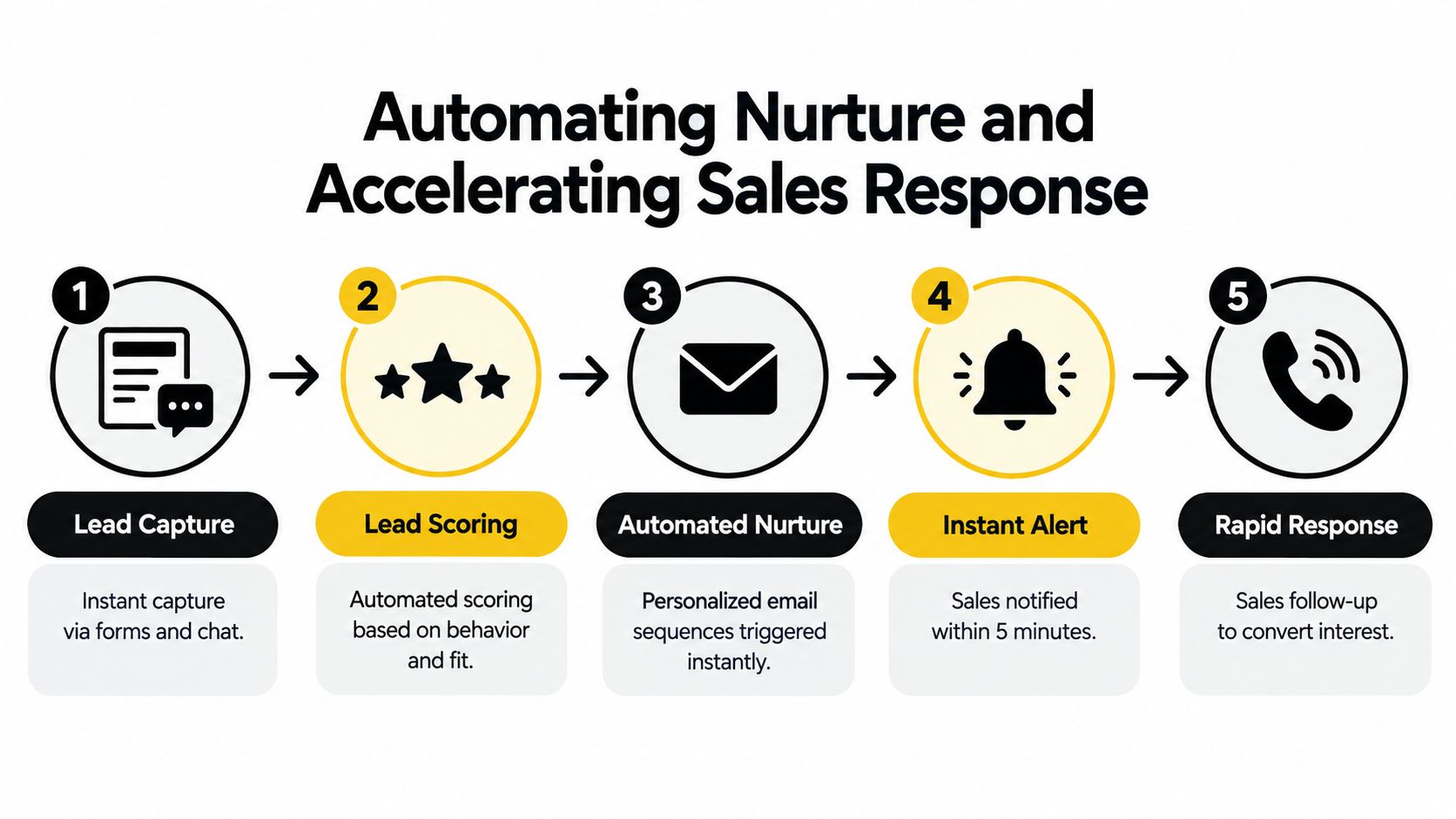
A useful score combines firmographic fit with behavior. A target account visiting a pricing or implementation page should receive a different treatment from an unqualified visitor who downloads an introductory guide. An interactive calculator completion, repeated visits to commercial pages, and a request for contact can each trigger a distinct route.
The workflow should assign:
A marketing and sales SLA should state who owns the lead, what qualifies as a response, how exceptions are handled, and when an unworked record returns to nurture. Teams that need additional human capacity can evaluate Appointment Setters as part of the handoff design, especially when qualification and meeting booking are creating a queue.
Speed doesn't replace relevance. The first response should prove that the company understood what the prospect did.
Brute-force follow-up often creates noise. Inbound sequences work better when each touch adds a new reason to engage, such as an answer to the prospect's assessment, a relevant proof point, an implementation question, or a clear invitation to discuss the stated problem. The sequence should stop, pause, or change direction when the prospect replies, books a meeting, or shows disqualifying behavior.
A 2026 lead-generation compilation reported that roughly 40% of B2B conversions happen by phone rather than form fill, and that the average B2B lead conversion rate was 5.13%, according to the same industry research summary. That makes phone readiness, accurate routing, and context-rich alerts important even for teams that generate demand primarily through digital channels.
<iframe width="100%" style="aspect-ratio: 16 / 9;" src="https://www.youtube.com/embed/sjAkl8pwLgg" frameborder="0" allow="autoplay; encrypted-media" allowfullscreen></iframe>Teams can use marketing automation and CRM integration to connect forms, scoring, nurture, alerts, ownership, and reporting. The system should make the next action obvious to both the prospect and the seller.
Not all inbound traffic carries the same buying intent. Social content can create awareness and establish a point of view, but a person scrolling past a post hasn't necessarily entered an evaluation process. Search, review sites, referrals, webinars, and email nurture often provide stronger context because the prospect has taken an action connected to a problem or decision.
One benchmark set reported 8% to 12% lead-to-customer conversion for organic search and content, 6% to 10% for webinars and events, 12% to 18% for review sites, and 3% to 5% for paid social, according to B2B conversion rate benchmarks. Another large benchmark reported average channel conversion rates of 4.9% for organic search and email, 5.4% for paid search, and 2.23% for organic social, in the same source. The variation reinforces a practical point: channel averages don't replace a company's own pipeline data, but they can challenge assumptions about where effort belongs.
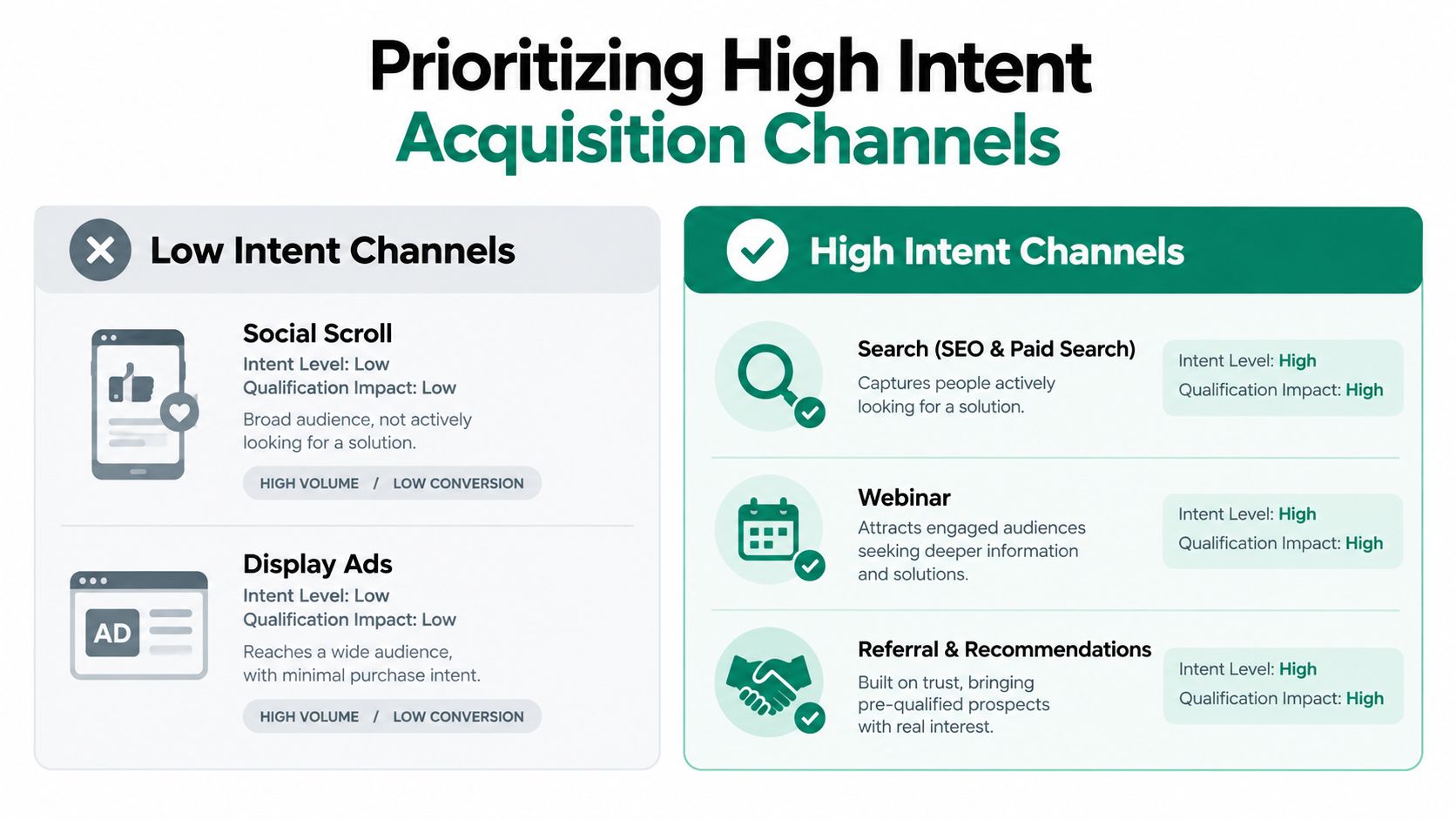
Organic search deserves attention when the page answers a specific commercial question and offers a relevant next step. Review sites and referrals can shorten trust-building because prospects arrive with external validation or a recommendation. Webinars create a useful middle ground, combining education with questions, participation, and a natural route to follow-up.
Paid social can still support an inbound program, particularly for distributing sharp points of view or retargeting engaged audiences. It becomes inefficient when teams use it to compensate for weak qualification. High volume from a low-intent source increases the number of records sales must reject or nurture without a clear path.
Search, social, and mid-funnel content shouldn't operate as isolated playbooks. A social post can point to a problem-specific article, the article can offer an assessment, and the result can route a qualified prospect to a sales conversation. A webinar can answer common objections, then direct attendees to a calculator or implementation review.
Teams should judge each channel by the quality of the opportunities it creates, not by reach alone. Review source, asset, opportunity value, sales acceptance, and closed-won outcomes in the CRM. For additional tactical ideas, the B2B lead generation tactics guide offers a useful reference for connecting acquisition with capture and follow-up.
When qualification capacity is the constraint, external support can help teams assess options for Hire SDRs while keeping ownership rules and quality standards explicit. Staffing doesn't fix poor intent capture, but it can prevent qualified demand from waiting in an unworked queue.
Paid acquisition stops producing new visits when spending stops. Owned assets can continue attracting relevant discovery, answering objections, and directing prospects into interactive capture experiences after the initial production work is complete. That compounding effect doesn't happen automatically. It requires strong information architecture, commercial search intent, internal linking, accurate measurement, and continuous improvement.
Inbound is widely reported to cost 62% less per lead than traditional outbound marketing, and to become 80% less expensive after five months of consistent execution, according to inbound marketing statistics. The figures should be treated as benchmark claims rather than a promise for every company. The underlying mechanism is clear, though: content and SEO can keep working across many buyer journeys, while each outbound push usually requires fresh effort to create attention.
Website, blog, and SEO should connect directly to commercial outcomes. A page targeting a broad educational query may build visibility, while a comparison page, calculator, assessment, or implementation guide can create stronger signals. The editorial calendar should prioritize the latter when the company needs qualified pipeline, not just a larger publishing record.
A durable operating model includes:
Teams working on software growth can use this SEO for SaaS companies resource to structure search-focused content around commercial intent. AI can accelerate research, outlining, repurposing, and quality checks, but human owners still need to validate positioning, evidence, differentiation, and the usefulness of every result.
The first phase should identify the weakest funnel stage, audit the highest-value pages, and choose one interactive offer that maps to a real buying decision. The next phase should launch the offer, connect it to scoring and routing, and establish a response SLA. The final phase should review accepted leads, opportunities, and sales feedback, then expand the asset or channel that creates the strongest qualified signal.
HubSpot reported that 77% of marketers rated lead quality as high or very high in 2026, while 30% still identified lead generation as a top challenge, according to its 2026 marketing statistics. That combination points to the right priority. Teams don't need to chase every available visitor. They need to make the right prospects easier to identify, easier to route, and easier for sales to help.
Sprints & Sneakers helps B2B and B2C teams build AI-powered, full-funnel growth systems across SEO, content, CRO, marketing automation, analytics, and lead capture. Visit Sprints & Sneakers to start with a personalized growth scan, identify the bottleneck limiting pipeline, and prioritize practical experiments that turn inbound demand into compounding revenue.
Growth marketing, AI and automation, SEO, performance marketing, retention strategies, and sustainable business practices.
Weekly. Subscribe to our newsletter to get new articles straight to your inbox.
Absolutely. Everything we publish is designed to be actionable. Take it, test it, and make it your own.
Yes. We publish experiments with real numbers. What worked, what didn't, and what we learned.
Our growth team — strategists, performance marketers, data specialists, and AI builders who work on client campaigns every day.
We're open to it. Reach out via our contact page with your topic and we'll take a look.