
See how LinkedIn Ads for B2B turns targeting into booked pipeline in 2026: proven formats, budget tips, and metrics that actually drive revenue.
A growth lead inherits a $20K monthly LinkedIn budget and finds two weeks of disappointing CPLs. The campaigns have produced form fills, but sales can't name a qualified opportunity that came from them. The first instinct is usually to tighten targeting, change the bid, and chase cheaper leads.
That instinct is often wrong. LinkedIn Ads for B2B work best as a long-nurture, account-based channel, where paid media keeps buying groups engaged until sales activity and revenue provide a clearer verdict. The practical question isn't “How cheaply can this campaign generate a form?” It's “Which accounts moved closer to a commercial conversation, and what evidence supports that conclusion?”
LinkedIn gives B2B advertisers professional identity data that supports account and role-based targeting. Its potential advertising reach was 1.2 billion people worldwide in February 2025, while one B2B benchmark reported LinkedIn Ads at 41% of total B2B ad spend and 121% ROAS across 2025 data. The same benchmark context cites an average buying journey of 211 days and 10 stakeholders per deal. (LinkedIn advertising benchmarks and reach data)
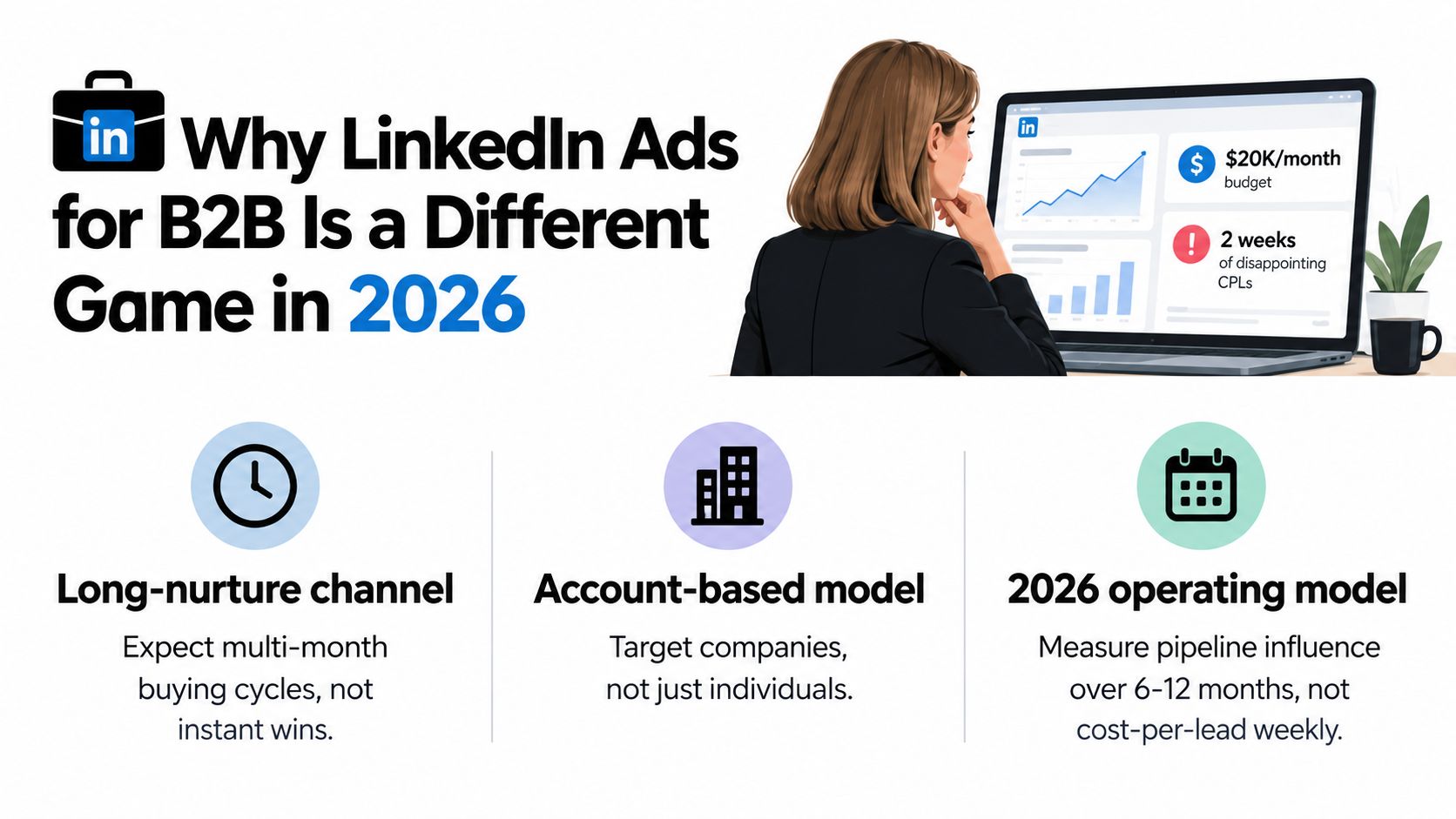
Those figures point to a different operating model. LinkedIn can influence revenue, but the evidence often appears across several months rather than in the first week of lead generation. Four changes matter:
The practical sequence is straightforward. Start with named accounts and the roles involved in their buying process. Use educational content to build familiarity, then show stronger proof to engaged audiences. Reserve the most direct offer for people who return, interact repeatedly, or reach a meaningful intent threshold. Sales and marketing should compare that account activity with MQL, SQL, opportunity, and revenue movement.
Practical rule: A LinkedIn campaign is not failing because it has not produced cheap leads in its first weeks. It deserves scrutiny when the right accounts do not engage, progress, or enter sales conversations.
Teams building their lead-capture process can use this modern sales playbook for LinkedIn. For planning beyond paid social, the B2B digital marketing trends guide provides useful channel-mix context. The goal is a defensible view of how paid exposure contributes to pipeline over time, not a weekly report dominated by vanity metrics.
Audience construction starts with the firmographic spine, not a favorite job title. Define the industries, company sizes, and geographies that match the ideal customer profile. LinkedIn supports professional attributes including job titles, job functions, seniority, companies, interests, locations, and skills, so a campaign can reflect how a real buying decision gets made. (LinkedIn audience targeting guidance)
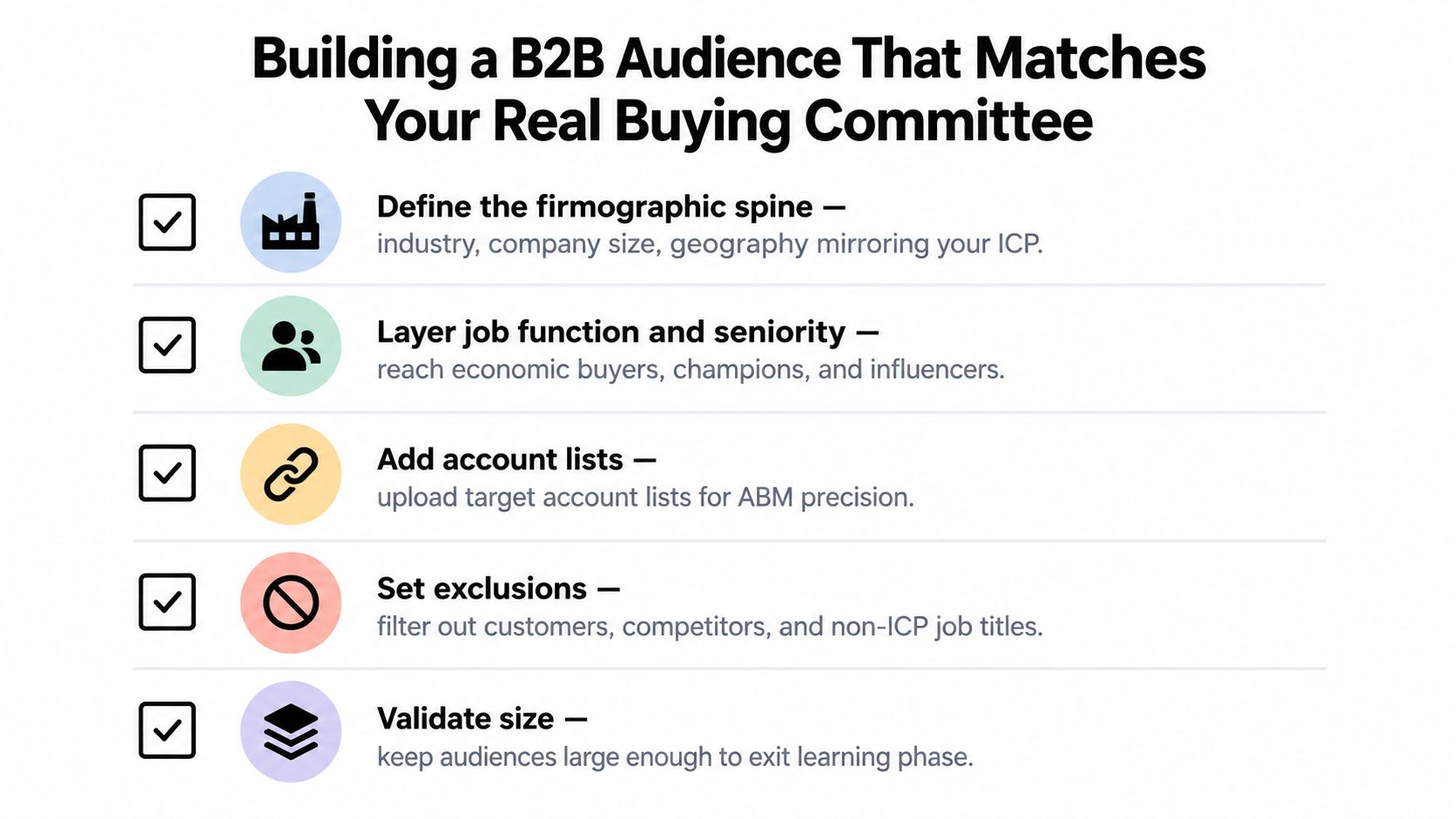
A practical build looks like this:
Over-narrowing is the most common failure. A campaign aimed at one exact title, one narrow seniority band, one industry, and a small company list may look precise but struggle to deliver enough qualified reach. The opposite failure is equally expensive, broad targeting with no account logic and no exclusion strategy.
The audience should be checked before launch:
The LinkedIn strategies for Solution Engineers resource is useful when technical stakeholders need a distinct message rather than a recycled executive pitch. Teams refining account selection can also compare a focused ABM 1-to-1 versus 1-to-many approach. The audience is ready only when the campaign can explain who it reaches, why those people matter, and which buying role each person represents.
Format should follow intent temperature, not creative preference. A thought-leadership asset shouldn't be forced into a direct-response campaign, and a high-intent visitor shouldn't be sent back to generic awareness content.
| Campaign Format | Best B2B Use Case | Funnel Stage |
|---|---|---|
| Sponsored Content | Distribute category education, thought leadership, webinars, and account-specific messages | Cold and warm |
| Message Ads | Deliver sponsor-branded, one-to-one outreach for a focused invitation or sales-related action | Warm and late funnel |
| Conversation Ads | Offer several paths, such as a guide, event, or qualification route, within one nurture experience | Warm |
| Lead Gen Forms | Capture hand-raisers for gated assets, events, consultations, or other clear offers | Warm and late funnel |
Sponsored Content is the workhorse for reaching a defined account audience repeatedly. It suits a problem-led post for cold accounts, a webinar invitation for engaged accounts, or a comparison asset for people who have already interacted with the brand.
Message Ads need restraint. They can work when the recipient has a clear reason to receive the message, such as an event invitation relevant to the person's role. They become intrusive when every cold prospect receives a disguised sales pitch.
Conversation Ads are useful when the buyer may have several legitimate next steps. One path can lead to educational content, another to an event, and another to a commercial conversation. The branching structure should simplify choice, not create a long qualification form.
Lead Gen Forms reduce friction because LinkedIn pre-fills member contact and profile information. The format supports up to 12 form fields and 3 custom questions, with CRM integration and CSV download options. (LinkedIn Ads Guide for Lead Gen Forms)
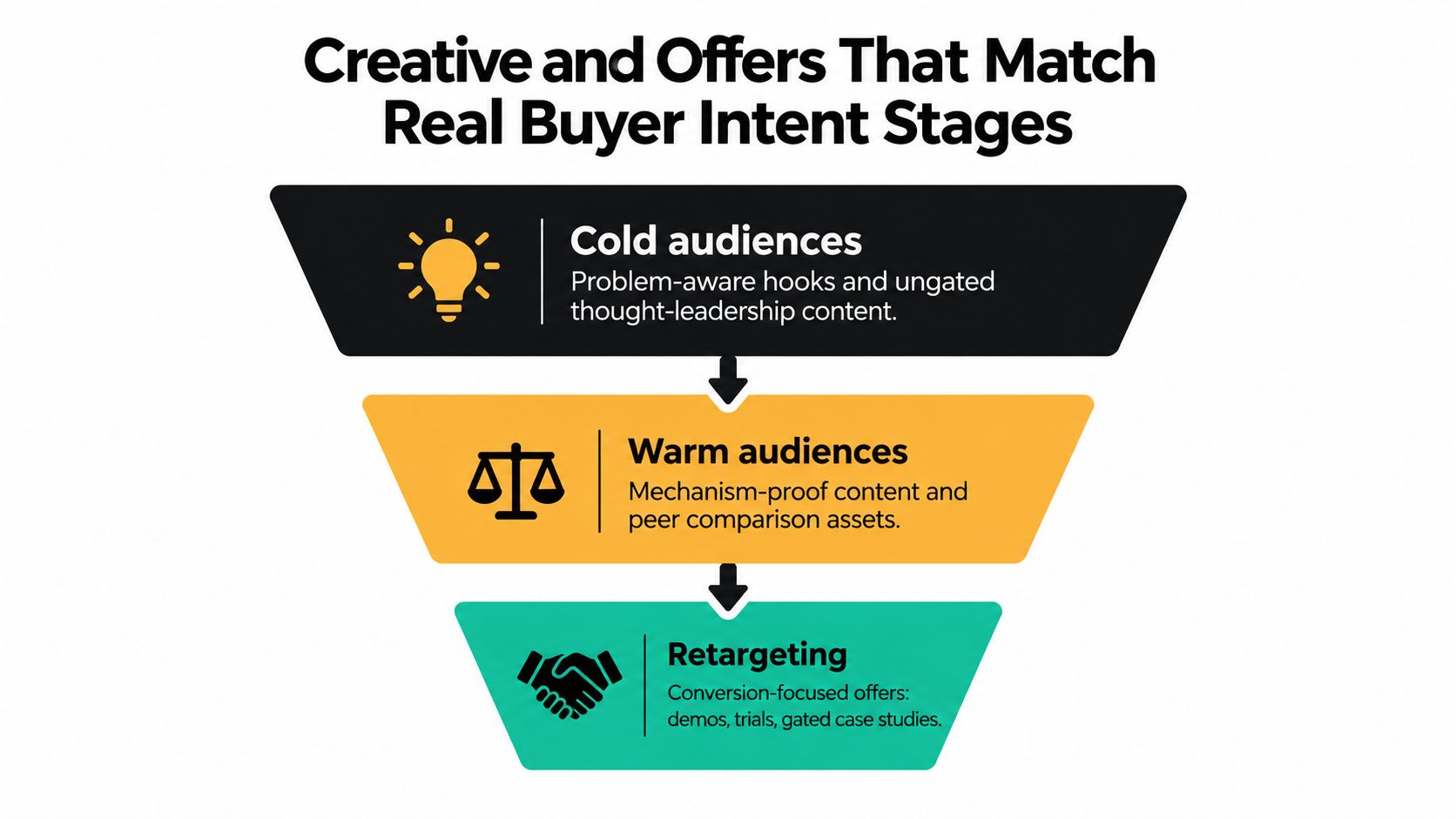
A simple decision rule works well: cold audiences receive useful education, warm audiences receive proof and a relevant next step, and retargeting audiences receive the most direct conversion offer. More examples of format selection appear in this guide to digital ad types. The campaign objective should make the next buyer action obvious.
Creative fails when it asks for a commercial commitment before the audience has a reason to trust the brand. Cold prospects need a sharp problem statement. Warm prospects need evidence that the proposed mechanism works. Retargeting audiences need a low-risk route to a conversation.
Hook: “The buying committee isn't ignoring the category. It may be receiving disconnected messages from every vendor.”
Body: “A practical guide to aligning executive, technical, and operational messaging before the first sales conversation.”
CTA: “Get the guide”
Hook: “Cheap leads can hide expensive targeting mistakes.”
Body: “Use a simple account and role framework to separate content interest from genuine commercial fit.”
CTA: “Read the framework”
Hook: “Most B2B campaigns speak to one persona and miss the decision.”
Body: “See how teams can build content around the people who approve, evaluate, use, and influence a purchase.”
CTA: “Explore the model”
Cold Lead Gen Forms should stay light. A benchmark report can use qualifying fields such as work email, company, role, and company fit. LinkedIn states that 90% of pilot customers using Lead Gen Forms beat their cost-per-lead goals, and that these campaigns produced lower CPLs than standard Sponsored Content campaigns. (LinkedIn Lead Gen Forms performance guidance) That claim supports testing the format, not treating every form fill as sales-ready.
Hook: “A buying committee needs more than another product overview.”
Body: “See the workflow behind a coordinated evaluation, including where marketing, sales, and technical teams usually lose momentum.”
CTA: “See the workflow”
Hook: “Two vendors can promise the same outcome and create very different implementation risk.”
Body: “Use this comparison framework to assess process, ownership, proof, and time to value before a shortlist is finalized.”
CTA: “Compare approaches”
Hook: “The strongest business case answers the operator's objections early.”
Body: “Review the questions teams should ask before moving from category interest to a serious evaluation.”
CTA: “Download the checklist”
Warm forms can add a workflow question, such as the current process, primary bottleneck, or evaluation stage. That answer gives sales context and helps separate research activity from active buying intent.
Hook: “The next step doesn't need to be a sales pitch.”
Body: “Book a focused review of the account's current process, gaps, and practical options.”
CTA: “Book a review”
Hook: “Still comparing ways to solve the same pipeline bottleneck?”
Body: “A short working session can clarify the likely constraints and the evidence needed for an internal decision.”
CTA: “Schedule a session”
Hook: “Turn repeated research into a decision path.”
Body: “Talk through fit, implementation requirements, and the questions that remain unanswered.”
CTA: “Discuss the next step”
Retargeting forms should ask only for information needed to route the request. Copy testing should change one variable at a time, such as the hook, offer, image, or CTA. Creative also needs rotation before audience fatigue makes frequency the hidden cause of weaker engagement.
A short visual explanation of the funnel is available below.
<iframe width="100%" style="aspect-ratio: 16 / 9;" src="https://www.youtube.com/embed/n7VScvkFgAI" frameborder="0" allow="autoplay; encrypted-media" allowfullscreen></iframe>LinkedIn is a premium B2B channel, so budget decisions should reflect both auction cost and downstream quality. A 2025 benchmark reported an average $9.39 CPC, 0.67% CTR, and $202 cost per lead for B2B advertisers. A separate spend-weighted summary reported approximately $63.19 CPM across 138 advertisers. (LinkedIn Ads B2B cost benchmarks)
| Objective | Typical CPM | Typical CPC | Typical CPL |
|---|---|---|---|
| Sponsored Content awareness and education | Varies by audience and auction | Not the primary decision metric | Not the primary decision metric |
| Traffic and content engagement | Varies by audience and auction | About **$9.39** in the cited B2B benchmark | Not applicable |
| Lead Gen Forms | About **$63.19** in the cited spend-weighted summary | Varies by campaign | About **$202** in the cited B2B benchmark |
The benchmark figures are reference points, not promises. Seniority, account concentration, creative relevance, offer strength, and auction pressure all change the result. A low CPL can still be a bad outcome if sales rejects the leads or the accounts have no commercial fit.
Enhanced bidding is a practical starting point when the account lacks reliable conversion history. Manual caps become more useful once the campaign has enough qualified conversion evidence to establish an acceptable range. Maximum delivery can help spend a fixed budget, but it shouldn't be used to hide weak audience quality or poor offer fit.
Daily budgets suit ongoing programs where spend needs close control. Lifetime budgets work better for defined launches, events, and short campaigns where the total ceiling matters more than daily consistency. Accelerated pacing belongs to time-sensitive bursts, not evergreen demand generation.
A budget should be large enough to produce a meaningful stream of qualified signals, but small enough that the team can still diagnose audience, offer, and sales-quality problems before scaling.
Bid caps should protect against sudden low-quality volume. If submissions rise during low-attention periods while sales acceptance falls, the account needs tighter controls, stronger exclusions, or a different offer. Pacing should follow the sales process, not just spend the available balance.
The Insight Tag belongs on every relevant domain before campaigns scale. It supports conversion measurement and audience creation, while Audience Insights can help teams understand the professional attributes present in the audience. A benchmark playbook describes LinkedIn's first-party data as including attributes such as job title, company, and industry, with Audience Insights available in Campaign Manager after the Insight Tag is installed. (LinkedIn Ads ROI playbook)
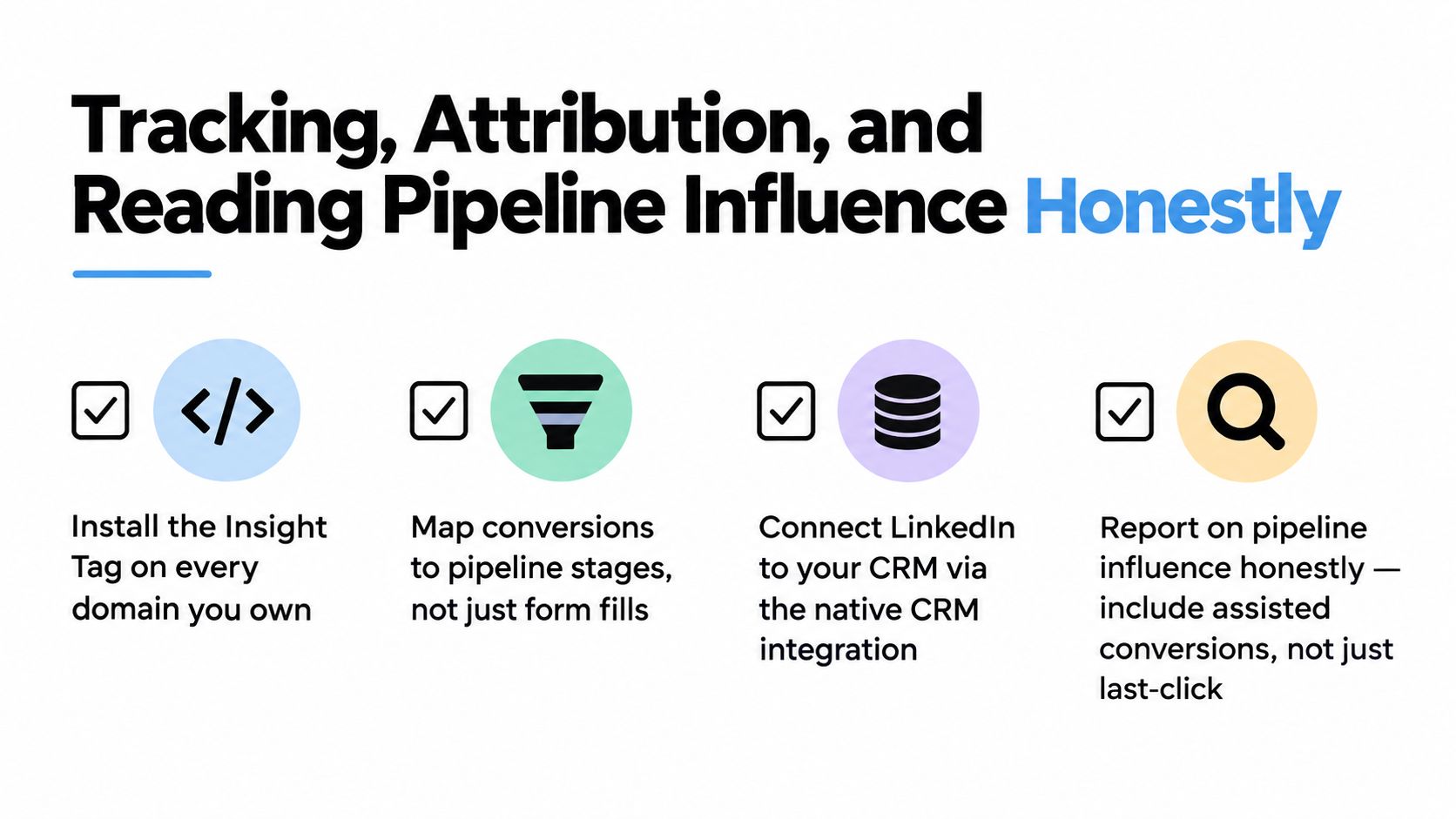
The tracking model should map activity to commercial stages:
CRM connection can use the native integration, an automation layer, or a reverse-ETL workflow. The technical route matters less than consistent field definitions and reliable ownership. Offline conversion uploads should follow a fixed operating rhythm, with campaign managers checking rejected records and mismatched identifiers.
Attribution should include first touch, last touch, assisted conversion, account engagement, and stage progression. Last click often gives the final action too much credit, especially when several buying-group members interact with content before a sales conversation.
A clean UTM convention includes source, medium, campaign, audience, creative, and offer. Values should be lowercase, documented, and stable. Teams reviewing the subject in more depth can use this guide to cross-channel marketing attribution. The report should answer two questions separately: did LinkedIn create demand, and did it help the account progress?
A useful testing plan starts with a controlled validation sprint rather than a dozen simultaneous changes. The first cycle should compare audience definitions and creative angles. Once the team knows which account group and message attract relevant engagement, later cycles can examine the offer, bid approach, placement, and form experience.
Early cycle: Run one audience comparison and one creative comparison, keeping the objective, offer, and landing experience stable. Judge the result by qualified engagement and form completion quality, not raw clicks alone.
Middle cycle: Test the offer or form question against the strongest early combination. A cold audience may respond to an educational asset, while a warm audience may respond to a workflow review or comparison resource.
Final cycle: Test pacing and bid controls around the proven audience and offer. The question is whether the campaign can generate qualified pipeline signals without creating a spike in low-fit submissions.
Each experiment needs a defined audience, a clear hypothesis, and one primary success metric. Audience size and impression volume should be sufficient for directional learning, but teams shouldn't manufacture certainty from weak data. A result that changes materially when one or two leads are removed isn't ready for scale.
A simple documentation row should include:
The A/B testing guide for marketing provides a useful framework for keeping those decisions disciplined. Underperformers should be paused when they repeatedly miss the team's qualified acquisition target and show no compensating pipeline signal. Winners should move into always-on campaigns gradually, with controlled budget increases and continued monitoring of audience saturation, sales acceptance, and opportunity quality.
The scaling decision belongs to the downstream metric. A winning click-through rate doesn't automatically make a winning pipeline campaign.
The strongest LinkedIn programs keep a learning log, preserve the winning control, and test one meaningful change at a time. That discipline prevents the common failure where a team changes audience, offer, creative, and bid together, then has no idea which decision affected the result.
Sprints & Sneakers helps B2B teams connect LinkedIn advertising with account-based campaigns, full-funnel experimentation, conversion optimization, and marketing analytics. Visit Sprints & Sneakers to explore a practical growth scan and identify the bottleneck limiting predictable pipeline.
Growth marketing, AI and automation, SEO, performance marketing, retention strategies, and sustainable business practices.
Weekly. Subscribe to our newsletter to get new articles straight to your inbox.
Absolutely. Everything we publish is designed to be actionable. Take it, test it, and make it your own.
Yes. We publish experiments with real numbers. What worked, what didn't, and what we learned.
Our growth team — strategists, performance marketers, data specialists, and AI builders who work on client campaigns every day.
We're open to it. Reach out via our contact page with your topic and we'll take a look.