
Personalization in Marketing That Actually Converts
Learn personalization in marketing with practical B2B and B2C strategies, AI use cases, and measurement tips to turn data into growth without the fluff.
A customer opens an email about something already purchased, reaches a homepage designed for first-time visitors, then sees an ad about a problem solved weeks ago. The copy may be polished. The experience still feels careless because each touchpoint ignores useful context.

A more helpful sequence recognizes the previous purchase, suggests a relevant accessory, and uses a channel the customer already chooses. For a B2B buyer, the message can match the role: an operations leader may need an implementation guide, while a finance stakeholder may need a business case. The company stays consistent. The interaction fits the buyer's situation.
Personalization in marketing is now an operating challenge for scale-ups and enterprise teams serving B2B and B2C customers. Industry coverage reports that, by 2025, 89% of marketing decision-makers considered personalization essential to business success over the next three years. The same coverage also found a gap between company confidence and customer experience: 85% of companies believed they delivered personalized experiences, while only 60% of customers agreed. That gap often points to fragmented data, unclear ownership, or messages that feel too revealing.
Personalization should not begin with more targeting. If customer records conflict, consent rules are unclear, or teams cannot explain why a message was selected, generic communication may be safer while the foundation is repaired.
Practical rule: Relevance isn't adding a first name. It's helping a customer take the next sensible step.
The guide ahead explains the concept, connects it to the buyer journey, and shows where automation can help without creating discomfort. It also gives scale-ups and enterprise teams a prioritized experiment menu, starting with data quality and governance before higher-risk tailoring. Teams building that foundation can review data-driven marketing principles before choosing their first test.
Table of Contents
- What Personalization in Marketing Really Means
- Why Personalization Matters for Growth and Customer Experience
- Personalization Across the Buyer Journey for B2B and B2C
- AI and Automation Use Cases That Scale Without the Creep Factor
- A Prioritized Framework to Implement and Measure Personalization
- Your Next Day Action Plan for Personalization in Marketing
What Personalization in Marketing Really Means
Personalization means using a customer's context to decide what to say, when to say it, and where to say it. The context might include browsing behavior, purchase history, stated preferences, account role, lifecycle stage, or a recent service interaction. The aim isn't to expose everything a brand knows. The aim is to make the next interaction more useful.
A loudspeaker sends the same announcement to everyone. A good concierge listens, notices the situation, and offers an appropriate suggestion. Personalization works more like the concierge, but it still needs boundaries. A relevant recommendation can help someone choose. A highly specific message that reveals hidden tracking can make that person uncomfortable.
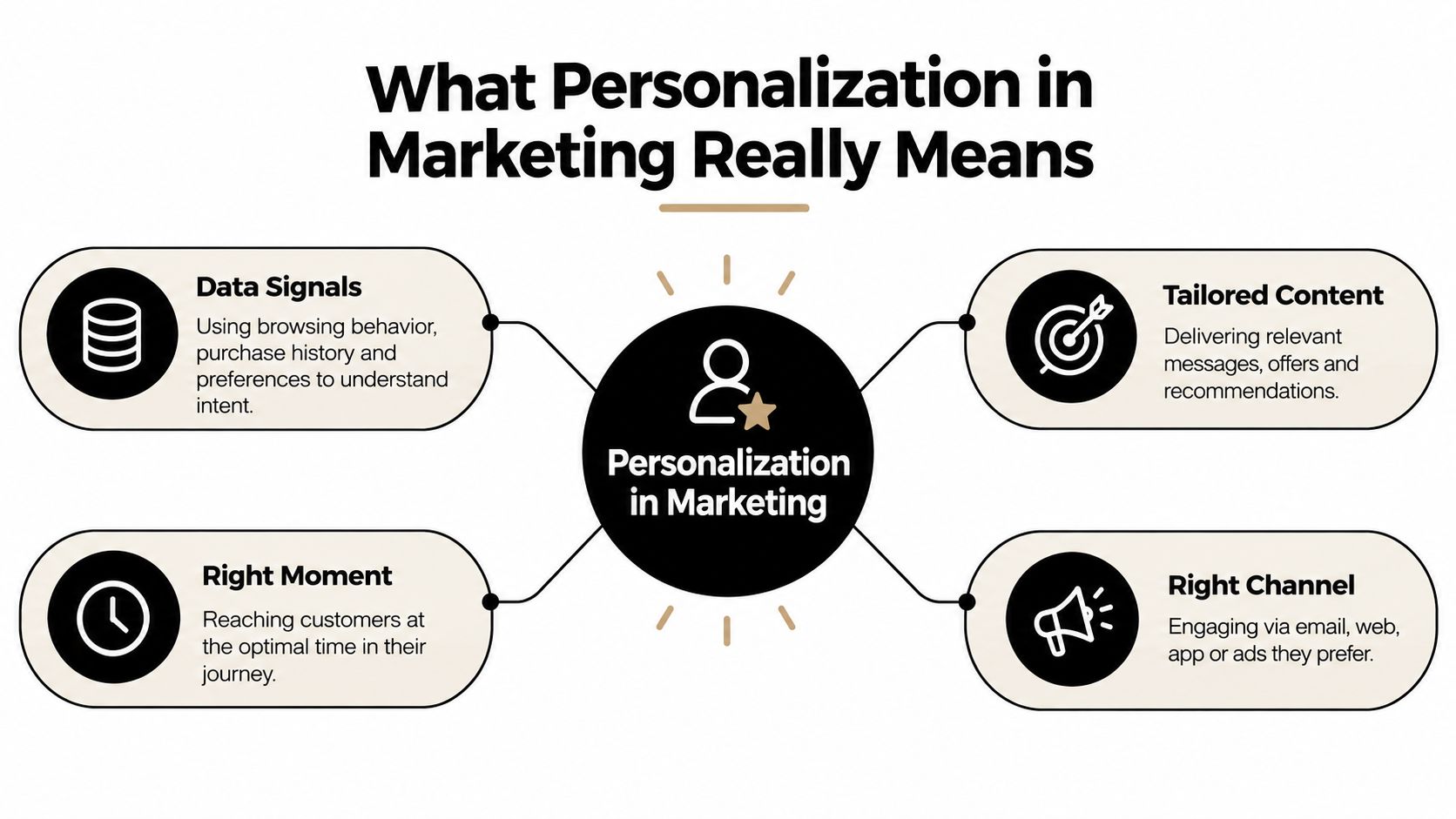
Four layers make the idea easier to use
Segmentation groups people who share a meaningful trait, such as new visitors, active customers, or businesses in a particular industry. A practical market segmentation strategy starts with a difference that changes the message or action, not a difference that merely looks interesting in a database.
Persona-based relevance adds a human interpretation. Two people in the same industry can have different jobs, concerns, and levels of urgency. A security manager may need implementation detail, while an executive sponsor may need risk and commercial clarity.
Contextual personalization responds to what's happening now. A visitor reading comparison content may need proof, while a returning customer browsing replacement parts may need availability and delivery information.
One-to-one decisioning chooses content or an offer for an individual based on several signals. This is the most advanced layer, but it isn't automatically the most valuable. A well-designed segment can outperform an elaborate system when the underlying data is cleaner and the decision is easier to explain.
Customization gives the customer control, such as choosing a dashboard layout or communication preference. Personalization is the brand making a relevant decision on the customer's behalf. A merge tag only inserts a field. It doesn't understand intent, timing, or the next step.
Personalization is the disciplined use of customer context to make each interaction more useful, not more noticeable.
That definition gives teams a useful test. If a data signal doesn't change the content, timing, channel, or action, it probably doesn't belong in the personalization rule.
Why Personalization Matters for Growth and Customer Experience
A visitor compares two products, a customer returns for a replacement, and an executive scans a risk page between meetings. A generic message treats these moments alike. 71% of consumers expect personalized interactions, 76% get frustrated when brands don't deliver them, and 81% ignore irrelevant marketing messages, according to consumer expectation research on personalization. Irrelevance wastes attention before it wastes budget.
The commercial case matters too. Widely cited industry research indicates that fast-growing companies generate 40% more revenue from personalization than slower-growing competitors. The compiled personalization statistics also describe a gap between what brands believe they deliver and what customers perceive. Personalization becomes a growth lever when it helps someone choose, understand, or act.
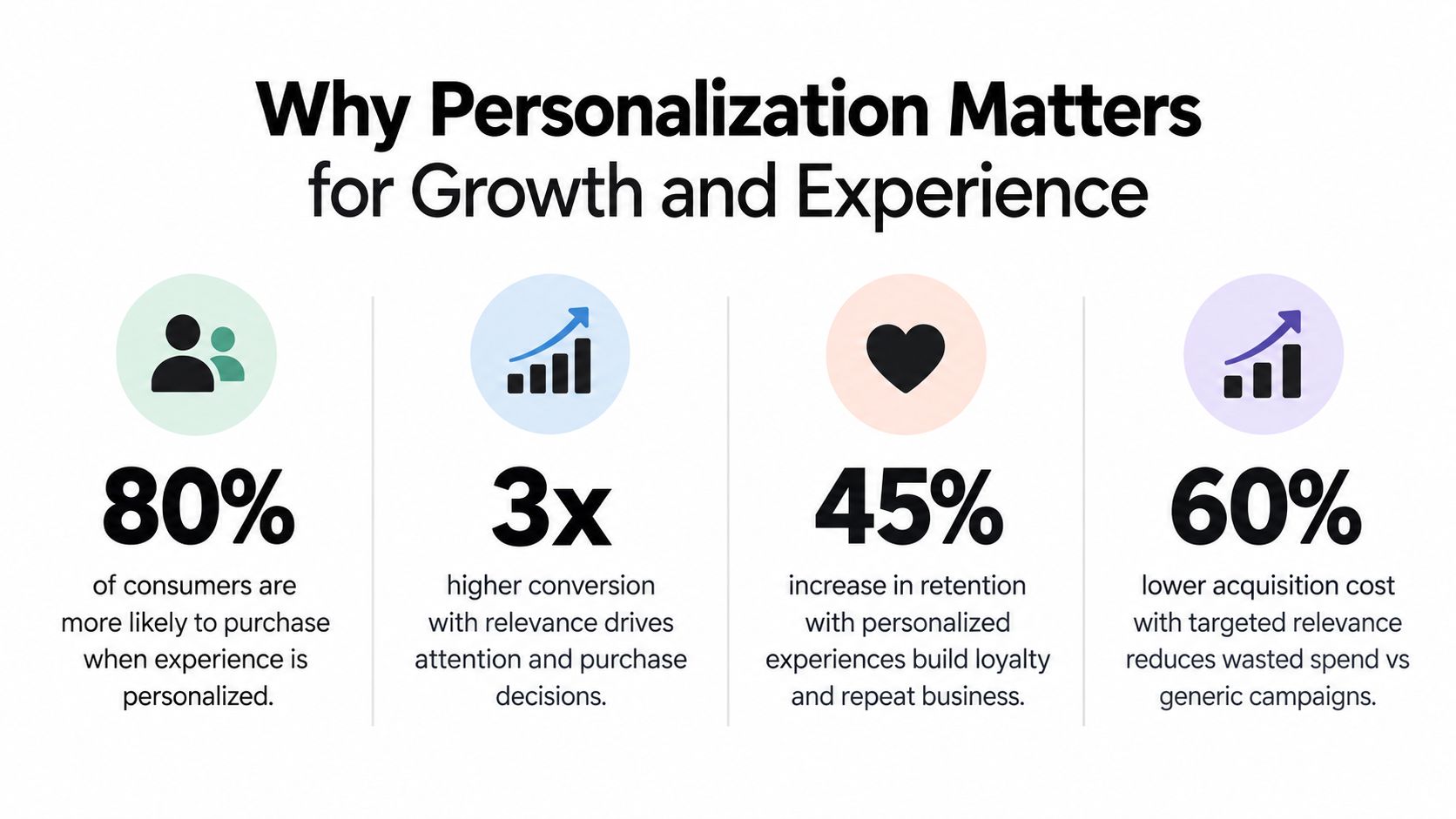
Relevance improves the economics of attention
Email offers a practical place to test. Personalized emails can deliver six times higher transaction rates than non-personalized messages, while personalized subject lines can raise open rates by 26% and click-through rates by 41%, according to compiled email and personalization benchmarks. Segmentation can improve relevance without requiring individual treatment. Segmented campaigns have a 14.31% higher open rate than non-segmented campaigns, and adding a lead's name to the subject line can increase open rates by 26%, based on email personalization benchmarks.
A website can apply the same principle closer to a decision. Personalized calls to action have been reported to improve conversions by 202%, while product recommendations account for 35% to 40% of e-commerce website revenue, with personalization reported to drive about 30% of that lift, according to e-commerce personalization data.
These figures support testing, not automatic personalization everywhere. A useful recommendation, clearer next step, or role-matched message can reduce friction. A random name insertion usually adds decoration without helping the customer.
Personalization also has a stopping point. Do not personalize when the signal is weak, the data is sensitive, the customer did not expect its use, or the experience cannot explain why the change occurred. First fix fragmented identity data, consent rules, ownership, and suppression logic. Otherwise, one team may recommend a product another team already knows the customer purchased.
A sensible order for scale-ups and enterprise teams is to test one high-intent, low-risk use case first, then connect data sources, document decision rules, and expand only after measurement and governance work. Trust belongs in the conversion model, not in a legal footnote. Teams can review this customer experience optimization resource when assessing the wider interaction.
<iframe width="100%" style="aspect-ratio: 16 / 9;" src="https://www.youtube.com/embed/6PXrSsRyOcM" frameborder="0" allow="autoplay; encrypted-media" allowfullscreen></iframe>Personalization Across the Buyer Journey for B2B and B2C
A shopper who returns to a product page needs a different next step from a procurement team comparing suppliers. B2C journeys may move from discovery to purchase quickly. B2B journeys often include several roles, reviews, approvals, and implementation questions. The same signal should therefore lead to different experiences.
Start with the buyer's task at each stage. In awareness, broad relevance helps people understand a category. During consideration, role-specific proof or product comparisons can reduce uncertainty. At conversion, remove the next source of friction. After purchase, guide adoption before asking for another order or referral.
| Journey Stage | B2B Play | B2C Play | Useful Signal |
|---|---|---|---|
| Awareness | Industry or role-based education | Content matched to broad interests | Industry, role, content interaction |
| Consideration | Case studies, guides, or demos for the stakeholder's question | Recommendations based on current browsing | Pages viewed, category interest |
| Conversion | Proposals and pricing aligned with stated needs | Relevant offers and a simpler checkout path | Sales stage, cart activity |
| Retention | Onboarding and customer success guidance | Loyalty, replenishment, and usage reminders | Adoption, purchase history |
| Referral | Expansion and referral conversations | Advocacy prompts and referral incentives | Satisfaction, repeat engagement |
The table is a menu, not an instruction to personalize every touchpoint. Choose one high-intent, low-risk experiment first. For a B2C team, that might mean suppressing a promotion after purchase. For a B2B team, it could mean showing a role-relevant case study after a stakeholder views an implementation page.
A signal must also fit the channel. Email needs consent and a reliable lifecycle stage. Web changes should remain understandable when the visitor is misidentified. Advertising requires suppression rules for purchases, category exclusions, and opt-outs. Sales representatives can use account context to ask a sharper question, while treating automated assumptions as hypotheses rather than facts.
Fragmented data can turn these ideas into contradictory experiences. One system may show a prospect as active while another records a completed purchase. Before expanding, assign ownership for identity resolution, consent, suppression, and decision rules. Document which source takes priority, what happens when fields conflict, and when personalization stops.
For a practical backlog, the Expressify AI playbook can help connect each idea to a stage, signal, owner, and measurement plan. A full-funnel marketing strategy adds the wider operating view, so teams test the journey bottleneck rather than the easiest channel.
AI and Automation Use Cases That Scale Without the Creep Factor
Automation should remove repetitive decisions, not manufacture intimacy. The safest use cases respond to a need the customer has already signaled, or help a team coordinate using information the customer reasonably expects the brand to use.
Start with small, reversible experiments:
- Dynamic content: Give a new visitor category-level guidance. Offer a returning visitor a comparison or implementation detail.
- Product recommendations: Rank related products using current session behavior, previous purchases, availability, and business priorities.
- Predictive audiences: Find people who may need education, assistance, or re-engagement, then test whether a different treatment improves their journey.
- Next-best-action support: Suggest a useful follow-up for sales or service teams, while leaving the final judgment with a person.
- Suppression automation: Stop promotions after purchase, remove customers from irrelevant sequences, and respect channel preferences.
A useful operating model separates machine speed from human judgment. Systems can classify events, select approved content, and trigger routine messages. People set the boundaries, review sensitive use cases, and handle high-consideration decisions where clarity and trust matter more than instant relevance.
The backfire test
Personalization can create regret when it appears at the wrong moment. An industry survey found that personalized marketing generated negative experiences for 53% of customers, making them 3.2 times more likely to regret a purchase and 44% less likely to buy again. The Gartner survey findings recommend active personalization when customers face real obstacles, rather than treating it as a default everywhere. That distinction matters in enterprise and industrial buying, where transparent information may feel more helpful than inferred persuasion.
Before activating a rule, ask:
- Would the customer expect the brand to use this signal?
- Does the treatment solve a real obstacle?
- Can the customer understand why the message appeared?
- Is there an easy way to opt out or choose a neutral experience?
- What happens when the data is wrong?
A practical day in the life of an AI employee helps teams examine handoffs between automated work and human review. Map the workflow before choosing the automation. If identity, consent, suppression, or decision ownership is unclear, fix that foundation first and keep the experiment narrow.
Ethical implementation also needs clear standards for content, consent, access, and accountability. Teams can use ethical AI content creation to examine those standards before expanding personalization across channels.
A Prioritized Framework to Implement and Measure Personalization
Personalization breaks at scale when teams add treatments before repairing the systems underneath them. In 2026, 42% of brand marketers cited limited platform integration as their top barrier, while only 26% of executives reported a unified definition of personalization across their organization, according to personalization barrier research. Fragmented data and unclear ownership turn promising campaigns into disconnected exceptions.
A scale-up or enterprise team should prioritize the work in this order.
Start with signals and identity
Create an event dictionary for important actions, including product view, form completion, trial activation, purchase, renewal, and support request. Then define how the organization recognizes a person or account across channels. If marketing, product, sales, and service use different definitions, one customer can appear as several unrelated records.
Assign an owner to each signal. That person does not need to control every system, but must be accountable for the signal's meaning, quality, access, and retirement.
Before personalizing, test whether the data is complete enough to support a decision. If identity resolution, consent, suppression, or ownership remains unclear, pause advanced treatments and repair the foundation first.
Add audience logic before advanced models
Start with a small set of audiences whose needs clearly differ:
- New visitors: Need orientation and a clear value proposition.
- Active evaluators: Need proof, comparison, and answers to objections.
- Recent purchasers: Need onboarding or useful follow-up, not acquisition messaging.
- At-risk customers: Need help, education, or a human conversation before another promotion.
Exclusions deserve the same attention as inclusions. Suppression logic prevents contradictory messages and can improve the customer experience faster than adding more content.
Choose experiments by bottleneck
| Bottleneck | Next-day experiment | Primary measure |
|---|---|---|
| Low email attention | Split one broad list into meaningful groups and change the subject line and first sentence | Open rate and downstream click |
| Weak product discovery | Add a recommendation block based on current category interest | Add-to-cart and revenue per visitor |
| Confusing B2B conversion | Match one landing page path to one role or account need | Qualified conversion |
| Poor retention messaging | Exclude recent purchasers from acquisition promotions | Repeat engagement and support signals |
| Unclear incrementality | Hold back a comparable audience from the treatment | Incremental conversion or revenue |
Personalized recommendations need disciplined measurement. E-commerce benchmark data, cited in recommendation-system statistics, indicates that roughly 7% of shoppers who click a product recommendation generate 26% of e-commerce revenue and 24% of orders. Because activity is concentrated among a small group, revenue per visitor and downstream purchase provide more useful evidence than click-through rate alone.
A separate recommendation-system study cited in the same source reported monthly conversion rates for personalized systems rising from 25% to 40% across six months, compared with 10% to 25% for non-personalized systems. Treat those figures as directional evidence, not proof of causation. Holdouts remain necessary because a click does not establish that personalization caused the purchase.
Industry research reports found that brands treating personalization as a core experience strategy rose 50% since 2022, while expected annual personalization budgets increased 29% year over year, as described in Deloitte's personalization research. Let verified lift guide budget decisions, rather than the number of automated treatments launched.
Your Next Day Action Plan for Personalization in Marketing
A scale-up discovers that its email team targets recent buyers differently from its service team. The same customer receives conflicting messages. The fix starts with shared data and rules, not another campaign.
Tomorrow morning, run a focused audit:
- Check data readiness. Confirm that identity matching, consent, event timing, and conversion definitions work across the journeys you want to personalize. If they do not, fix those gaps first.
- Choose one journey stage. Select the moment with the clearest customer friction and the cleanest signal. A fragmented audience record is a reason to delay personalization, not force it.
- Name one signal. Use a behavior or preference that can change the next interaction, such as a recent purchase or an unanswered setup step.
- Create one treatment. Change one meaningful element, including a subject line, recommendation block, landing-page proof, or suppression rule.
- Keep a control group. A holdout or reliable baseline separates genuine lift from normal variation.
- Set one primary measure. Choose the outcome nearest to business value, such as qualified conversion, revenue per visitor, activation, or repeat purchase.
- Document governance. Record permitted data, audience exclusions, consent requirements, owners, and the condition that stops the treatment.
Start with the safest experiment. A team with inconsistent records should prioritize identity resolution and a shared event dictionary. A team with reliable data can test one treatment, then expand only after the result survives a holdout.
The strongest programs build a shared learning backlog. Product, data, sales, service, and marketing can see which signals deserve trust, which moments need human help, and which messages customers ignore.
Sprints & Sneakers uses a personalized scan to identify a growth opportunity and the bottleneck limiting performance, then prioritizes experiments across the funnel. Teams can use that scan to turn a next-day test into a focused plan.
Related articles
Frequently asked questions
Growth marketing, AI and automation, SEO, performance marketing, retention strategies, and sustainable business practices.
Weekly. Subscribe to our newsletter to get new articles straight to your inbox.
Absolutely. Everything we publish is designed to be actionable. Take it, test it, and make it your own.
Yes. We publish experiments with real numbers. What worked, what didn't, and what we learned.
Our growth team — strategists, performance marketers, data specialists, and AI builders who work on client campaigns every day.
We're open to it. Reach out via our contact page with your topic and we'll take a look.