
Master affiliate program management with actionable strategies. Learn how to recruit partners, prevent fraud, and scale revenue from your program.
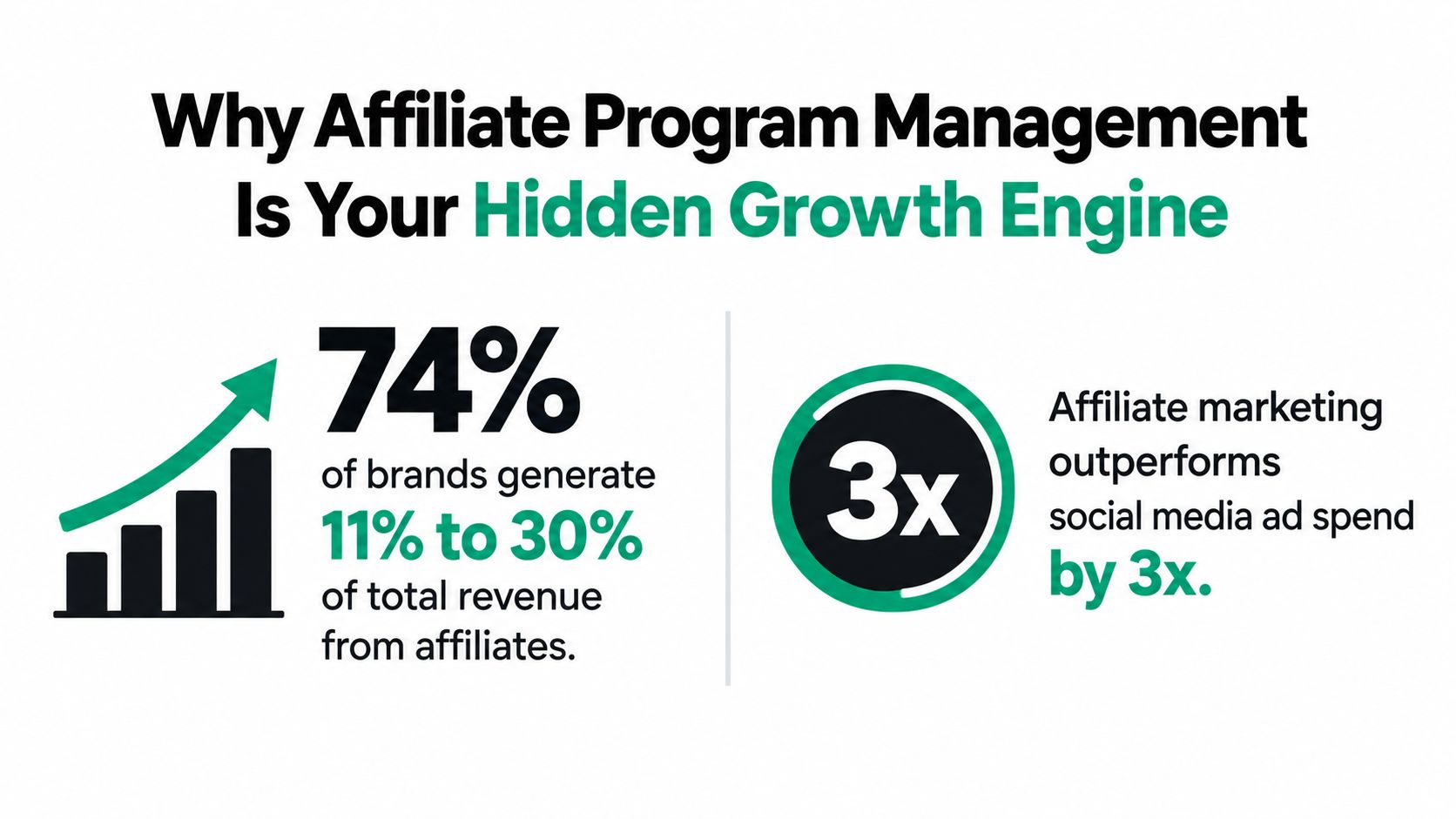
74% of brands now generate 11% to 30% of their total revenue from affiliate marketing. Affiliate program management is therefore a core growth lever, not a side channel left to run on referral links and occasional payouts.
That reality is counterintuitive because many teams still treat affiliates as a low-maintenance acquisition source. The channel looks simple from the outside: a partner shares a link, a customer converts, and the brand pays a commission. Behind that transaction sits a complicated operating system involving recruitment, attribution, partner incentives, compliance, fraud prevention, reporting, and customer quality.
A scalable program doesn't win by adding the most affiliates. It wins by identifying which partners create genuine demand, paying them fairly, protecting attribution, and proving that affiliate activity adds revenue the brand wouldn't otherwise capture.
Affiliate marketing has moved into the center of the performance stack. A 2025 industry report found that 74% of brands generate 11% to 30% of total revenue from affiliate marketing, while market estimates place the global industry at roughly $18.4 billion to $18.5 billion in 2025. Those figures are reported in Impact's affiliate marketing research.
A channel producing that share of revenue can't be managed as an administrative afterthought. It needs clear ownership, reliable data, defined partner rules, and a regular operating cadence. A brand that approves partners without reviewing their audiences, pays commissions without reconciling events, or reports attributed revenue without testing incrementality is managing risk, not growth.
Practical rule: Treat every affiliate decision as a commercial decision. Partner approval affects brand reach, commission design affects margin, and attribution rules affect who gets paid.
The strongest programs connect affiliate operations to the wider growth marketing system. Recruitment supports acquisition, partner education improves conversion, customer-quality analysis informs retention, and clean reporting gives finance and marketing a shared view of contribution.
Ad hoc management creates predictable problems. Strong partners receive little support and stop promoting. Low-quality publishers remain active because nobody reviews their traffic. Coupon and loyalty partners claim conversions that may already have been close to purchase. Finance sees a payout total, while growth teams can't explain which partner types create new demand.
The solution isn't just more affiliates. More partners can increase noise, disputes, and compliance exposure. The solution is a portfolio managed with commercial discipline:
Affiliate program management becomes a hidden growth engine when the brand turns those activities into a repeatable system. The channel then does more than capture existing demand. It can introduce products through trusted creators, comparison publishers, specialist communities, educators, and complementary businesses that paid media may struggle to reach efficiently.
A referral link isn't an operating model. Before scaling, a brand needs to decide what action earns a commission, which partners fit the commercial objective, and how the system will preserve evidence from click to conversion.
The most common structure is cost per sale, where a partner earns a percentage or fixed amount after a confirmed purchase. SaaS and B2B programs may instead pay for qualified leads, activated accounts, or closed contracts. A multi-tier design can add different rates for partner categories, customer types, product lines, or performance bands. Each model changes the data requirements and the behavior it encourages.
An impulse purchase can support a short attribution window. A considered software purchase may involve content discovery, evaluation, a sales conversation, and a later conversion. Most programs use 30-day cookies, while 60 to 90 days can suit high-consideration products or B2B offers, according to affiliate program management guidance from Attn Agency.
Program terms should state the attribution model, cookie window, and fallback when cookies aren't available. Those details shouldn't be hidden in platform settings. They belong in the partner agreement because they determine whether a publisher sees the program as predictable and fair.
A practical architecture captures the affiliate click ID at every touchpoint, alongside timestamps, source identifiers, sub-IDs, and campaign parameters. The system stores the identifier on click, carries it through the session, and reads it at checkout or lead submission. This lets the team reconcile the conversion path instead of guessing from aggregate traffic, as outlined in this guide to affiliate attribution models.
The tracking setup should answer five questions:
A brand considering how merchants run affiliate programs should focus less on copying another company's commission rate and more on understanding the operating mechanics behind recruitment, tracking, approval, and payout.
The program also belongs inside the wider marketing technology stack. Affiliate data should connect with customer records, order data, payment status, analytics, and reporting. Without those connections, the affiliate platform becomes an isolated ledger, and the team can't assess customer quality or incremental contribution.
The right operating model depends on the work the brand can perform consistently, not on whether internal ownership sounds more strategic. An internal team offers control and product proximity. An agency offers specialist capacity, external pattern recognition, and operational coverage. Neither option fixes weak economics or unclear rules.
| Decision factor | In-house management | Agency management |
|---|---|---|
| Brand knowledge | Deep daily product context | Requires structured onboarding |
| Partner relationships | Direct ownership | Broader recruiting reach may be available |
| Operational control | High | Shared through agreed governance |
| Specialist capability | Must be built internally | Available from an experienced team |
| Cost structure | Staff and tooling commitments | Service fees and coordination costs |
| Speed during scale-up | Limited by hiring and training | Can expand faster if capacity exists |
An internal model works well when the brand has a clear owner, enough partner volume to justify dedicated attention, and the ability to handle tracking, compliance, payouts, and recruitment without relying on spare capacity. It also suits products that require close collaboration with sales, product marketing, or customer success.
The hidden cost is not just salary. Internal teams need time to learn publisher economics, inspect promotional methods, resolve attribution disputes, monitor suspicious patterns, create partner assets, and keep terms current. If those jobs sit with a marketer already responsible for paid acquisition and reporting, affiliate activity often gets managed only when something breaks.
An agency becomes useful when the program needs specialist recruitment, rapid diversification, fraud monitoring, or a disciplined operating rhythm that the internal team can't sustain. The agency should provide more than introductions and monthly slides. Its responsibilities need to include partner selection, onboarding, communications, tracking QA, compliance checks, payout review, and commercial recommendations.
The brand still needs internal governance. A delegated program manager shouldn't have unchecked authority over commissions, exceptions, or partner approvals. A weekly operating review can cover new applications, active partners, conversions, rejected events, disputes, and upcoming campaigns. A monthly commercial review can assess partner mix, margin, customer quality, and tests.
Brands comparing external support can use this guide to choosing a digital marketing agency as a framework for evaluating capability, transparency, and strategic fit.
The best arrangement is the one that keeps decisions close to the business and repetitive execution close to the people equipped to handle it.
A hybrid model often makes sense. The internal team owns positioning, economics, product access, and final approvals. The specialist partner handles recruitment, activation, monitoring, and reporting operations. That division preserves control without forcing the brand to build every capability from scratch.
Partner recruitment should start with customer access, not audience size. A publisher with a smaller but highly relevant audience can create stronger commercial value than a broad channel that generates clicks without product understanding.
The first step is to define the partner segments the program needs. Content publishers can educate buyers. Review and comparison partners can capture active evaluation. Creators can demonstrate use cases. Consultants, communities, and complementary businesses can introduce the product inside a trusted workflow. Each segment needs different assets, approval criteria, and commission logic.
Start with evidence. Review existing referral sources, customer advocates, sales introductions, organic content partnerships, and communities where target buyers already seek advice. Existing customer knowledge often reveals better partner candidates than a generic application queue.
Create a short partner brief. State the ideal customer, approved promotion methods, restricted claims, product differentiators, commission rules, payment terms, and application requirements. Serious partners want clarity before they invest creative effort.
Personalize outreach. Reference a specific article, video, newsletter, community, or customer problem the partner already addresses. The message should explain why the product fits the audience, not merely announce an available commission.
Onboard for activation. Provide tracking instructions, approved copy, creative assets, product access where appropriate, disclosure requirements, and a first campaign idea. A partner who has to assemble the entire promotion alone may never publish.
Rewardful's 2026 SaaS benchmark reports an average commission rate of 24.16%, with 96.4% of commissions calculated as a percentage of the sale. It also reports an average referral-to-sale conversion rate of 0.8%, or roughly 8 paying customers from every 1,000 referred visitors. Those figures appear in Rewardful's affiliate marketing benchmarks.
That benchmark is a reference point, not a default. A SaaS brand should model commission against gross margin, payback period, retention, refunds, and the role played by the partner. A one-time percentage may suit a simple purchase. A subscription program may use recurring commissions, a fixed bounty for a qualified activation, or higher rates for partners who generate retained customers.
A tiered structure can reward sustained quality without overpaying every partner from the first conversion. For example, a brand might reserve higher rates for partners who meet agreed standards for approved traffic, customer fit, and retention. The terms should define how tiers are earned and when they are reviewed.
Creative support should be specific:
A clear referral marketing strategy should connect recruitment, incentives, enablement, and measurement. The commission alone won't create a productive relationship. Partners promote consistently when the economics are understandable, the product fits their audience, and the brand responds quickly when questions arise.
Attribution data can look precise while still rewarding the wrong activity. A conversion may be tracked correctly and still be commercially misleading if a partner intercepted the customer at checkout, used an unapproved coupon method, generated invalid traffic, or overwrote another partner's contribution.

The financial exposure is material. 2026 industry reporting estimates that invalid traffic and fraud can consume 17.3% of total affiliate spend globally. Programs using automated screening cluster at roughly 4% to 8% loss, compared with 14% to 22% for manual spot-check workflows, according to reported affiliate fraud statistics.
Fraud prevention shouldn't be a quarterly audit performed after payouts leave the business. The operating system should flag unusual click and conversion patterns, duplicate events, rapid conversions, suspicious sub-ID behavior, invalid lead details, and unexplained shifts in partner mix.
Daily reconciliation should compare tracking events with order or lead records. Server-side postbacks, duplicate-event handling, refund status, chargebacks, and clawback records should feed the commission calculation. When a partner disputes a rejected event, the manager should be able to show the event trail and the relevant rule.
Manual review still matters, especially for high-value partners and unusual patterns. Automated screening improves coverage, but a human needs to understand the partner's promotional method before taking action. A sudden change may indicate fraud, a new campaign, a product launch, or a tracking defect.
The following video provides additional context on fraud prevention in affiliate operations:
<iframe width="100%" style="aspect-ratio: 16 / 9;" src="https://www.youtube.com/embed/g8UPjC3-H2k" frameborder="0" allow="autoplay; encrypted-media" allowfullscreen></iframe>The FTC says affiliate and endorsement relationships must be disclosed clearly and conspicuously so readers can evaluate the recommendation properly. The disclosure should appear close to the recommendation and before the first affiliate link, as explained in FTC endorsement guidance.
The operating rule is simple:
Partner agreements should prohibit misleading claims, undisclosed incentives, deceptive traffic, trademark abuse, and promotional methods the brand can't verify. Compliance reviews should check live pages, social posts, emails, landing pages, and promotional code use. A brand protects its reputation by enforcing standards consistently, not by publishing rules nobody monitors.
Attributed revenue answers who received credit. It doesn't answer whether the customer would have purchased without the affiliate. Mature affiliate program management treats incrementality as the central commercial question, especially when several partners, paid channels, organic content, and direct visits influence the same buyer.
Ninety-four percent of brands are experimenting with or planning alternative attribution models within the next year, while affiliate journeys lengthen during research and compress at checkout, according to research on affiliate program management. Last-click reporting can therefore undervalue content and education partners while over-crediting the partner closest to the transaction.
Days 1 to 30, establish control. Audit active partners, terms, tracking parameters, cookie settings, payout rules, rejected events, and compliance status. Segment partners by role rather than treating every publisher as interchangeable. Create a baseline dashboard covering clicks, conversions, revenue, commissions, refunds, customer type, and partner activity.
Days 31 to 60, improve the portfolio. Recruit deliberately into missing partner categories. Activate approved partners with product education, campaign briefs, and usable creative. Test one commission or incentive change at a time, and record the business reason for each change. Review whether coupon, loyalty, creator, content, and referral partners influence different stages of the journey.
Days 61 to 90, test contribution. Compare partner performance under more than one attribution view. Examine assisted conversions, new customer quality, repeat behavior, and margin after commissions. Run controlled partner tests where practical, hold out selected audiences or placements when the business can do so responsibly, and document what changes when a partner is introduced or removed.
A useful marketing performance reporting system should make those decisions visible to growth, finance, sales, and leadership. The report shouldn't stop at attributed sales. It should show the partner role, effective commission cost, rejected activity, customer quality, and the evidence supporting incremental value.
Scaling then becomes a loop, not a launch event: recruit, activate, measure, investigate, adjust, and reinvest. Brands that follow that loop can increase partner diversity, tighten governance, and reserve their best economics for the partners that create durable demand.
Sprints & Sneakers helps brands connect affiliate programs with broader acquisition, conversion, retention, and referral experiments through data-led growth strategy and reporting. Visit Sprints & Sneakers to identify the bottleneck limiting growth and build a focused plan for scaling partner-driven revenue.
Growth marketing, AI and automation, SEO, performance marketing, retention strategies, and sustainable business practices.
Weekly. Subscribe to our newsletter to get new articles straight to your inbox.
Absolutely. Everything we publish is designed to be actionable. Take it, test it, and make it your own.
Yes. We publish experiments with real numbers. What worked, what didn't, and what we learned.
Our growth team — strategists, performance marketers, data specialists, and AI builders who work on client campaigns every day.
We're open to it. Reach out via our contact page with your topic and we'll take a look.