A growth team can finish a quarter with three new AI seats, a stack of polished drafts and the same conversion problem it started with. The issue usually isn't a shortage of tools. It's that nobody has picked the funnel leak worth fixing, named who owns the work or decided what result would justify keeping it.
A practical AI implementation roadmap starts with that leak, not the newest model. The sequence below gives teams six phases across 26 weeks, one accountable owner for each phase and a finished artifact that must exist before work advances. The point isn't to move slowly. It's to make sure each sprint answers a business question.
Table of Contents
Your 26-Week AI Implementation Roadmap
The roadmap has six phases, one owner per phase and a required artifact at every handoff. Each artifact makes the next decision concrete: which job to test, whether the workflow is ready, what happened in the pilot and what deserves to scale.
| Phase | Weeks | Owner | Artifact you must finish |
|---|
| Spot the bottleneck | 1–2 | Growth lead with an analyst | Ranked job list and tracking gaps |
| Strategy and forecast | 3–4 | CMO, head of growth or founder | One use case, one KPI, written kill rule |
| Data and tooling | 5–8 | Marketing ops with the data owner | Clean source, access and a review path |
| Pilot | 9–12 | Named experiment owner | Decision log after each ten-day cycle |
| Scale what won | 13–20 | Team leads who run the work | Playbook entry and trained operators |
| Govern and cadence | 21–26 | Executive sponsor | Access policy and monthly KPI review |
Start with the leak, then make the bet
Weeks 1–2 are for identifying one funnel leak and exposing tracking gaps that could disguise or mislabel it. The growth lead and an analyst leave with a ranked list of jobs, not a wish list of AI ideas. If the team can't tell where volume or margin is slipping, it can't tell whether a workflow helped.
Weeks 3–4 turn the top job into a bounded test. The CMO, head of growth or founder chooses one use case, one KPI and a written kill rule. The rule belongs on the page before anyone saves a prompt: without it, a team can mistake attractive output for a business result.
For a practical example of how AI might support marketing work, Sprints & Sneakers has an overview of the benefits of AI in marketing. The decision here is still local: the workflow has to address the team's chosen bottleneck, not fit a broad category.
Fix the workflow before expanding it
Weeks 5–8 are for the data path and human review path, not model selection. Marketing ops works with the data owner to confirm the source is clean, access is appropriate and someone can inspect the output before it reaches a customer or changes live work. A consumer brand whose product feed already joins to orders may be able to compress the tooling work into four weeks. Enterprise and industrial B2B teams should protect the full eight weeks for permissions and legal review.
Weeks 9–12 are for live two-week pilots, with a named owner and a decision log after each ten-day cycle. Weeks 13–20 are for copying only workflows that beat their own baseline into a playbook and training the people who will run them. Weeks 21–26 establish access rules and a monthly KPI review so the work remains accountable after launch.
Teams looking for a planning reference can use this mid-market AI adoption roadmap to compare phases against their own operating context. It shouldn't replace a local decision about which funnel leak matters most.
The schedule is a guide, not permission to skip a phase. Circle the phase the team is in, not the phase a vendor demo assumed.
Score the Bottleneck Before You Pick Tools
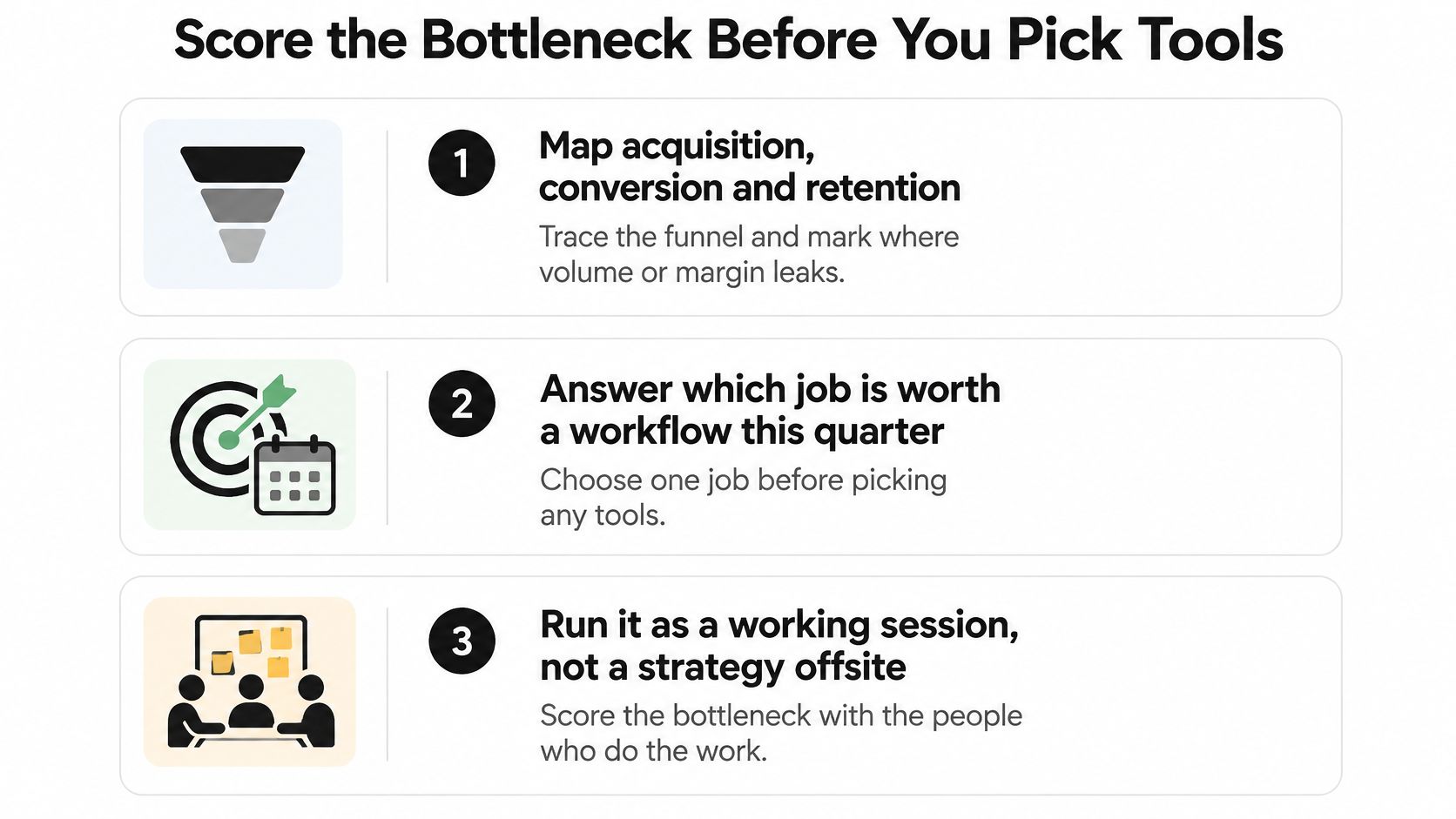
The worthwhile job this quarter is the one with visible business impact, usable data and an owner who can run it without buying a new platform. Finding it takes a working session with the people who know the funnel and the work. It doesn't require a strategy offsite.
Run the session in this order
-
Map the funnel. Put acquisition, conversion and retention on one page. Mark where volume or margin leaks, and check the account structure, tracking and underperforming areas together. Sprints & Sneakers' first-step audit combines those checks in one session. Record what the team measures, what it guesses and what it misses, including gaps in attribution.
-
Write jobs as actions. “Use AI for growth” isn't a job. “Draft the first follow-up after a sales call” is. Other candidates might be grouping support tickets, preparing inbound lead notes or drafting ad angles. Each should describe work someone does this week.
-
Score the job against the work. Compare weekly volume, the cost of a wrong answer, the data already available and whether a human can review the result in under ten minutes. A frequent task with a clear source and a fast review path is easier to test than a rare, high-consequence decision that relies on missing information.
-
Keep the highest-scoring job a named owner can run. A new platform isn't a prerequisite for testing a workflow. If the job needs a platform purchase before the team can learn anything, check whether the scope is too broad.
-
Forecast a KPI movement the team would believe. Name the KPI, the likely direction of movement and the angles or formats worth testing. Treat a forecast copied from a vendor slide as a claim to verify, not a target to promise.
-
Leave with at most three experiments. More candidates don't make the roadmap stronger. A short, ranked list helps the team focus on the best test instead of spreading attention across unrelated workflows.
Let the leak choose the job
A B2B SaaS team whose sales reps already log replies may score follow-up drafts highly: the source data exists, the task repeats and a rep can review the draft before sending. A retailer whose paid spend is the main leak may instead prioritize creative variants. The same scoring criteria produce different jobs because the bottleneck and available data differ.
A growth scan can help teams structure this kind of funnel review. The useful output is a forecast tied to a specific KPI and a set of testable angles, not a general promise of growth.
A roadmap without a ranked bottleneck is a shopping list.
Make Data and Tools Ready for a Real Pilot
Readiness is a set of practical tests, not a platform project. Before a pilot starts, the team needs a source it trusts, a usable connection to business outcomes, records a person can check and a place for the output to land.
Four checks before any build
- One source of truth with a named owner. If several records disagree, name which one the pilot uses and who corrects it.
- A join between campaign data and CRM or order data. The team must be able to connect an activity to the lead, order or customer outcome it is meant to influence.
- Thirty recent records a human can label in an afternoon. A small, relevant sample lets the reviewer see whether the workflow's input contains enough context and whether its output is useful.
- An output destination someone already checks. That could be a CRM task, an ad account or a CMS draft queue. A result nobody sees won't change the workflow.
The same tests lead to different preparations by company type. The table sets a sensible starting point for the data, tool category and pilot length.
| Context | Data to ready first | Tooling bar | Pilot length |
|---|
| B2C ecommerce | Product feed, orders, creative results | Drafts inside the ad or CMS workflow | 10 business days |
| B2B SaaS scale-up | CRM stage, source, win and loss notes | Scoring or drafts inside the CRM | 10 business days |
| Enterprise | Permissioned access and a review log | Approved workspace with export and audit | 4 to 6 weeks including review |
| Industrial B2B | Call notes and a thin CRM | Existing CRM plus a shared workspace | 10 business days on one sales job |
Choose the smallest fit for the job
A B2C ecommerce team can start with the product feed, order history and creative results. A B2B SaaS team can prepare CRM stages, source and win or loss notes. Enterprise teams need permissioned access and a review log before the pilot can use business data. Industrial B2B teams often have a thin CRM and useful call notes, so the first stack can be the existing CRM plus a shared workspace rather than an agent platform.
Tooling should fit the scored job, export its result, allow a person to edit it and switch off cleanly. That may mean writing assistance inside the CMS, scoring inside the CRM, call notes added to an opportunity or a check of how a brand appears in AI answers. A marketing technology stack overview can help teams think about where a workflow belongs without turning the choice into a vendor contest.
When an internal engineering contribution is needed, a resource such as LATAM developers may help a team think through that capacity requirement. But a developer can't repair a missing data join by writing a better prompt. If the campaign-to-outcome connection or output destination fails, spend the next two weeks fixing that join or destination. Don't spend them on prompts.
Run a Two-Week Pilot With a Clear Kill Rule
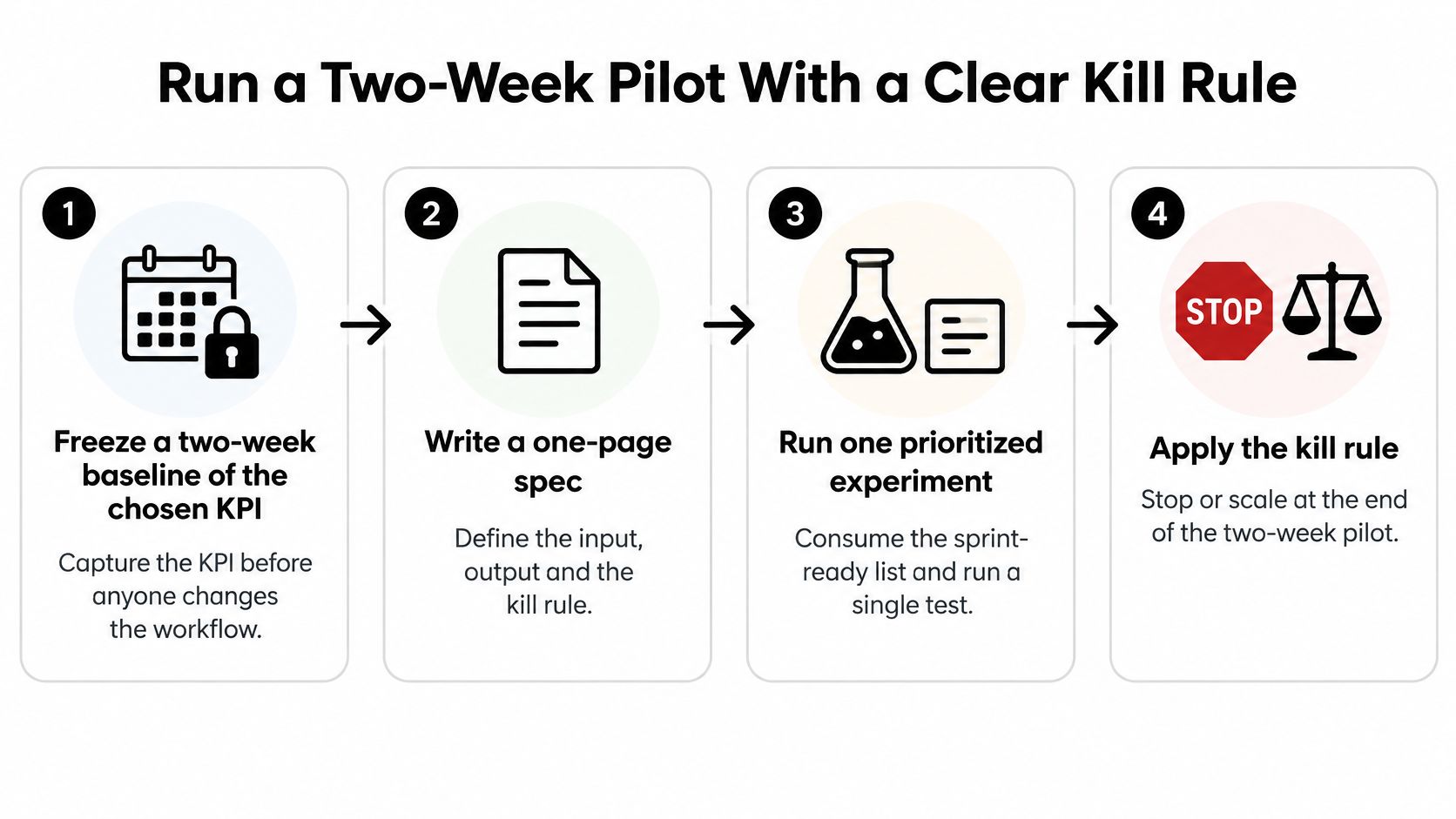
A pilot should answer a decision, not produce a demo. The team starts with a sprint-ready list of prioritized experiments and selects one job to test. If the chosen workflow doesn't beat its own baseline, or creates more review burden than the team can accept, the kill rule makes stopping a sound outcome rather than an awkward surprise.
Seven steps from baseline to decision
-
Freeze a two-week baseline. Record the chosen KPI before anyone changes the workflow. Use the same definition and source throughout, or the team won't know whether a later movement came from the test or from a measurement change.
-
Write a one-page spec. Name the input, the expected output, the reviewer and the time box. Include the kill rule from the strategy phase, so the experiment owner doesn't rewrite success criteria after seeing the results.
-
Run it on live work for ten business days. A sandbox can show that a workflow runs. It can't show whether people use it in the actual process or whether the result helps the KPI.
-
Review every output in the first week and a sample in the second. Early review catches mistakes before they spread. Sampling later helps the team judge whether the workflow stays useful as real work continues.
-
Log time saved, quality misses and KPI movement on one sheet. Keep the measures together. Time saved alone doesn't prove value if the drafts need extensive correction or customer responses get worse.
-
Apply the written kill rule on day ten. Keep the workflow, change one variable or stop. A B2B team could test follow-up drafts from call notes against a rep's own prior reply rate. A retail team could test three ad angles for a hero product and keep only an angle that beats the control's cost per acquisition. In each case, the rule governs the decision, not how polished the draft looks.
-
Write the playbook entry the same day if the team keeps it. Record the inputs, steps, reviewer and conditions for use while the details are fresh. Don't wait for a future rollout to capture how the workflow works.
The sponsor should receive a short weekly note on what changed and what moved. The monthly meeting is for sharpening the bet, not adding a second use case before the first one has a decision. Sprints & Sneakers' operating approach includes weekly updates on changes and results, with a monthly meeting to sharpen the strategy. Teams can use a practical A/B testing guide to think through how to compare a test with its control.
The pilot has failed as a roadmap step if day ten ends without a decision, even when the drafts look polished. The experiment exists to produce a keep, change or stop call.
<iframe width="100%" style="aspect-ratio: 16 / 9;" src="https://www.youtube.com/embed/3ONfwMTk7Zo" frameborder="0" allow="autoplay; encrypted-media" allowfullscreen></iframe>
Scale Winners and Stop Shelfware
A workflow earns expansion by beating its own baseline, not by saving time in isolation. If hours saved rise while conversion, reply quality or margin gets worse, the team hasn't improved the business outcome it set out to change. A successful pilot should become a repeatable operating practice, not a reason to add seats and hope adoption follows.
Turn a successful pilot into routine work
Write the playbook entry on the day the team decides to keep the workflow. Then train the two people who will run it, and put the workflow where they already work, inside the CRM, CMS or ad account. Sprints & Sneakers records successful experiments in a playbook that provides the basis for expanding. That entry is the only basis for asking another team to adopt the process.
After rollout, check a leading signal every week and its matching lagging signal monthly. The leading signal warns whether work is changing in the intended direction. The lagging signal shows whether the change is connected to a business outcome.
| Funnel stage | Leading signal | Lagging signal | Review |
|---|
| Awareness | Qualified reach or branded search | Assisted pipeline or revenue | Weekly lead, monthly lag |
| Acquisition | Cost per qualified lead or session | Customers acquired | Weekly lead, monthly lag |
| Activation | Time to first value | Activated accounts or first orders | Weekly lead, monthly lag |
| Revenue | Proposal or checkout rate | Win rate or conversion value | Weekly lead, monthly lag |
| Retention | Usage or repeat-visit rate | Renewal or repeat purchase | Weekly lead, monthly lag |
| Referral | Invites sent by customers | Referred customers who buy | Weekly lead, monthly lag |
Keep governance small and usable
Governance needs clear rules people can follow while doing the work:
- Keep customer data out of public chat. Use an approved, permissioned workflow for information that identifies customers.
- Name a reviewer for customer-facing output. Drafts don't become customer messages just because they read smoothly.
- Log what the model changed. A reviewer needs enough context to spot an unexpected edit and trace the work.
- Check quarterly that the workflow still beats baseline. If the result has slipped, investigate the process and decide whether to revise or stop it.
Enterprise teams should add a legal read before publishing external content. A scale-up may be able to operate with the four rules above, provided people know who reviews the work and where its record lives. A process automation overview can help teams assess whether a workflow belongs in an existing operating process or is merely adding another handoff.
Catch the two failure modes early
Shelfware is a set of seats purchased for launch week and left idle by week six. Cancel or reassign access when the team can't name a live workflow, an owner and a business result that justifies keeping it. Tool access isn't a measure of adoption.
Shadow AI appears when reps paste customer details into personal accounts because the official path is slow. A ban alone doesn't fix the cause. Make the approved route faster and reduce review friction, then make the boundaries for customer data unmistakable.
Monthly reviews should share wins, learnings and the next month's focus. The sponsor needs a decision about what to keep improving, not a growing catalogue of disconnected experiments. If no one can name the owner and the baseline, the team hasn't got an operating roadmap yet.
Book the First Sprint This Week
The first move is to name the phase the team is in and book a 90-minute working session before the week ends. If no job has been scored, use the session for the bottleneck and tracking audit. If the data join or output destination fails, fix the source, the connection and the landing place first. Nobody writes prompts until the workflow can carry the work.
If a job is already scored, book the ten-day pilot. Name the reviewer and freeze the prior two-week baseline before anyone leaves the room. The one-page handoff should tell the sponsor what job is being tested, what baseline it will be judged against and what result will kill the test.
For a B2B team, that might be follow-up drafts from call notes, judged against one rep's reply rate over the prior ten business days and stopped if the rate doesn't beat that baseline or review takes more than ten minutes. For a retailer, it might be three ad angles on one hero product, stopped if none beats the control's cost per acquisition.
Sprints & Sneakers can facilitate when an internal owner is already named and the first sprint is still stuck on a slide. Write the job, the baseline and the kill rule today, then put the 90-minute session on the calendar.
Sprints & Sneakers helps growth teams turn scattered AI experiments into an operating model embedded across workflows, teams and governance. Its growth work connects funnel analysis, prioritized experiments and ongoing course-correction, so the roadmap stays tied to measurable outcomes. To discuss a practical next step, visit Sprints & Sneakers.