
Explore the real benefits of AI in marketing, from funnel gains to ROI, with practical examples, data, and clear next steps for growth teams.
AI marketing revenue is projected to reach about US$47 billion in 2025 and exceed US$107 billion by 2028, according to Statista's AI marketing market overview. That scale changes the question for growth teams. AI is no longer something to test because it feels modern. The useful question is whether it improves qualified pipeline, conversion, customer acquisition cost, or retention, rather than only helping a team produce more work.
The benefits of AI in marketing become visible when a model is connected to reliable customer signals, a clear decision, and a downstream business metric. Without those connections, AI can make a marketing department faster while leaving commercial performance untouched.
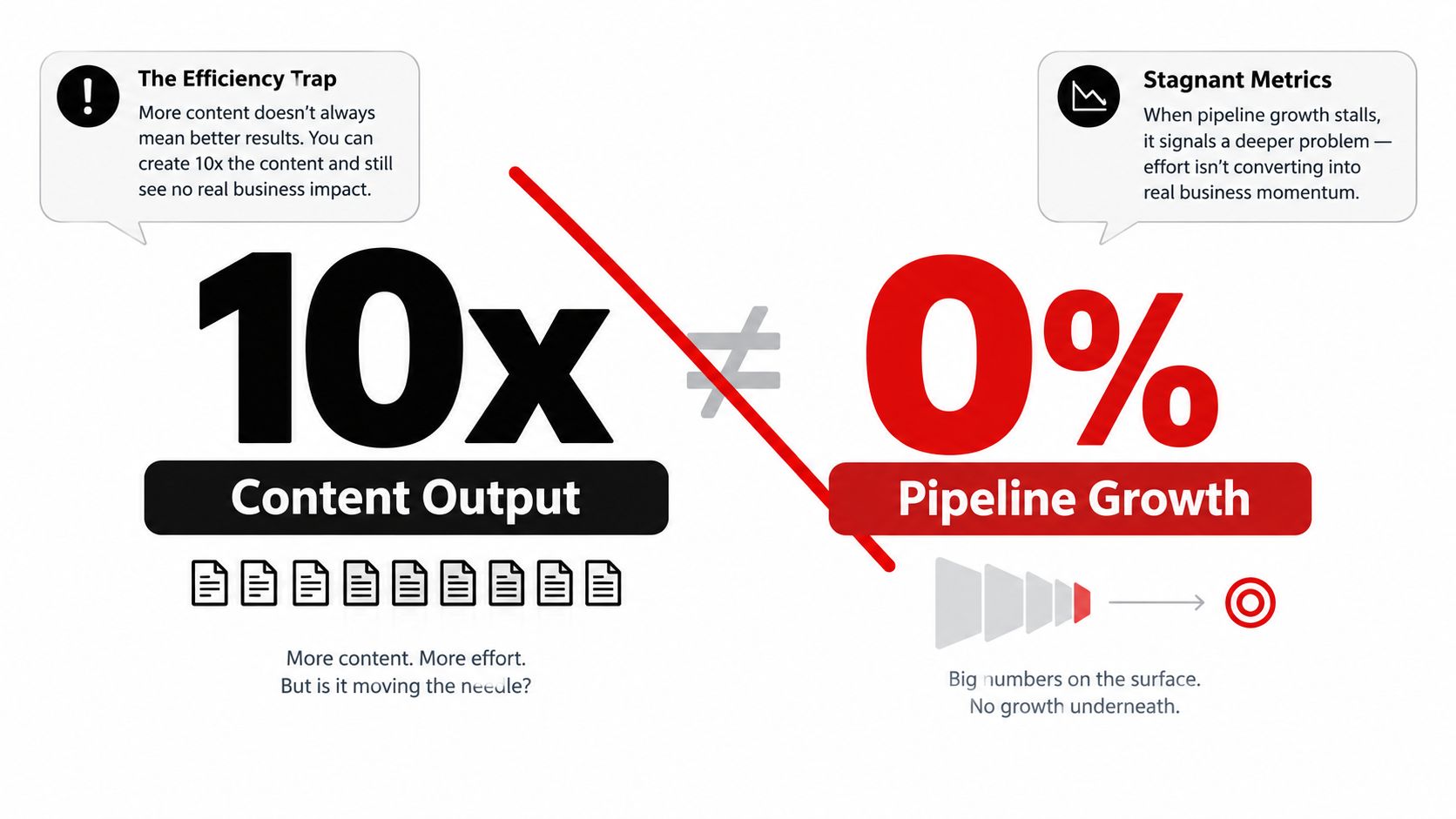
A growth lead rolls out AI for ad copy, email subject lines, blog outlines, and campaign summaries. The team publishes more assets, launches campaigns sooner, and spends less time on repetitive production. Two reporting cycles later, the dashboard looks healthier, but qualified pipeline is flat and acquisition costs haven't improved.
That outcome isn't unusual. Output volume is not demand quality, and faster execution doesn't automatically create stronger positioning, better audience selection, or a more persuasive buying journey. AI can reduce the cost of making an asset while leaving the cost of acquiring a customer unchanged.
The first diagnostic is to separate activity metrics from pipeline metrics. A reporting view such as this guide to marketing reporting dashboards becomes useful only when the dashboard connects work to commercial movement. Content shipped, hours saved, and campaigns launched matter, but they should sit beside lead quality, opportunity creation, conversion, retention, and revenue.
| Metric | What the dashboard shows | What pipeline reveals |
|---|---|---|
| Content production | More pages, ads, or emails completed | Whether the content attracts qualified demand |
| Cost per asset | Lower production effort or spend | Whether acquisition cost falls after conversion is included |
| Campaign speed | Faster launch and iteration | Whether faster tests produce better decisions |
| Engagement | Opens, clicks, views, or reactions | Whether engaged people become qualified opportunities |
| Lead volume | More captured contacts | Whether sales accepts and progresses those leads |
| Automation rate | More steps handled without manual work | Whether customers receive a better experience |
A team can win on every left-hand metric and still lose on the right-hand side. The problem usually starts when AI is assigned a production target instead of a business problem. “Create more variations” is an instruction. “Improve conversion among high-intent visitors without increasing spend” is a growth hypothesis.
Practical rule: Every AI workflow needs one efficiency metric and one downstream metric. If the second metric never moves, the workflow is useful for capacity, not proven growth.
The right standard is therefore not whether AI saves time. It's whether the time saved gets reinvested into sharper experiments, better customer understanding, and decisions that improve the economics of the funnel.
AI in marketing is best understood as a set of operating capabilities, not a category of software. A system can detect patterns, predict likely outcomes, generate variations, or automate decisions based on incoming signals. The marketing value comes from what happens after the system acts and whether the result improves a measurable customer or commercial outcome.
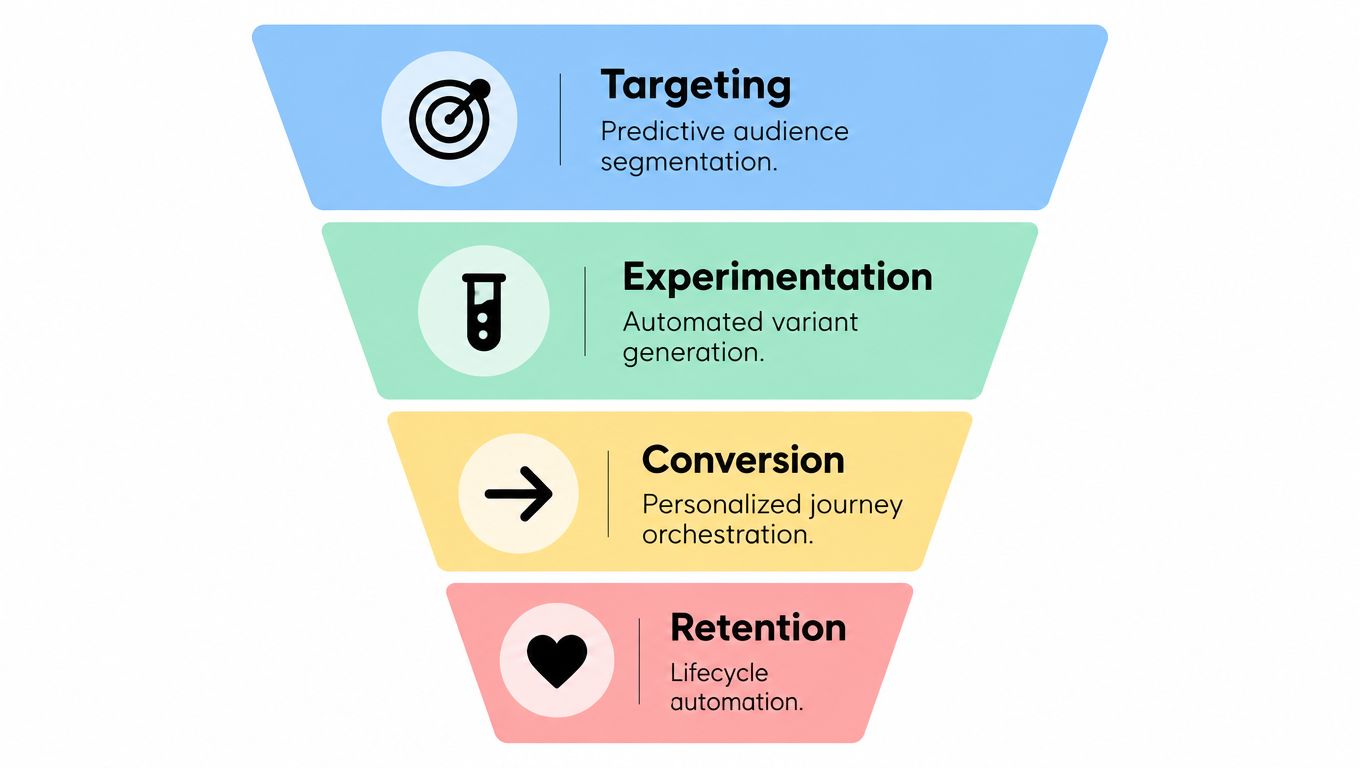
A practical funnel analogy makes the distinction clear:
Generative AI is only one part of this picture. An LLM can draft a useful email, but it doesn't automatically know whether the recipient is qualified, whether the offer is commercially sensible, or whether the copy reflects the brand's positioning. Machine learning can score leads or forecast behavior, but it depends on clean event data and an outcome worth predicting.
Rule-based automation follows a fixed condition. If a visitor submits a form, send an email. AI-based decisioning attempts to infer which action is most appropriate from patterns in data, such as the combination of page behavior, product activity, previous responses, and account context. The boundary can blur in modern marketing stacks, so teams should ask what the system really decides rather than accepting an AI label.
AI isn't a strategy, a creative director, or a substitute for positioning. It won't decide why a buyer should care about a product, which category a company should own, or what promise the brand can credibly keep. Those decisions still require customer research, commercial judgment, and human accountability.
A September 2024 survey of more than 1,000 professional marketers found that nearly 90% had used generative AI at work, 71% used it weekly or more, and nearly 20% used it daily. Among AI-using marketers, 85% said it increased productivity, while about half said it saved time and improved both the quality and quantity of creative content, as reported by the American Marketing Association. Adoption is therefore not the differentiator by itself. The differentiator is connecting adoption to a decision that affects the funnel.
The practical guide to using AI in marketing should begin with that question: which decision is currently too slow, too broad, or too inconsistent for the team to manage manually?
<iframe width="100%" style="aspect-ratio: 16 / 9;" src="https://www.youtube.com/embed/Dlq1fWMt8Wk" frameborder="0" allow="autoplay; encrypted-media" allowfullscreen></iframe>The strongest benefits of AI in marketing don't come from generating a larger pile of assets. They come from improving the quality and timing of decisions across the funnel.
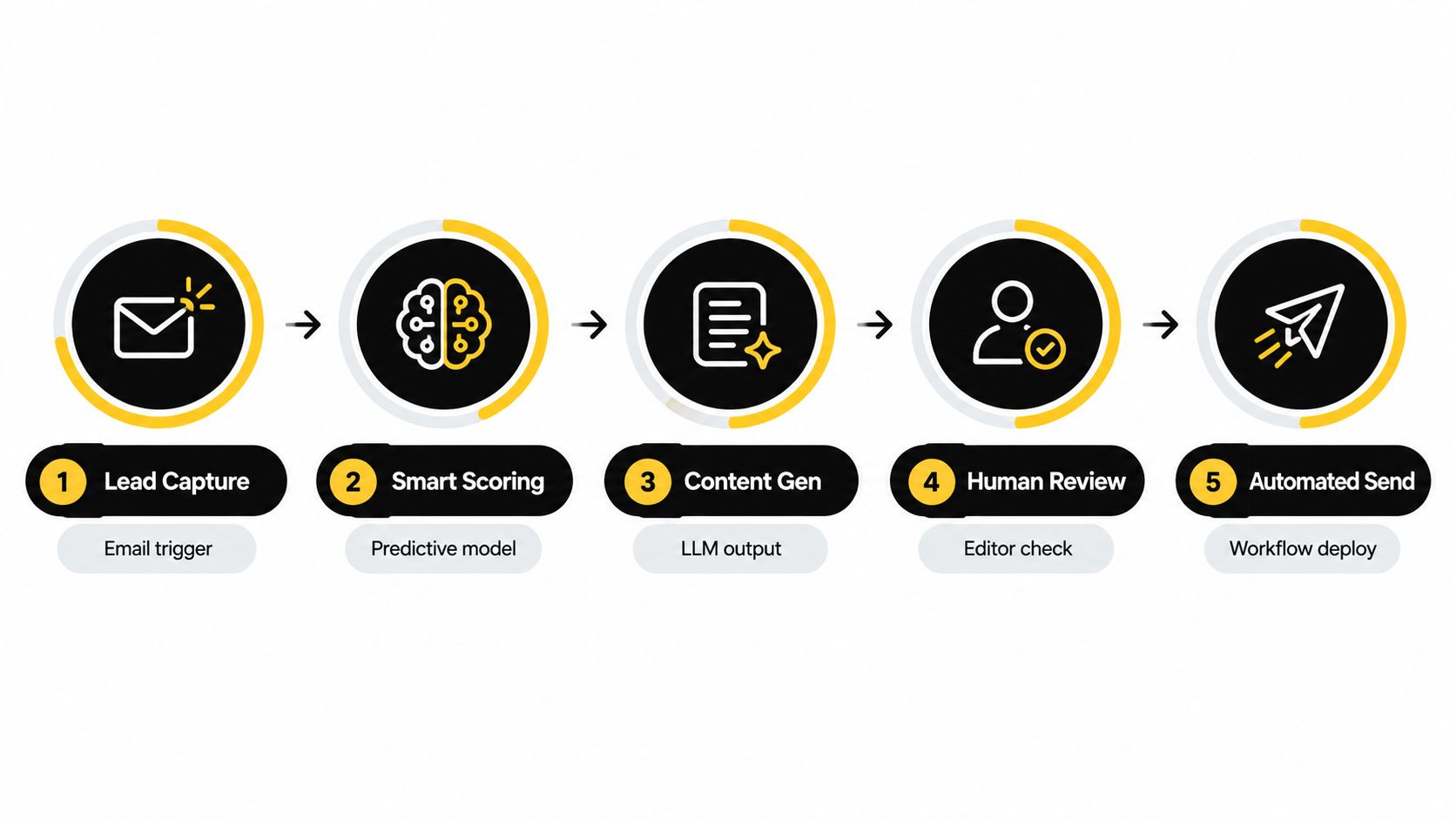
Predictive segmentation uses behavioral and conversion data to identify groups that share a meaningful likelihood of taking action. The input might include content consumption, product events, previous responses, account attributes, or purchase history. The output should be a better allocation of attention and budget, not merely a more detailed audience report.
Targeting and personalization are among the most effective applications identified in the AI marketing trends overview from Adobe. Adobe's cited survey data reports that 42.02% of marketers identify enhanced personalization as a major outcome and 36.30% identify better targeting. Those benefits matter when the segments change the message, channel, offer, or sales priority.
AI can generate multiple ad concepts, landing page structures, email angles, or calls to action from a defined brief. That shortens the drafting cycle, but the commercial gain comes only when the team tests meaningful hypotheses and retires weak variants quickly.
A benchmark cited by Omnibound's marketing AI research reports an average saving of 6.1 hours per marketer per week. The same source reports 32% more conversions and 29% lower customer acquisition costs for AI-driven campaigns versus non-AI campaigns. The mechanism is plausible when speed increases test velocity, but teams shouldn't assume that every generated variation will reproduce those outcomes. Better testing discipline matters more than raw generation capacity.
Personalization becomes valuable when it responds to current intent. A visitor comparing plans needs a different next step from a first-time reader, and a customer who has stopped using a core feature needs a different message from someone approaching a renewal decision.
The useful workflow connects first-party events to a controlled set of journey decisions. It might select a proof point, reorder a page module, recommend an offer, or suppress an irrelevant message. The team should define the conversion event before activation, then compare the personalized experience with a suitable control.
AI can help match creative and offers to higher-propensity cohorts, adjust bidding decisions, and identify wasted impressions. The economic chain is straightforward: better scoring directs spend toward people more likely to respond, while faster creative learning reduces the time spent funding weak messages.
One benchmark set reports a 3.2x median ROI for AI marketing investments overall, with personalization engines also at 3.2x. It reports head-to-head tests with 27% higher conversion rates and 19% lower cost per acquisition for AI campaigns than non-AI campaigns, as detailed in Presenc's AI ROI research. These figures are benchmarks, not promises. They should encourage controlled testing, not replace it.
Retention models look for changes that precede churn, such as declining usage, stalled onboarding, support friction, or reduced purchase frequency. The model doesn't retain customers by itself. It helps the team choose who needs attention and what intervention deserves testing.
The best retention workflow combines a risk score with a useful response. A product education message may suit a new customer with low adoption. A service review may suit an account showing repeated friction. A discount sent to every at-risk customer can damage margin and train customers to wait for incentives.
The process automation benefits guide is relevant here because operational efficiency only compounds when workflows have ownership, review points, and feedback loops. AI should make the right action easier to execute, not hide an unexamined process behind automation.
The quickest way to find value is to attach AI to an existing workflow with a clear trigger, a human checkpoint, and one outcome metric. The following examples are deliberately modest. Each can begin as a controlled pilot rather than a broad transformation.
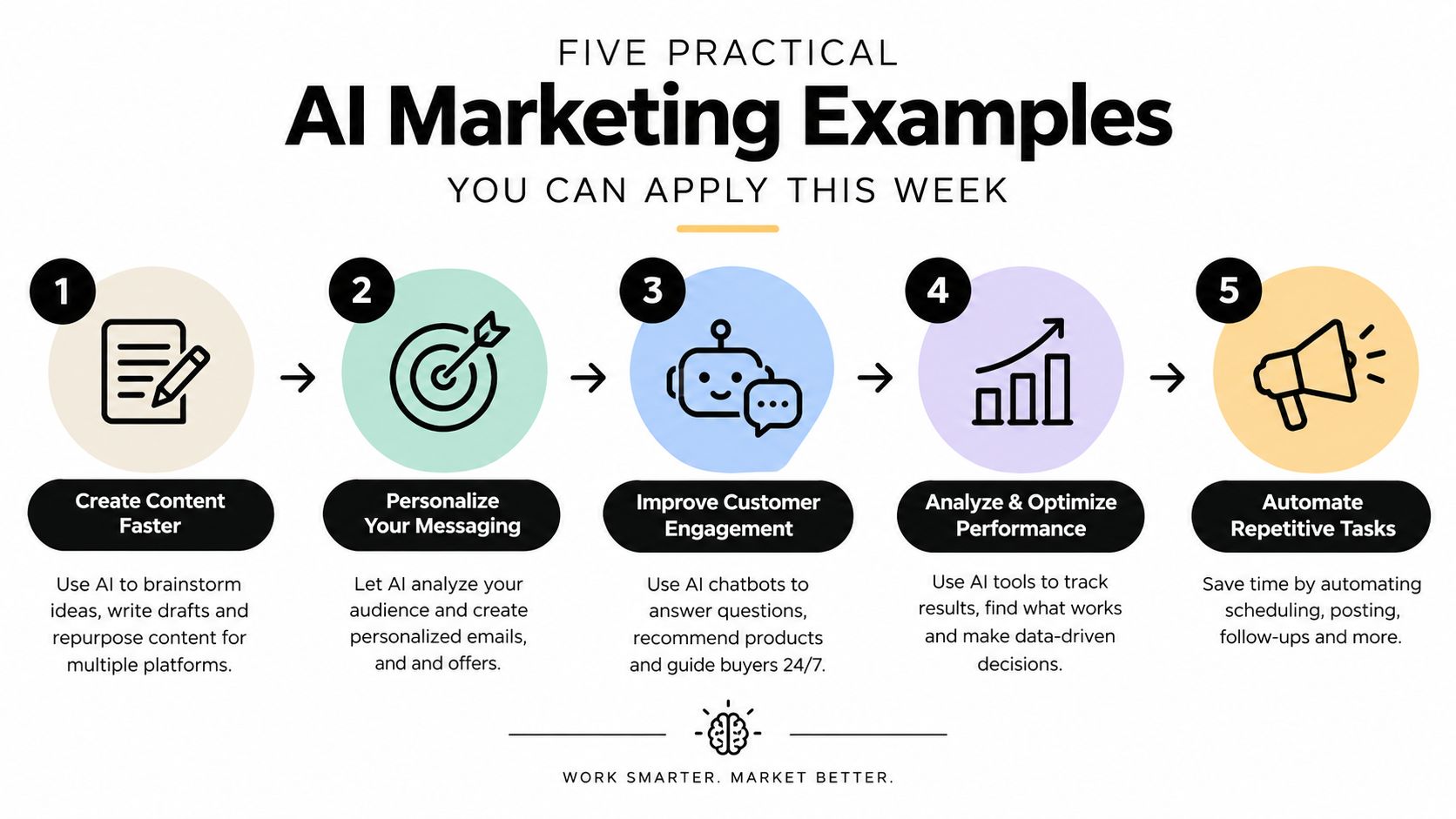
Feed recent engagement signals, declared interests, and conversion outcomes into an audience model. Ask it to identify clusters with similar intent, then have a marketer review the segments before activating them in paid or owned campaigns. Test the model-selected audience against the existing targeting approach using qualified visits or accepted leads as the outcome, rather than impressions.
The same principle applies to posting via AI agents. An agent can turn approved content into channel-specific posts and schedule distribution, but a human should review claims, tone, and audience fit before publication.
Give an AI-assisted landing page workflow the search intent, ad promise, customer objections, and approved proof points. Generate a small set of page variants, then let an editor check factual accuracy, compliance, and brand voice. Test one material change at a time, such as the headline promise or proof sequence, and measure completed conversion actions.
Over-automation usually appears when the model rewrites every page element at once. That makes the result difficult to diagnose and can create a polished page with a weaker commercial argument.
Use product events to trigger onboarding messages. A new account that hasn't completed a key setup action should receive a message explaining the next step, while an account that has already completed it should receive a more relevant progression.
The model can draft the message from approved product information and customer language, but a marketer should verify that the advice matches the actual product experience. Track completion of the activation event, not just email engagement.
Create a churn-risk view from usage decline, support interactions, renewal timing, or purchase gaps. Route high-risk accounts to the appropriate intervention, then have customer-facing teams review the recommendation before contact.
The test should compare retention outcomes for eligible customers who receive the intervention with a holdout group. If the workflow only increases outreach volume, it hasn't demonstrated that it improves retention.
Use customer activity and satisfaction signals to identify a likely moment for a referral request. A request after a successful outcome or completed milestone should be more appropriate than a generic message sent on a fixed schedule.
The model can recommend timing and draft options, but it shouldn't manufacture praise, pressure a dissatisfied customer, or imply a relationship that doesn't exist. Brand trust is the constraint that keeps a referral workflow useful.
AI personalization earns its place when the system uses a strong first-party signal to change a decision that affects the customer. Thin attributes may help with basic relevance, but they rarely explain what a person wants now. Behavior streams, product events, declared preferences, and purchase context usually provide a stronger basis for action.
Nielsen's 2025 analysis of AI in marketing reports that 59% of global marketers view AI for campaign personalization and optimization as the most impactful trend. The same research reports adoption of AI for customer segmentation at 44%, personalization at 42%, and predictive analytics at 46%. Adoption confirms interest, but it doesn't prove incremental lift in every use case.
| Funnel Stage | Signal Depth Required | AI Personalization Tactic | Expected Lift |
|---|---|---|---|
| Retargeting | Recent page and product behavior | Match creative to active consideration signals | Potentially strong when the message answers the current objection |
| Product experience | Feature usage and completion events | Change prompts or education based on adoption gaps | Potentially strong when the intervention removes friction |
| Cart or checkout | Product, price, and purchase context | Select relevant offer or reassurance | Potentially strong when the offer resolves a known barrier |
| Cold email | Limited engagement and inferred attributes | Generate individualized subject lines | Often uncertain because intent is weak |
| Website greeting | Anonymous visit with little context | Add a generic personalized salutation | Usually limited because the decision hasn't changed |
| Broad demographic targeting | Inferred identity or coarse profile data | Vary copy by assumed preference | Risky when the inference is inaccurate or intrusive |
The high-lift cases share three traits. They use a current signal, change a meaningful experience, and connect to a measurable event. They also give the customer a reason to notice the personalization.
The low-lift cases often automate an old segmentation scheme. A system may produce hundreds of customized subject lines, but if the list contains weak intent and the offer remains generic, the extra variation adds production effort without improving the buying decision. Generic chatbot greetings have the same problem. They sound personalized while giving the visitor no better answer.
A useful audit asks three questions:
If the team can't answer all three, the workflow is probably personalization theater. The personalization in marketing framework can help teams prioritize signal quality before expanding message volume.
Marketing teams often celebrate the wrong finish line. More content, faster production, and lower effort per campaign can all be genuine improvements, yet none proves that buyers are more qualified or that customers are staying longer.
A 2025 survey cited by ZoomInfo's marketing AI research reports that 82% of marketers using AI cite reducing repetitive work as the main goal, 79% say AI helps them spend less time on manual tasks, and 64% track productivity as a success metric. Those measures are useful for capacity planning. They become dangerous when teams treat them as substitutes for pipeline and revenue measures.
A new AI workflow should have a paired scorecard:
The pairing prevents a common failure mode. A team may reduce the effort required to produce campaigns, then spend the recovered capacity on even more campaigns without improving the underlying offer or audience. The result is a busier calendar and the same commercial constraint.
A faster workflow is only productive when the team uses the time to make better decisions.
Guardrails matter. Set limits on message frequency, define suppression rules, require human approval for sensitive claims, and stop workflows when quality or customer response deteriorates. Even a simple retail process that uses mobile scans to reduce returns illustrates the wider principle: automation should address a measurable source of friction, not create another layer of activity.
Use holdout groups or holdback budgets wherever the channel allows it. Record the baseline, define the success condition before launch, and keep the evaluation window consistent. The marketing attribution framework should then connect the local test to the wider customer journey, while acknowledging that attribution is a decision aid rather than perfect proof.
The most credible AI programs measure incremental commercial value, not just the amount of work removed from a team's queue.
AI performance depends more on operating conditions than on novelty. A complex model trained on incomplete events, inconsistent CRM fields, or unconsented data will produce confident recommendations that the business shouldn't trust.
Start with a data audit across web, product, CRM, advertising, and customer service systems. Confirm that key events have consistent definitions, that identity resolution is defensible, and that the team has permission to use the signals for the intended purpose. First-party data should be useful because it reflects customer behavior, not because it gives the company permission to infer anything it wants.
Document what the model receives, what it produces, who approves the output, and how the team can reverse the decision. Keep version control for prompts, templates, scoring logic, and campaign rules. High-stakes outputs, including pricing decisions, medical claims, eligibility decisions, or sensitive customer communications, need human review before release.
The 2024 State of Marketing AI report from the Marketing AI Institute and Drift found that 51% of marketers were piloting or scaling AI, while 80% wanted to reduce time spent on repetitive, data-driven tasks. Only 20% said more than 25% of their marketing tasks were intelligently automated at that time, according to the report. That gap creates room for progress, but it also argues for deliberate governance rather than uncontrolled expansion.
Teams need prompt literacy, analytics fluency, and the ability to challenge model outputs. They should know when a recommendation reflects a real pattern, when it reflects biased historical behavior, and when the available data is too thin to support a decision.
Bias, dark-pattern personalization, synthetic media disclosure, and privacy obligations require explicit policy. Inference-based targeting also needs review against applicable rules such as GDPR and CCPA. Before scaling, the checklist should include a data audit, policy review, kill-switch criteria, human owners, and stakeholder sign-off.
Week 1: Inventory current AI workflows, map the data feeding them, and identify one funnel stage with the largest revenue gap. Choose one baseline metric and one downstream outcome.
Week 2: Run one focused pilot, such as AI-assisted subject-line testing or lead-scoring recalibration. Keep the human review step visible and document every change.
Week 3: Add a holdout group, uplift tracking, and a weekly review cadence. Record quality issues as carefully as performance gains.
Week 4: Expand to one adjacent use case only if the pilot shows a clear, defensible improvement. If it doesn't, refine the original workflow instead of adding more automation.
The benefits of AI in marketing compound when teams treat AI as a measurement discipline, not a productivity hack. Clear baselines, revenue-linked KPIs, and controlled experimentation turn saved time into better growth decisions.
Sprints & Sneakers helps B2B and B2C teams identify funnel bottlenecks, audit automation opportunities, and run AI-powered experiments tied to pipeline, conversion, and retention. Visit Sprints & Sneakers to explore a practical growth scan and find the next measurable opportunity.
Growth marketing, AI and automation, SEO, performance marketing, retention strategies, and sustainable business practices.
Weekly. Subscribe to our newsletter to get new articles straight to your inbox.
Absolutely. Everything we publish is designed to be actionable. Take it, test it, and make it your own.
Yes. We publish experiments with real numbers. What worked, what didn't, and what we learned.
Our growth team — strategists, performance marketers, data specialists, and AI builders who work on client campaigns every day.
We're open to it. Reach out via our contact page with your topic and we'll take a look.