
BANT vs MEDDIC: Which Framework Fits Your Deals
BANT vs MEDDIC compared on criteria, strengths and limits, with the deal types each suits and a staged way to use both to qualify faster.
Why do sales teams debate BANT vs MEDDIC as if choosing a framework also determines whether the buyer will buy?
A prospect can have budget, authority, need, and a target date without a workable route through procurement. Equally, a straightforward purchase doesn't need an elaborate investigation into every internal relationship. The useful choice isn't which framework wins. It's when deeper qualification earns its cost, and whether the team has reliable buying-group evidence to support it.
Table of Contents
- BANT vs MEDDIC at a Glance and Where Each Came From
- Mapping BANT Questions to MEDDIC Fields
- Strengths, Limits and the Precision Trade-Off
- What the Performance Numbers Really Prove
- Choosing the Framework by Deal Type and Buying Group
- Running BANT and MEDDIC in One Pipeline
BANT vs MEDDIC at a Glance and Where Each Came From
BANT vs MEDDIC side by side
| Dimension | BANT | MEDDIC |
|---|---|---|
| Origin | IBM, associated with enterprise technology sales from the 1950s | Parametric Technology Corporation (PTC), 1990s |
| Criteria | Budget, Authority, Need, Timing | Metrics, Economic Buyer, Decision Criteria, Decision Process, Identify Pain, Champion |
| Primary job | Decide whether an opportunity deserves attention | Understand how a complex opportunity will be won |
| Effort per opportunity | Light, a few questions early in the funnel | Heavy, every field needs buyer-verified evidence |
| Best deal type | High-volume deals with a single decision path | Multi-stakeholder deals with formal evaluation criteria |
| Forecast value | Limited beyond early screening | Strong late-stage predictability when evidence is accurate |
The origin dates in the table reflect Salesforce's account of BANT and MEDDIC, which associates BANT with IBM from the 1950s and MEDDIC with PTC during the 1990s. BANT addressed expensive enterprise technology purchases, lengthy sales cycles, and the need to identify financially viable prospects; MEDDIC developed as enterprise software buying involved more complex groups.
Those origins explain the different jobs. BANT gives a rep enough information to decide whether another conversation makes commercial sense. MEDDIC helps a rep inspect the business case, buyer power, evaluation standards, and internal actions needed to close.
BANT tells a sales team whether an opportunity deserves attention, while MEDDIC tells the team how a complex opportunity will be won.
What the criteria mean in practice
BANT asks whether the prospect can pay (Budget), whether decision authority is accessible (Authority), whether a relevant problem exists (Need), and whether the purchase fits a workable timeframe (Timing). MEDDIC examines measurable business outcomes (Metrics), spending power (Economic Buyer), evaluation standards (Decision Criteria), approval steps (Decision Process), operational consequences (Identify Pain), and internal advocacy (Champion).
The effort difference matters. A rep can use BANT to establish a useful starting position without pretending to understand the entire account. MEDDIC requires continued discovery, confirmation, and updates as the opportunity develops.
That extra effort makes sense when the buyer must justify change across departments. It makes less sense when the buyer already understands the product, controls the purchase, and needs a clear commercial answer rather than another discovery meeting.
Separate pursuit from prediction
Say a department lead requests a proposal for a familiar service. The lead describes the problem, confirms an available funding route, explains signing authority, and names a purchase window. BANT can support the decision to continue.
Now suppose the scope expands into a company-wide deployment. Security must approve access, finance wants an economic case, and operations needs an implementation plan. The original answers remain useful, but they're no longer sufficient for predicting a close.
The same-day test is simple: have the opportunity owner write either deciding whether to pursue or deciding how to win beside the next deal action. The first calls for a light screen. The second calls for deeper inspection wherever the buying process creates meaningful risk.
Mapping BANT Questions to MEDDIC Fields
Budget, authority, need and timing work best as screening answers that point to deeper discovery. Each answer should create a field the rep can confirm with the buyer, then update as the deal changes. Treat BANT as the first pass and MEDDIC as the evidence layer that makes the first pass useful for forecasting.
BANT questions mapped to MEDDIC fields
| BANT question | MEDDIC fields | Question to ask next | Evidence that counts |
|---|---|---|---|
| Budget | Metrics, Economic Buyer | What number changes if this works? | A revenue, cost, or time figure the buyer confirms |
| Authority | Economic Buyer, Champion | Who signs, and who can stop it? | A named person with P&L responsibility plus an internal advocate |
| Need | Identify Pain, Decision Criteria | What breaks today, and how will options be compared? | Pain stated in the customer's operational terms and written standards |
| Timing | Decision Process | Which approvals come before go-live? | Mapped approval steps with dates the buyer agreed to |
Use the table as a CRM field map: keep the original BANT answer, the MEDDIC field it informs, the follow-up question, and the buyer evidence in the same opportunity record.
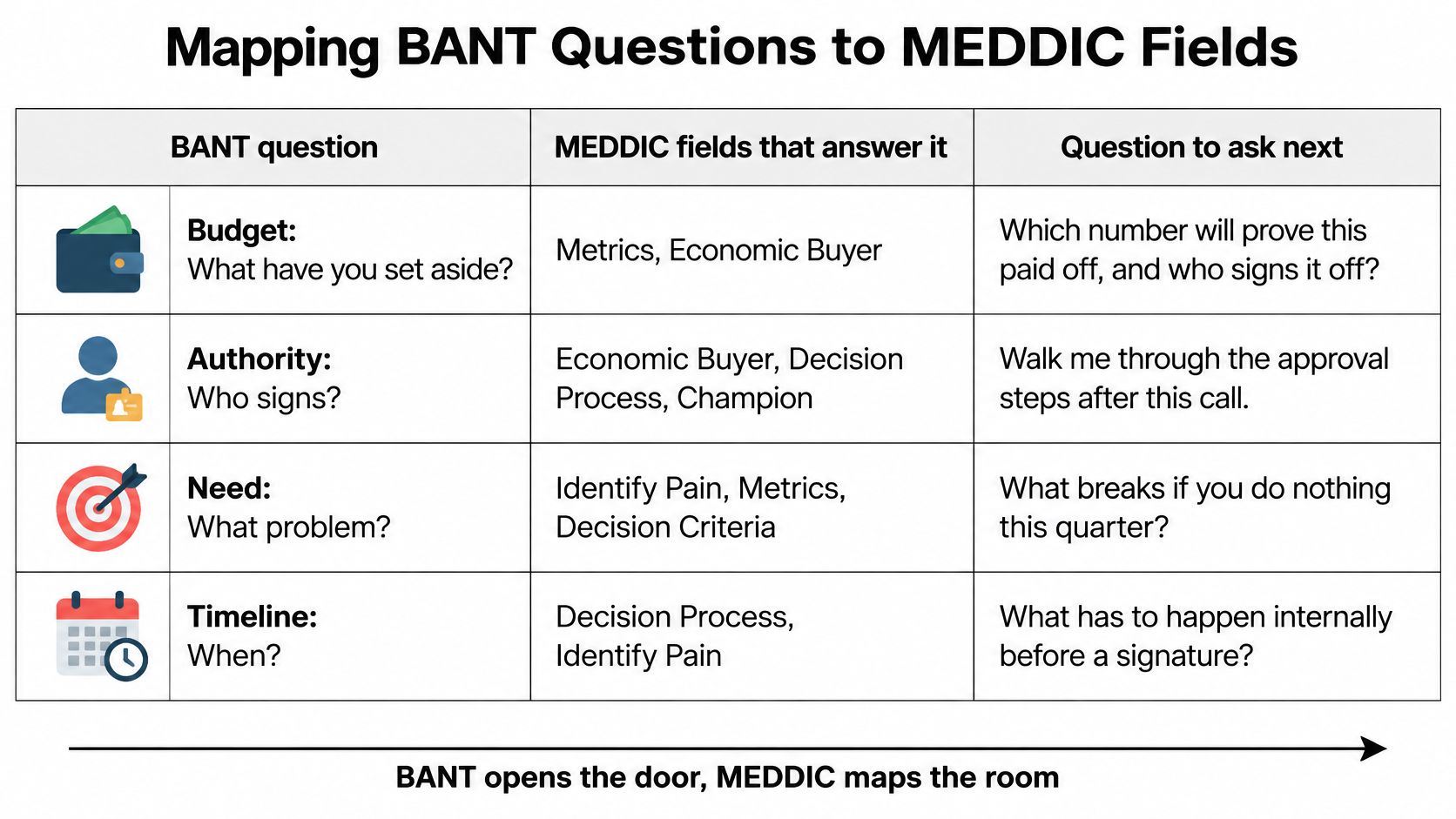
Turn answers into a business case
Budget becomes Metrics and Economic Buyer. An available spending envelope says little about whether the purchase deserves funding. The rep should establish which operating result matters, how the buyer measures it, and who accepts the business case.
For example, a software prospect might want to reduce manual reconciliation. A useful record identifies the workflow, the current effort, the expected improvement, and the buyer who confirmed the assumptions. A seller's calculator is a seller's estimate until the buyer confirms it.
Authority becomes Economic Buyer and Champion. The signer and the internal advocate perform different jobs. A supportive contact may arrange meetings but lack spending authority; a budget owner may approve funding without doing the internal work needed to build agreement.
The rep should test advocacy through actions. Will the supporter introduce the relevant functions, challenge an unrealistic implementation assumption, or help prepare the internal recommendation? Responsiveness by itself gives you a contact who replies, which is useful, but it leaves influence unproven.
Separate the problem from the purchase path
Need becomes Identify Pain and Decision Criteria. A broad desire to improve efficiency needs an operational description: which task fails, who absorbs the consequence, and what acceptable performance looks like. The evaluation standards should then connect to that problem rather than become an unranked feature list.
Timing becomes Decision Process. A preferred launch date functions as a target until the buyer maps the approvals behind it. Gong's MEDDIC guide distinguishes decision criteria, the standards used to evaluate an option, from decision process, the steps that produce a purchase decision.
A product can meet every requirement and still stall because legal review hasn't been scheduled. Recording the standards without the approval sequence creates a misleading impression of progress.
Use marketing automation and CRM integration to preserve the handoff: keep the original answer, the confirming contact, the supporting note, and the next action together. A BANT answer becomes a MEDDIC field only when the buyer confirms it.
Strengths, Limits and the Precision Trade-Off
An Isoglu review of qualification evidence describes a 1988 field test where tightly qualified leads converted at substantially higher rates but generated fewer total sales. It also describes a 2011 scorecard study whose cutoff would have rejected approximately one-third of eventual bookings under the review's arithmetic. That is the precision trade-off in one line: a gate can improve the average while shrinking the total.
Neither finding establishes a universal advantage for BANT or MEDDIC. The review reports that the identified studies didn't test those frameworks by name. Keep that distinction. These studies show why qualification rules need outcome checks, not why one framework always wins.
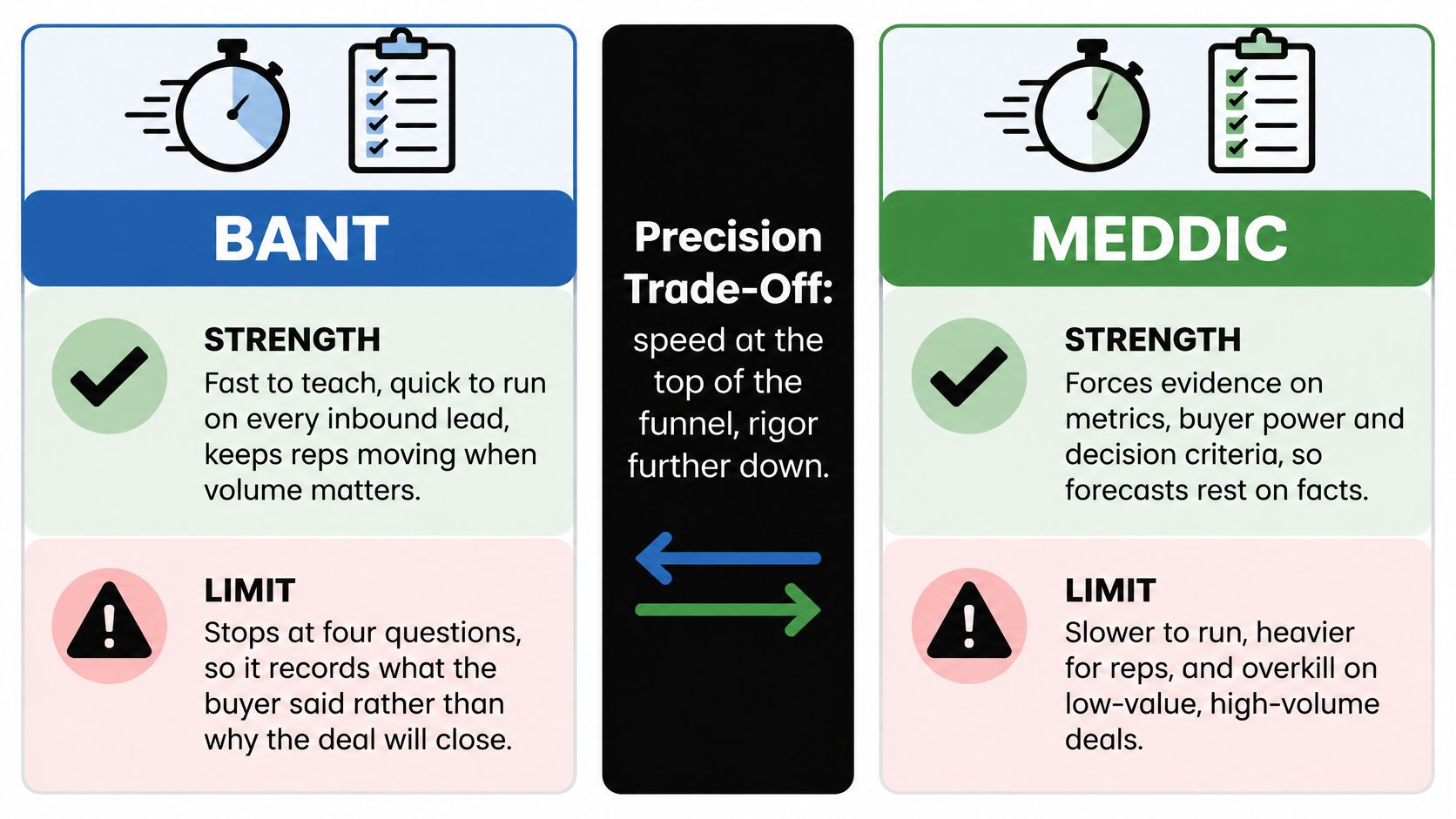
BANT works well when the seller needs a quick, shared view of budget, authority, need and timing. It is easy to teach, easy to review in a pipeline meeting, and useful across inbound demand. Its weakness appears when a clean qualification record substitutes for deal understanding. A buyer can confirm funding and timing while leaving the rep unaware that an implementation team opposes the purchase.
MEDDIC gives managers more specific coaching questions. Instead of asking whether a deal feels healthy, they can inspect the business case, the decision criteria and the approval route. That extra structure helps when several people influence the outcome. Its cost is time, and a mandatory form can encourage reps to write plausible answers just to advance the opportunity. MEDDIC only pays off when the buying-group evidence is accurate.
Consider a routine purchase where the buyer already controls the decision. Requiring extensive stakeholder discovery adds work without resolving a meaningful uncertainty. A complex deal is different. Allowing it to advance on a friendly contact's assurances skips precisely the work that matters.
Qualification safeguard: Unknown information should trigger a discovery action, not automatically become a rejection reason.
The video below offers another format for the same qualification discussion.
<iframe width="100%" style="aspect-ratio: 16 / 9;" src="https://www.youtube.com/embed/IvHdggOZnfM" frameborder="0" allow="autoplay; encrypted-media" allowfullscreen></iframe>Before tightening a gate, inspect the previous quarter's closed-won opportunities using only information available at the original qualification stage. Count which deals each proposed rule would have rejected, and distinguish genuine mismatch from information the buyer revealed later. Use B2B sales intelligence to investigate gaps, not disguise them. Treat the framework as an operating hypothesis that the team can challenge against actual outcomes.
What the Performance Numbers Really Prove
Can a higher close rate still be a bad trade? Avoma's MEDDIC overview presents Atlassian-attributed reports of roughly 20–30% higher close rates among organizations adopting MEDDIC versus traditional approaches, alongside approximately 15% increases in win rates reported by some high-growth SaaS companies.
Those figures are useful as directional signals. They do not show that MEDDIC beat BANT under matched conditions, because the reported material does not give a controlled comparison with randomized assignment, consistent eligibility, sales-cycle controls, or a clean before-and-after measurement design. Treat the numbers as a prompt to define the commercial question more precisely: what extra pipeline quality must a deeper framework create to justify the time it consumes?
Run a comparison that answers the commercial question
Use one qualification definition for the cohort entering the test, then compare outcomes against the same eligibility rules. Define those rules before deals are assigned so reps cannot reserve the deeper process for prospects they already expect to win.
Track both selling outcomes and the cost of obtaining them:
- Progression: Stage-to-stage conversion and no-decision rate.
- Economics: Average contract value and rep discovery time.
- Timing: Sales-cycle duration and delays between agreed milestones.
- Reliability: Forecast variance against actual results.
- Customer quality: Expansion or retention outcomes once enough time has passed.
Define each measure before the test starts. Forecast variance needs a consistent forecast snapshot. Discovery time should include preparation, internal coordination, and documentation, not just the length of buyer meetings. Without those definitions, a team ends up comparing working styles rather than frameworks.
Buyer-confirmed evidence matters in the deeper cohort. If one group records a named Economic Buyer, a documented pain, a decision process, decision criteria, a compelling event, and a champion from buyer conversations, while the other group relies on rep notes, the comparison tests record quality as much as qualification method. Audit a sample of records for that reason.
The pipeline velocity formula connects conversion, deal value, and cycle length, which makes it useful for reading the commercial result. Rep capacity belongs in the same decision. A 15% win-rate lift can still lose money in practice if the extra discovery blocks reps from working enough viable buyers to cover the same pipeline value.
Inspect the segments, not just the average
Break results down by deal size, stakeholder count, industry, inbound versus outbound source, and cycle length. A blended average can hide the pattern: complex opportunities may improve while straightforward purchases slow down.
Use narrower reads before making a framework rule. Segment results show where precision pays and where it creates friction. If the gain appears only in deals with multiple stakeholders, that points to buying-group complexity as the reason for the extra work. If it appears across simple, single-buyer deals, check whether the measurement is capturing stronger discovery habits rather than the framework itself.
I would judge the framework by three questions: did it improve conversion where risk was high, did it protect forecast accuracy, and did the team still have enough selling time left to serve viable demand? When MEDDIC performs, it usually performs because the buying-group evidence is accurate. When that evidence is thin, the extra fields create the appearance of control while the forecast still rests on guesses.
Use BANT when speed and volume dominate. Deploy MEDDIC when deal risk, buying complexity, or forecast value justifies the additional discovery.
Choosing the Framework by Deal Type and Buying Group
Deal type should set the qualification path. A sales team that treats BANT and MEDDIC as rivals loses useful signal from both. BANT works as the fast screen for fit and timing. MEDDIC earns its keep when the purchase touches several functions and the forecast depends on verified evidence.
| Deal situation | Lead framework | Why it fits |
|---|---|---|
| High-volume inbound with one buyer | BANT | A light screen keeps reps moving; add MEDDIC only if the deal grows |
| Mid-market with two or three approvers | BANT, then MEDDIC on qualified deals | Effort rises only where risk rises |
| Enterprise with many functions involved | MEDDIC with buying-group mapping | Formal criteria and approval paths decide the outcome |
| Renewal or expansion with a known buyer | Economic Buyer and Identify Pain | Discovery is shorter and the buyer is already known |
| Team without accurate cross-functional data | BANT plus a buying-group map | MEDDIC fields become guesses without reliable evidence |
Routing should follow the purchase, not the logo. A modest purchase can carry heavy review if security, legal, or finance has a mandatory gate. A large account can still move quickly when the expansion stays inside a familiar buying path. That distinction matters because framework choice is an operating decision: it determines where reps spend discovery time and where managers demand proof.
Renewals and expansions deserve a shorter path, with the key checks intact. The account owner confirms whether spending authority changed and whether the original problem still drives the purchase. A familiar contact makes the work faster, but it does not prove that the approval path stayed the same.
A champion covers one function, not the buying group
The 2025 Demandbase State of the B2B Buyer Report reports that 72% of B2B purchases involve complex multi-stakeholder groups and identifies ten distinct decision-maker functions. A named advocate therefore cannot stand in for support across security, procurement, finance, legal, and the business owner.
That gap shows up in ordinary deals. A operations lead may confirm the productivity case and still have no influence over data review. A procurement owner may negotiate terms while the technical reviewer waits for architecture detail. Each person can be positive about the purchase and still leave a blocking requirement untouched.
The buying-group map should record people, functions, approval gates, and required evidence. It should also distinguish the person who recommends the purchase from the person who can stop it. Keep the map close to the opportunity record, where reps can update it after each buyer conversation.
Score coverage through observable actions
A practical coverage review should inspect:
- Critical functions engaged: The share of required functions with an identified contact and meaningful participation.
- Criteria confirmed: Evaluation standards accepted by the people responsible for applying them.
- Process documented: Approval steps, owners, dependencies, and expected decisions.
- Risk requirements understood: Security, legal, procurement, and implementation conditions.
- Milestones agreed: Mutual action-plan commitments acknowledged by the relevant buyers.
Do not collapse those dimensions into one reassuring score. A single number can hide a missing veto-holder while the rest of the account looks active. Keep the weakest requirement visible, because that is where the deal will wait.
At the proposal stage, an economic buyer may approve the business case while the security reviewer has not engaged. If security approval is mandatory, coverage is weak and the opportunity should stay out of the committed forecast. The next move is an introduction and requirements review, not another discount.
Framework choice also depends on how the account works across functions. Marketing, sales, customer success, product, finance, security, and legal each need different evidence. An account-based approach matched to account complexity can coordinate that work without asking the champion to relay every message.
Self-serve research and AI-assisted evaluation also belong in discovery. Ask which people have already reviewed the category and which concerns shaped the shortlist. The first sales contact may not be the first person involved.
MEDDIC pays off only when the team maintains accurate cross-functional evidence. Without that discipline, BANT plus an honest buying-group map gives managers a more usable view than a completed but unreliable scorecard.
Running BANT and MEDDIC in One Pipeline
A combined process needs explicit stage rules, named owners, and a review cadence. Treat BANT as the entry screen and MEDDIC as the deeper buying-group test. That keeps qualification usable without turning every opportunity into a research project.
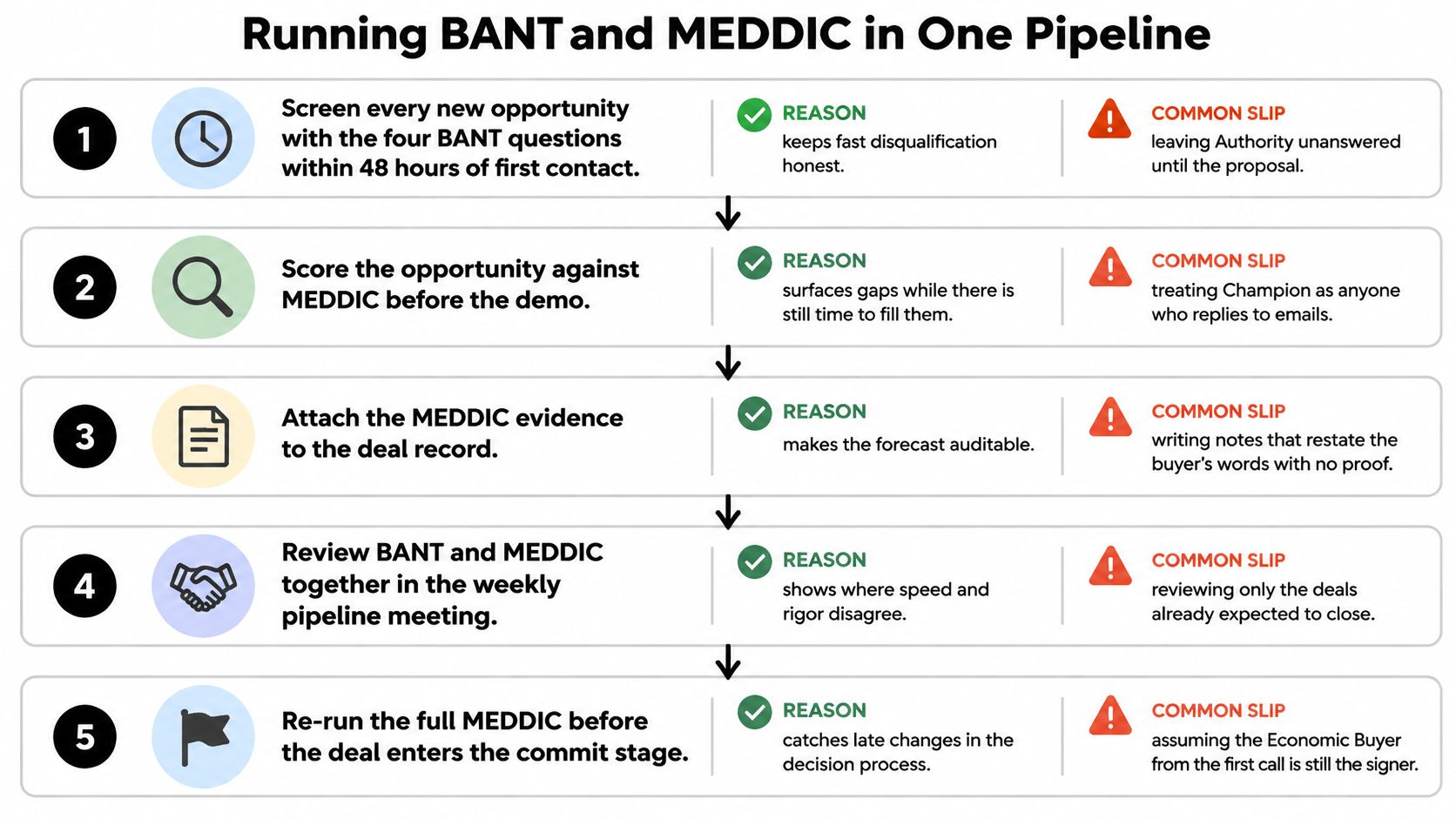
Set the gates and preserve the evidence
-
Screen new opportunities within 48 hours of first contact. Use the BANT questions and record unanswered items explicitly. The reason is speed with accountability; the common slip is scoring enthusiasm instead of obtaining answers.
-
Promote confirmed opportunities into MEDDIC discovery. Confirm budget, authority, need, and timing before assigning deeper qualification work, then scale that work to the deal's complexity. Promotion should create discovery tasks, not imply that the opportunity is already forecast-ready. A champion's excitement alone should not trigger advancement.
-
Map the buying group by function. Mark required roles as engaged, identified but unengaged, or unknown. This prevents an executive name from standing in for actual coverage and gives the opportunity owner a concrete introduction plan.
-
Require buyer-verified evidence before forecast inclusion. Attach confirmation notes, agreed criteria, approval milestones, and relevant buyer correspondence to the deal record. Managers should inspect what supports each field rather than accept seller-entered assumptions. Active pipeline and committed forecast should remain distinct.
The control-cohort design from the performance discussion gives the test structure. This operating layer gives it daily discipline. Put the rules inside sales pipeline management, where stage owners can see what evidence permits advancement and what happens when evidence changes. Enablement materials can explain the framework, but the pipeline is where behavior gets checked.
Test the policy and remove unused work
-
Review the configuration each quarter. Remove unused or unevidenced custom requirements, revise confusing fields, and adjust entry rules when they reject viable demand. If the team removes a core MEDDIC criterion, label the process as adapted rather than claiming full MEDDIC coverage. Keeping fields that nobody checks adds admin without improving qualification.
-
Assign ownership for every gate. The opportunity owner maintains the record, the manager checks advancement evidence, and functional reviewers confirm requirements in their area. Clear ownership makes missing evidence visible before the deal reaches a late-stage forecast conversation.
This week's starting actions are concrete: write the BANT entry rule, name the gate owners, and schedule the first review. That creates a testable operating process without requiring a company-wide methodology overhaul.
Sprints & Sneakers offers a free growth audit. For teams reassessing BANT vs MEDDIC, it's a practical starting point for examining where qualification fits the wider growth bottleneck. Visit Sprints & Sneakers to request the audit and discuss the next experiment toward a more predictable pipeline.
Related articles


ABM: One-to-one vs. one-to-many. Which approach is right for your business in 2026?
Are you going in-depth with 1-to-1 ABM or scaling up with 1-to-many? AI has changed the answer by 2026. With agentic workflows, contact-level intent data, and a personalized approach, the best strategy is a mix of these. Below you’ll find the complete guide to the right ABM approach.
Frequently asked questions
Growth marketing, AI and automation, SEO, performance marketing, retention strategies, and sustainable business practices.
Weekly. Subscribe to our newsletter to get new articles straight to your inbox.
Absolutely. Everything we publish is designed to be actionable. Take it, test it, and make it your own.
Yes. We publish experiments with real numbers. What worked, what didn't, and what we learned.
Our growth team — strategists, performance marketers, data specialists, and AI builders who work on client campaigns every day.
We're open to it. Reach out via our contact page with your topic and we'll take a look.