
SEO Content Strategy: A Framework for Full-Funnel Growth
Learn how to build an SEO content strategy in six steps: audit, keyword mapping, pillar pages, AI-assisted production and measurement that proves growth.
91% of respondents said SEO positively affected website performance and marketing goals in Conductor's 2025 State of SEO survey of more than 350 digital marketing, SEO and content marketing professionals, according to Conductor. That's a broader definition of success than ranking for a keyword. A useful SEO content strategy connects the questions buyers ask with the pages that help them evaluate, purchase and get value from a product.
The difficult decisions come when clicks fall. A content lead needs to distinguish a page that's losing relevance from one that still supports qualified sales conversations. That requires a plan for content, navigation and commercial measurement, not just a publishing schedule.
Table of Contents
- Why Organic Search Still Anchors Your Growth
- Audit Your Existing Content Before You Write Anything
- Map Keywords to Every Stage of the Funnel
- Build Pillar Pages and Topic Clusters That Link Up
- Produce Content with AI Without Losing Quality
- Measure Content by the Revenue It Influences
- Confirm Your Strategy and Book a Free SEO Session
Why Organic Search Still Anchors Your Growth
In its historical analysis, BrightEdge found that organic search generated 53% of trackable website traffic in 2019, up from 51% in 2014, that organic and paid search together accounted for 68%, that combined organic and paid search averaged 76% of B2B website traffic, and that B2B companies generated twice as much revenue from organic search as from any other individual channel.
An SEO content strategy turns that demand into a plan: which topics a business publishes, for which searcher, in what order, and how each page connects to revenue. It works like a well-run library: every book answers a real reader question, and the catalogue points people toward the next useful resource. A random shelf can hold excellent writing and still leave readers stuck.
A SaaS company selling invoicing software faces that choice early. Disconnected articles about productivity can attract readers; a connected collection about overdue payments, invoice automation and software evaluation serves potential customers more directly.
What the business case does prove
Historical share figures establish search's importance; they do not forecast every business today. Start with customer intent, then verify contribution in the company's own reporting: assisted conversions, qualified leads, opportunities and revenue influenced. A strategy has to produce decisions, including which questions deserve pages, which pages come first, which assets to expand or retire, and how each page supports pipeline. The operating layers are:
- Audit: Establish what already exists and where it underperforms.
- Keyword mapping: Connect customer questions to appropriate pages.
- Cluster planning: Organize related resources into useful journeys.
- Measurement: Evaluate commercial contribution alongside search visibility.
Search planning can extend beyond conventional web results when the audience warrants it. For visually led consumer categories, Pin Generator's guide to build a Pinterest SEO strategy is a channel-specific resource for audiences that already search there.
Quick self-check: List the three questions buyers ask before purchasing. Then identify the page that gives a convincing answer to each.
A missing answer gives the next sprint a sharper target than another broad keyword with attractive volume.
Audit Your Existing Content Before You Write Anything
-
Build the URL inventory. Export indexed URLs, then join page titles with organic impressions and clicks from Search Console and conversions from the analytics system. Use a consistent reporting period and separate branded demand from non-branded discovery where possible. Existing pages reveal which subjects already attract attention and which assets deserve investigation.
-
Group URLs by template, such as product pages, comparisons, documentation and editorial articles. Add the intended audience, funnel role and commercial destination. A template-level problem can affect an entire content collection, so reviewing articles individually isn't enough.
-
Check the promise in each title. Flag duplicates, vague wording and titles unrelated to the actual page. Google's SEO Starter Guide recommends unique, clear, concise and accurate titles. For example, B2B SaaS Churn Analysis and Retention Workflow gives a clearer expectation than Retention Tips, provided the page delivers that workflow.
-
Prioritize templates with high impressions and failed Core Web Vitals. Optimize hero images, critical CSS, server response and font loading for LCP; reduce JavaScript execution and third-party scripts for INP; reserve dimensions for images, embeds and dynamic modules for CLS. The following field-measured thresholds come from Google's Core Web Vitals guidance.
Core Web Vitals thresholds for content pages
| Metric | Good threshold | What it affects on a content page |
|---|---|---|
| Largest Contentful Paint (LCP) | 2.5 seconds or less | How quickly the primary answer appears |
| Interaction to Next Paint (INP) | Below 200 milliseconds | Whether calculators, filters and lead forms respond |
| Cumulative Layout Shift (CLS) | Below 0.1 | Whether text and buttons move and cause misclicks |
- Assign an action. Keep useful pages, update incomplete ones, merge overlapping resources and retire pages without a defensible purpose. Before removing anything, check backlinks, customer use and sales relevance. Low traffic alone isn't a retirement criterion.
Turn findings into owned work
Compare engaged sessions, form starts, demo completions and revenue per landing-page visit after template releases. Good page experience doesn't guarantee strong rankings, and a faster page still needs a useful answer.
For a wider assessment, CitationOS's guide to evaluating your firm's digital marketing provides context beyond the content inventory. A separate competitor analysis for marketing can help distinguish missing buyer information from topics competitors merely publish frequently.
During intake and analysis, Sprints & Sneakers reviews the client's current content and looks for opportunities to grow visibility in AI search results. The finished audit should be equally actionable: a sheet with a row per URL, an action per row, and named owners for the first ten updates.
Map Keywords to Every Stage of the Funnel
Say a B2B invoicing software company exports 400 queries and groups them into 35 clusters. Those are hypothetical working numbers, not a benchmark. The useful work is deciding which queries share a reader's task and therefore belong on the same target page.
The funnel view makes those assignments easier to inspect.
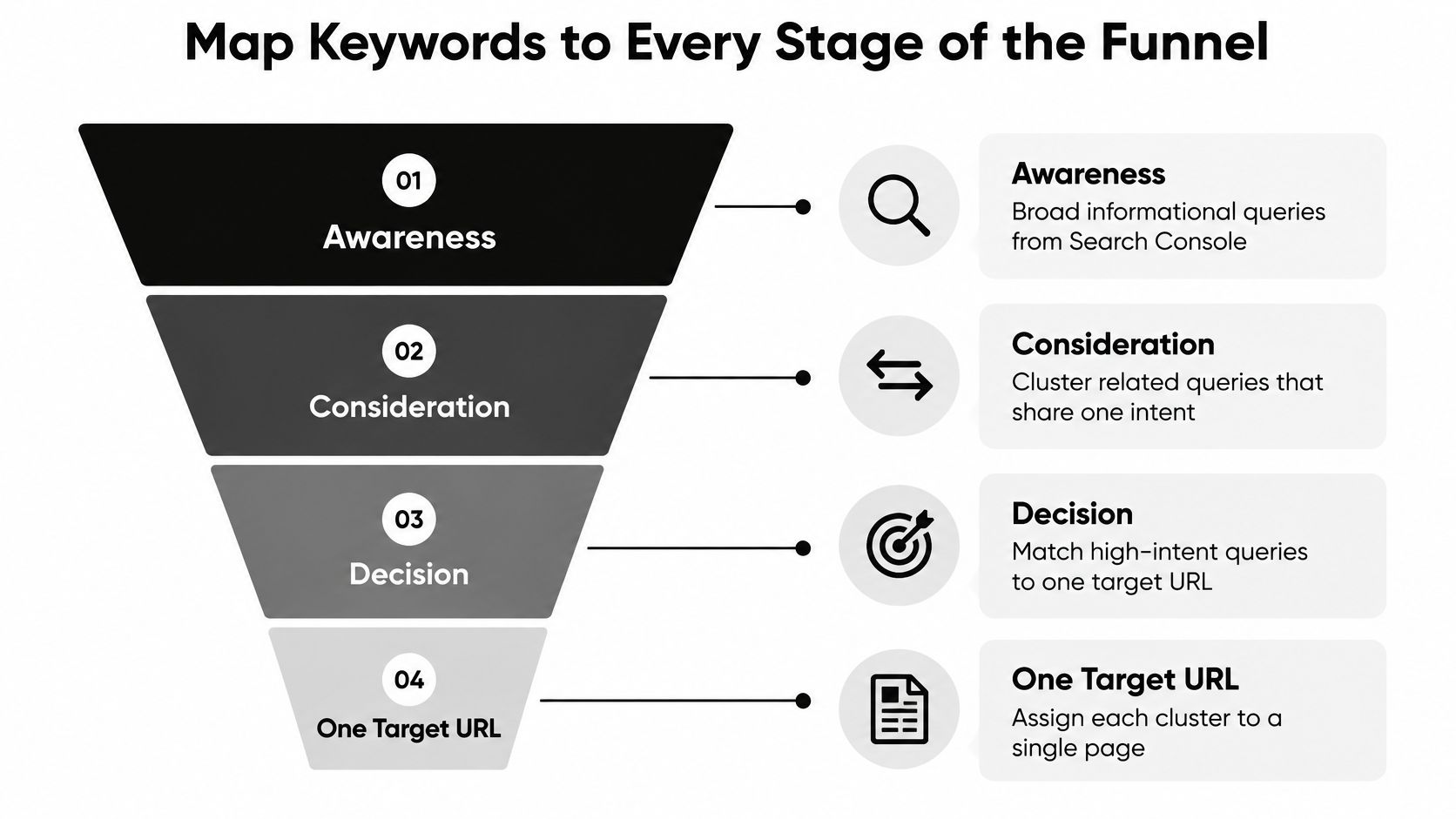
Funnel stages, searcher questions and matching content
| Funnel stage | Typical searcher question | Content format | Success signal |
|---|---|---|---|
| Awareness | What is a payment reminder? | Guides and explainers | Impressions and engaged sessions |
| Consideration | Invoicing software vs spreadsheets | Comparisons and use-case pages | Form starts and assisted conversions |
| Decision | Invoicing software pricing or alternatives | Product and proof pages | Demo requests and purchase rate |
| Retention | How to set up recurring invoices | Help docs and onboarding guides | Activation and expansion revenue |
A payment-reminder definition needs an accessible guide, not a product pitch disguised as education. A software-versus-spreadsheets query needs an honest comparison of workload, limitations and switching costs. Pricing queries need commercial clarity, while recurring-invoice setup queries need instructions that customers can follow.
Choose impact over writing convenience
Start with Search Console queries, group related questions by intent, and assign a primary target URL to each cluster. Check the existing results before choosing a format. Similar vocabulary doesn't necessarily mean identical intent: invoice templates and invoice automation may require different resources.
At Sprints & Sneakers, a strategist chooses the keywords and pages with the biggest effect on traffic and revenue rather than working on everything at once. A useful prioritization sheet records commercial relevance, existing visibility, missing proof and production effort.
An easy article isn't automatically the right next investment. A comparison page that addresses a recurring sales objection may deserve attention before a broader explainer, even when the explainer is simpler to produce.
This video offers an additional reference for keyword planning.
<iframe width="100%" style="aspect-ratio: 16 / 9;" src="https://www.youtube.com/embed/xDofKvgAHfM" frameborder="0" allow="autoplay; encrypted-media" allowfullscreen></iframe>Retention belongs in the map, too. A lifecycle marketing strategy helps connect acquisition content with activation and ongoing customer value, rather than ending the journey at a completed form.
A cluster isn't finished until the team can name the next useful page the reader should visit.
That next step might be a calculator, implementation guide or product demonstration. It shouldn't always be a sales call.
Build Pillar Pages and Topic Clusters That Link Up
An outdoor-gear retailer could build a Running Shoe Buying Guide supported by focused articles about trail versus road shoes, choosing shoe width and running shoe lifespan. The pillar helps readers make the broad buying decision. Each cluster page resolves a narrower question without forcing the reader through the entire guide.
As an illustrative editorial scope, the retailer might plan a pillar of around 2,500 words. That isn't a ranking requirement or a reason to add filler. Coverage should follow the decisions the buyer needs to make.
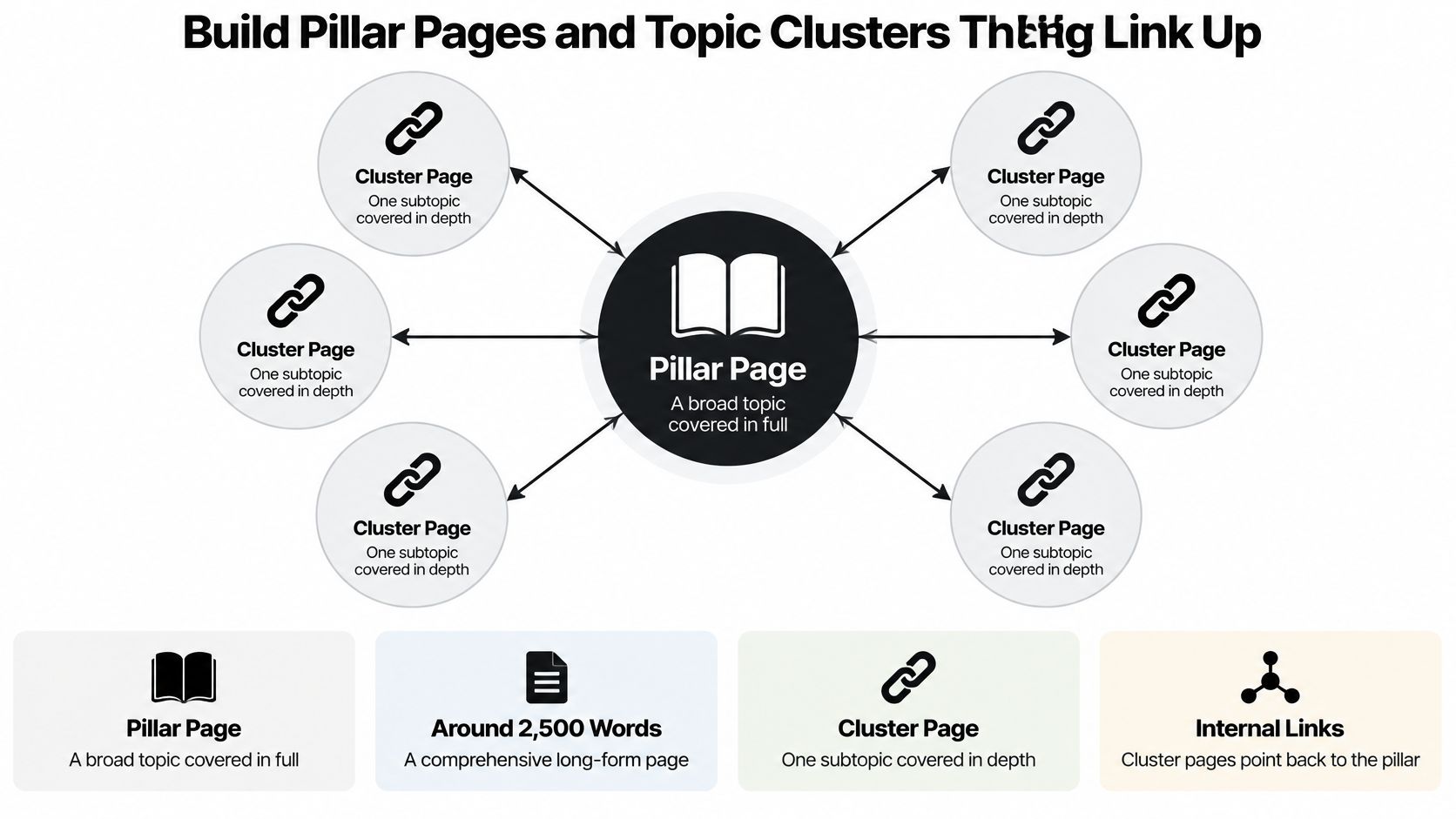
Connect pages around the reader's task
Google's link guidance says every important page should receive a link from at least one other page on the same site. Context matters: a useful link explains why the related resource belongs at that point in the reader's journey.
A shoe-width article can link back to the buying guide and across to trail-running fit advice. Descriptive anchor text such as trail running shoe fit sets a clearer expectation than a generic instruction to click.
A practical publishing check looks like this:
- Find an inbound route. Identify an existing page where the new article answers a natural follow-up question.
- Add next-step links. Include contextual routes to relevant supporting guidance or a commercial destination.
- Inspect the destination. Confirm that the linked page works and delivers what the anchor promises.
- Remove decorative links. A link added only to satisfy a quota doesn't improve the reader's decision.
Topic selection can also draw on audience conversations. When an industry expert shares useful observations publicly, SuperX's guide to find a user's best tweets offers a way to locate discussion themes worth investigating. Those themes still need validation against customer questions before becoming cluster pages.
A content distribution strategy can give a connected collection an initial audience through relevant existing channels. Distribution doesn't replace internal linking, and internal linking doesn't replace useful content.
A cluster with no inbound links is a page the business has published but hasn't connected. Fixing that gap belongs on the publishing checklist, not in a future cleanup project.
Produce Content with AI Without Losing Quality
AI can handle keyword clustering, competitor-page scanning, content briefs and first drafts. A senior strategist still owns the two decisions a draft cannot make: which pages deserve investment, and whether the published claims are accurate.
At Sprints & Sneakers, a senior strategist decides which pages and topics come first based on their effect on leads and revenue, and every piece is read by a human before it goes live.

Review added value, not just grammar
Google's spam policy defines scaled content abuse by purpose and value, regardless of whether a human or AI produced the pages. Its examples include mass production with generative AI, scraped content, automated synonymizing and stitched-together pages when they're created primarily to manipulate rankings without sufficient user value.
A hypothetical batch of 100 lightly rewritten keyword pages could pass every grammar check and still contribute nothing beyond existing answers. Replacing synonyms and varying introductions doesn't create distinct expertise.
The safeguard belongs in the editorial workflow:
- Require a distinct brief. Identify the reader, the question, the intended action and the reason the page deserves to exist, including which step toward a purchase it supports. If another page already does the job, improve that page instead.
- Add an original contribution. Each page needs something only your team can supply, such as internal performance data, a tested process or an expert interpretation. A comparison should explain meaningful trade-offs rather than repeat feature labels.
- Check facts and examples. A human reviewer should verify claims against source material and distinguish tested results from hypothetical scenarios.
- Cut what doesn't help. Delete sections that fail to help the reader decide or complete a task. Generic introductions and repeated conclusions are common places to start.
Google's people-first content guidance asks publishers to serve an identifiable audience, demonstrate experience and help readers accomplish their goals. For a churn article, a documented onboarding experiment is more useful than another unspecific recommendation to improve customer experience.
An ethical AI content creation workflow makes those checks routine instead of leaving them to the reviewer's memory. Keep an evidence field on every brief, record unresolved questions, and hold publication while important claims remain unverified.
Editorial test: Would the page still deserve publication if no search engine existed?
A clear yes usually rests on something concrete: an answer, a working method, a useful comparison or evidence the audience couldn't get from a generic summary.
Measure Content by the Revenue It Influences
Clicks are getting harder to earn. Pew Research's browsing study found that users clicked a traditional organic result far less often when an AI Overview appeared on the page, and Google's guidance on succeeding in AI search reports that visits arriving from AI Overviews tend to be higher quality, recommending that publishers measure conversions, signups and engagement rather than raw traffic. The practical consequence: a page can lose clicks while doing more commercial work, so traffic alone cannot decide what stays and what goes.
Informational pages can contribute before a measurable visit, while pricing pages and proof assets capture the eventual conversion. The way to test that contribution is to record it. Log which pages appear in a buyer's path before a demo request, and which assets buyers name on sales calls.
Build a contribution view
A content measurement sheet should distinguish visibility, engagement and commercial evidence:
- Impression visibility and AI citations: Record whether relevant answers appear and whether the brand receives attribution.
- Engaged sessions: Check whether visitors use the resource rather than treating every landing as equal.
- Assisted revenue and demo influence: Connect recorded content interactions with qualified opportunities and sales conversations.
- Retention: Track whether customer-facing resources support activation, continued use or expansion.
Connect page identifiers and campaign fields to CRM records where consent and measurement capabilities allow. Ask sales teams to record content mentioned during evaluation, and treat a documented interaction differently from an assumed influence. A practical marketing attribution approach keeps those limits visible, so nobody reads a correlated touchpoint as a closed deal.
Content decisions from traffic and influence signals
| Signal pattern | Likely meaning | Action |
|---|---|---|
| High traffic, low conversion | The page answers the query but the next step is unclear | Update the call to action and add proof |
| Low traffic, high influenced pipeline | The page works before the click | Keep it and track assisted conversions |
| Low traffic, no influence for two quarters | The page does not serve a buyer question | Merge into a stronger page or retire it |
Treat the final row as a proposed review rule, applied after checking the basics: confirm that tracking works, that the sales cycle fits the observation window and that the resource isn't important to existing customers. Review cadence matters here too. Sprints & Sneakers clients see these signals live, including what works, what doesn't and where the biggest opportunities sit, so a fading page surfaces months earlier than it would in a quarterly report.
Separate influence from causation
Use incrementality tests where practical. Compare similar page groups, document release dates and avoid changing content, navigation and conversion offers simultaneously when the aim is to isolate an effect. Attribution describes observed paths; it doesn't prove that the content caused the deal.
Expand pages when qualified demand, repeated buyer questions and missing supporting material point in the same direction. Keep commercially useful resources even when their audience is narrow.
Say a comparison page for a niche product category loses half its clicks over two quarters, yet salespeople cite it in three calls a month. That page stays in the plan. The next task is to record what buyers found useful and whether those conversations progress to qualified pipeline, so the keep decision rests on evidence instead of instinct.
Confirm Your Strategy and Book a Free SEO Session
A workable strategy should produce decisions during the coming week, not another presentation waiting for approval. A manageable starting scope is a small audit, a connected topic plan and a measurement sheet the team can maintain.
Set a practical first-week scope
The following quantities are suggested work limits, not performance benchmarks:
- Audit the top 50 URLs. Choose them by a mixture of organic visibility and commercial importance. Assign keep, update, merge or retire, and record the evidence behind each decision.
- Map the top 100 queries to funnel stages, then choose a hypothetical starting collection of one pillar and five cluster pages. Confirm that each proposed page resolves a distinct question before commissioning drafts.
- Create the measurement sheet. Give every new page a funnel role, intended next action, conversion event and place to record assisted conversions.
Use the week to expose where execution is blocked: an underperforming template, missing decision-stage evidence, unclear ownership or incomplete conversion tracking. Choose one template fix from those findings. Review the sheet monthly and keep a change log so the team can separate a content release from a tracking change or seasonal shift.
Prepare evidence before seeking help
An outside review becomes more useful when the team brings working material rather than a broad request for more traffic.
Prepare the following before the session:
- Priority URLs: Bring the top-page inventory with proposed actions and unresolved questions.
- Pipeline context: Include the CRM pipeline split by content source, clearly marking unknown attribution.
- Page-speed report: Show the affected templates and the technical issues already identified.
If the review leads to onboarding, have the website connection, analytics access and growth goals ready so setup does not stall while people chase permissions.
The immediate priority remains a useful release. Select the existing page with a clear buyer need, enough supporting evidence and a fix the team can complete this week. If traffic has fallen, decide whether to keep, expand or retire it using influenced pipeline and repeated buyer questions rather than clicks alone. Ship the improvement, record the release date and measure the result.
Bring that URL inventory, funnel map and pipeline questions to a free SEO session with Sprints & Sneakers and leave with the next page to improve plus the conversion signal that will judge its contribution.
Related articles


Frequently asked questions
Growth marketing, AI and automation, SEO, performance marketing, retention strategies, and sustainable business practices.
Weekly. Subscribe to our newsletter to get new articles straight to your inbox.
Absolutely. Everything we publish is designed to be actionable. Take it, test it, and make it your own.
Yes. We publish experiments with real numbers. What worked, what didn't, and what we learned.
Our growth team — strategists, performance marketers, data specialists, and AI builders who work on client campaigns every day.
We're open to it. Reach out via our contact page with your topic and we'll take a look.