
Build a lifecycle marketing strategy across awareness, acquisition, activation, revenue, retention, and referral with stage tactics, KPIs, and AI optimization
More automation isn't a lifecycle marketing strategy. It's often a faster way to send the wrong message to the wrong customer.
The highest-impact work happens before another email, SMS, push notification, or nurture branch gets added. Teams need synchronized data, clear ownership of each stage, and journeys tied to outcomes. Once those foundations work, fewer messages can create more useful customer interactions, protect attention, and improve the economics of every cohort.
Lifecycle programs usually fail before the creative brief exists. A team sees a drop in activation or repeat purchase, adds another sequence, and calls the result a strategy. The customer experiences something else, a stream of disconnected messages with no shared understanding of what happened before.
The deeper problem is structural. In a 2025 lifecycle marketing challenges survey, more than half of marketers said their biggest blocker was that data and integrations were out of sync across systems. That finding points to the first question: can the business trust the event, identity, consent, and stage data well enough to trigger the next action?

Fragmented customer data leaves marketing, sales, service, and product teams with different versions of the same customer. A purchase may not suppress a promotion. A qualified lead may continue receiving beginner content. A canceled subscription may still sit inside a renewal nurture.
Unclear stage ownership creates silent handoff failures. Marketing owns acquisition, product owns activation, customer success owns retention, and nobody owns the transition between them. Every team optimizes its own output while the customer moves through a broken experience.
Shallow journey maps describe stages as labels rather than decisions. “Onboarding” is not a journey until the team defines the trigger, intended behavior, message, fallback, exit condition, and accountable owner.
Practical rule: If a journey can't answer who owns the next customer action, which event proves progress, and which message gets suppressed after success, it isn't ready for automation.
A useful marketing operations framework helps teams connect process, systems, data, and accountability before they scale campaign volume. The rest of the program should follow that discipline: define the stages, choose the metrics, repair the operating layer, then add carefully timed interventions. Two practical scenarios, one B2B and one B2C, show how the same framework changes with the business model. An AI layer can then optimize timing, channel, and suppression, not just generate more copy.
A lifecycle marketing strategy is a coordinated set of programs, content, and triggers that moves a known audience from first contact toward purchase, continued value, and advocacy. Each stage has a relationship goal, a customer signal, an accountable team, and a measurable outcome.
That definition separates lifecycle work from a campaign calendar. A campaign asks what the company wants to promote this week. Lifecycle planning asks what the customer has done, what the customer needs next, and what business outcome should follow. One is schedule-led. The other is signal-led.
The clearest analogy is a relay race. Each team member runs a distinct leg, but the result depends on a clean handoff. Awareness earns attention. Acquisition converts interest into a known relationship. Activation helps the customer reach value. Revenue turns that value into a commercial event. Retention protects the relationship. Referral gives satisfied customers a reason to bring in another customer.
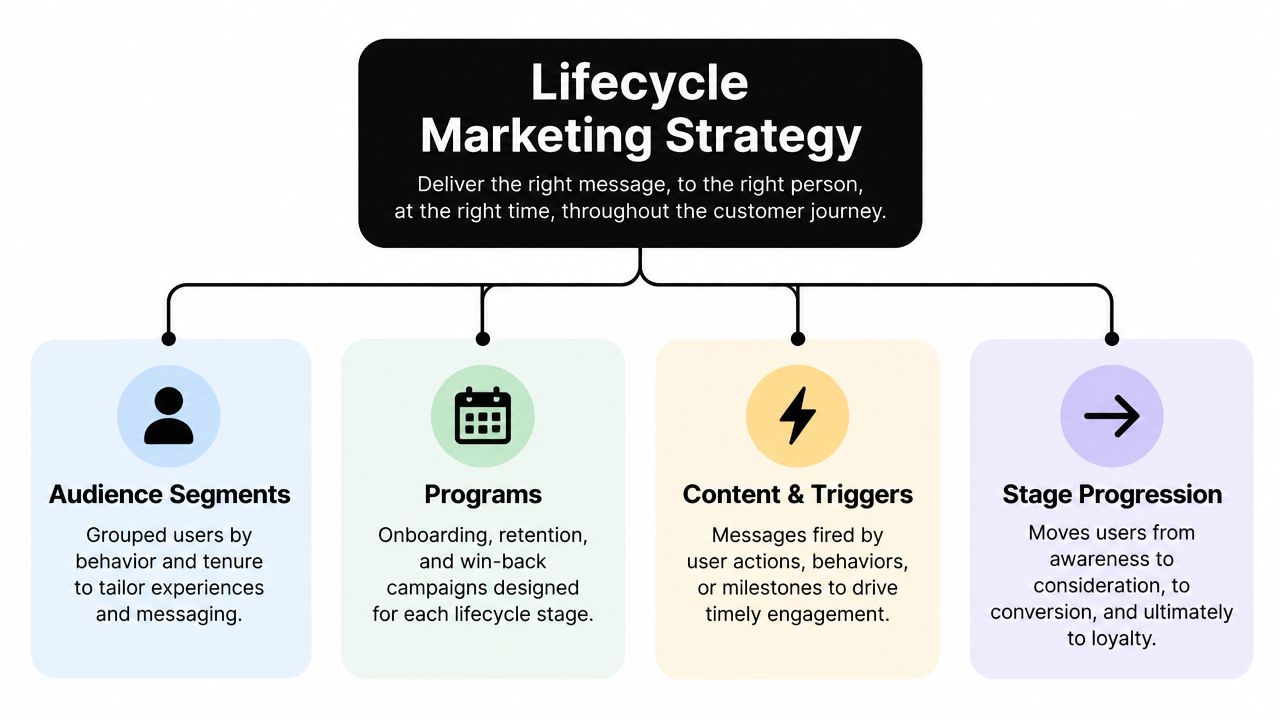
Each stage needs a small number of metrics, not a dashboard full of activity counts. A lifecycle marketing strategy should define the relationship goal for every stage and tie it to an outcome such as engagement, conversion, repeat purchase, renewal, retention, or advocacy. It should also coordinate channels and set suppression rules, so email, SMS, mobile, and web don't compete for the same attention.
For smaller teams, email lifecycle marketing for SMBs offers a useful lens for turning broad customer stages into practical email programs. The important principle is portability. The same stage logic can guide a small email operation, a complex SaaS journey, or a cross-channel commerce program, provided the business knows what progress looks like.
A stage is healthy when its metric changes the next decision. If a number only decorates a report, it doesn't belong in the core lifecycle dashboard.
| Stage | Relationship Goal | Primary Tactic | Channel Mix | Core KPI |
|---|---|---|---|---|
| Awareness | Earn relevant attention | Problem-led education and intent capture | Search, content, social, landing pages | Qualified engagement |
| Acquisition | Create a known relationship | Clear conversion path with useful permission exchange | Landing page, form, sales touchpoint, email | Conversion rate |
| Activation | Reach first meaningful value | Guided onboarding built around one key action | Product or web experience, email, in-app support | Activation rate and time to value |
| Revenue | Convert realized value into commercial action | Offer, expansion path, sales motion, or purchase prompt | Product, email, sales, checkout, SMS where appropriate | Cohort conversion |
| Retention | Sustain useful behavior | Adoption, replenishment, renewal, or risk intervention | Product, service, email, SMS, success outreach | Retention or repeat rate |
| Referral | Encourage advocacy at the right moment | Referral ask after a positive milestone | In-product prompt, email, community, customer success | Referred cohort value |
Awareness shouldn't be measured by reach alone. The team needs evidence that the audience recognizes a relevant problem and moves toward a next step. Content, search, paid media, and landing pages should share one promise, then pass the resulting intent signal into the acquisition system.
Acquisition is the point where anonymous interest becomes usable permission. Forms, trial starts, account creation, or first purchases should write clean identity data and source information into the customer record. If that handoff fails, later segmentation becomes guesswork. The audience segmentation explained resource is useful for teams deciding whether to segment by behavior, tenure, needs, or account context.
Activation needs one meaningful behavior, not a checklist of every possible feature. A SaaS business might define value as completing a core workflow. A retailer might define it as a first purchase followed by product use or a replenishment signal. The team should measure activation rate and time to value, then inspect where users stall.
Revenue follows value, but the trigger differs by model. A sales-assisted account may need an expansion conversation after adoption grows. A commerce customer may need a relevant second purchase path. Cohort conversion shows whether customers who reach the intended milestone progress commercially.
Retention programs should react to declining behavior before a customer becomes inactive. Track retention or repeat rate by cohort, tenure, product usage, and acquisition source. Teams can use the customer retention metrics framework to keep the review focused on action rather than vanity engagement.
Referral belongs after evidence of value, not immediately after signup. A positive usage milestone, successful outcome, or satisfying unboxing creates a better context for the ask. The stage-metric rule is simple: activation rate and time to value diagnose onboarding, retention or repeat rate diagnose habit, and cohort conversion or stalled-step analysis diagnose friction inside the journey.
A journey builder can make a broken program look finished. The operational backbone determines whether the program behaves correctly after launch.
Start with segments that explain behavior. Combine lifecycle stage with tenure, product usage, purchase history, renewal status, risk signals, and consent. Avoid segments that exist only because a field is available. “Customers with a profile” is rarely useful. “New accounts that completed setup but haven't used the core workflow” can support a precise intervention.
A workable journey map answers six questions:
The minimum viable stack needs a dependable customer data source, a journey builder, the required messaging channels, an experimentation layer, and an analytics layer. The architecture matters less than the handoffs between those categories. Customer identity must resolve consistently, events must arrive with usable context, and each system must expose the fields needed for decisions.
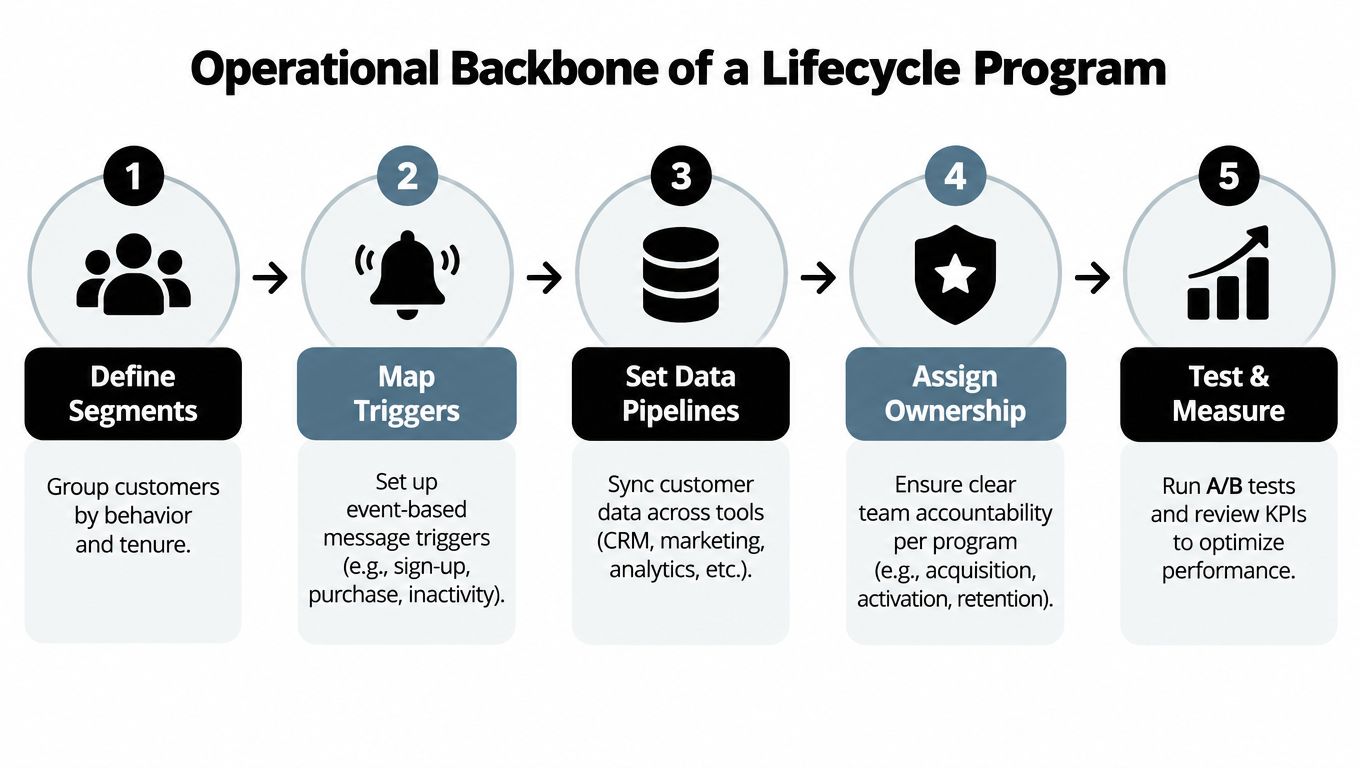
Suppression rules protect the customer from contradictory communication. A purchase should pause acquisition offers. A support escalation should pause promotional pressure. A renewal decision should remove a customer from generic education. A sales-qualified account should stop receiving content that assumes the buying problem is still undefined.
Data synchronization deserves its own workstream. Teams should test event freshness, identity matching, missing properties, consent propagation, and failure alerts. They should also assign an owner for each pipeline and document what happens when a key event doesn't arrive.
A program isn't operational because it works in a test record. It's operational when real customer events produce the right handoff, suppression, and measurement without manual rescue.
Marketing automation and CRM integration needs the same attention. This integration guide is relevant when lifecycle stage, routing, qualification, and nurture pausing must stay aligned across systems.
<iframe width="100%" style="aspect-ratio: 16 / 9;" src="https://www.youtube.com/embed/u6B744B5apo" frameborder="0" allow="autoplay; encrypted-media" allowfullscreen></iframe>The stages stay consistent, but the event that proves progress changes sharply between B2B SaaS and B2C commerce.
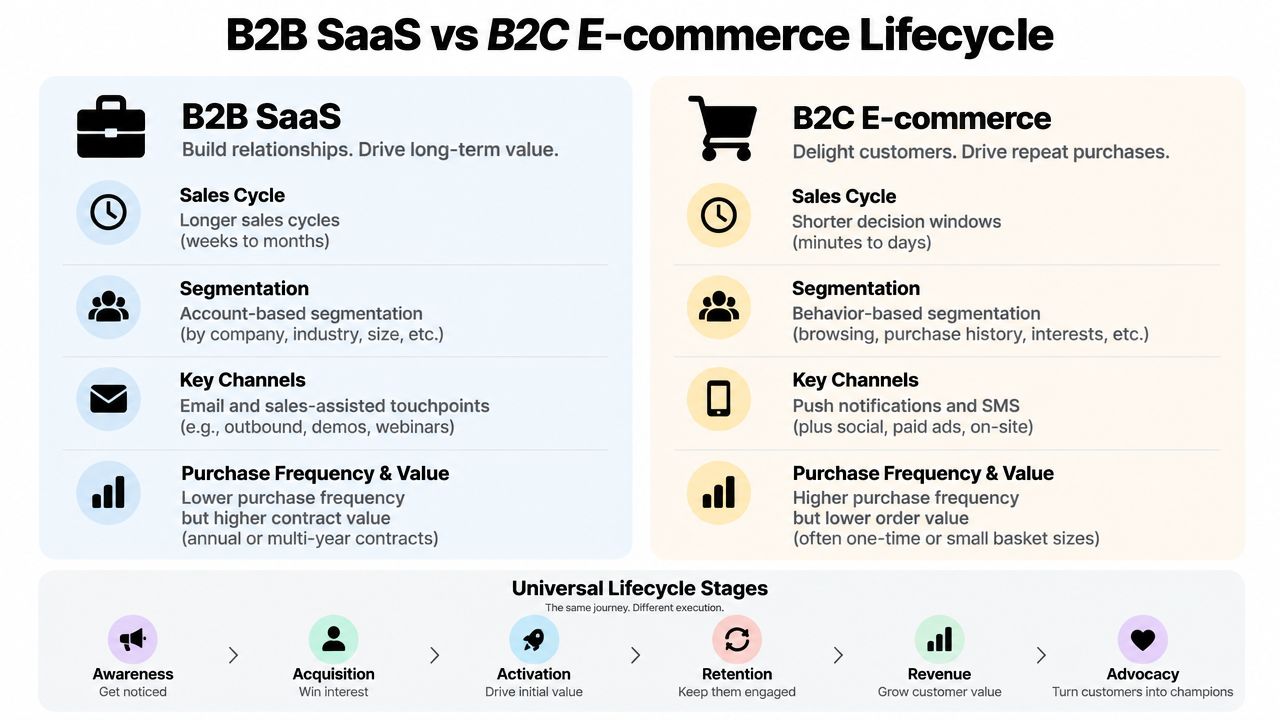
A SaaS scale-up with a free trial should resist the temptation to measure onboarding by email engagement. The useful question is whether an account reaches the product behavior that predicts practical value.
The lifecycle might begin with acquisition content tied to a defined use case. After signup, activation focuses on setup, inviting the right users, and completing a core workflow. Product events can trigger contextual help, while sales receives a signal when account behavior suggests commercial readiness. Revenue then includes conversion and expansion, with retention programs segmented by tenure, usage depth, support history, and renewal risk.
A stalled account shouldn't receive the same message as a growing account. The former needs friction removal or human help. The latter may need an expansion path. Ownership must sit across marketing, product, sales, and customer success, with one shared definition of activation.
A direct-to-consumer subscription box has a different rhythm. Acquisition may depend on product discovery and a clear first-order promise. Activation happens through a successful first delivery, a useful onboarding experience, and an unboxing moment that makes the subscription feel worth keeping.
Retention focuses on the second-purchase or save decision. Customers showing delivery dissatisfaction need service recovery, not another promotion. Customers engaging positively with the product can receive replenishment guidance, curated recommendations, or a referral prompt tied to the unboxing experience.
Referral economics deserve separate measurement. A six-year study found referred customers delivered 16% higher average lifetime value than non-referred customers with similar demographics and acquisition timing. (The Wharton study on referral programs supports tracking referred and non-referred cohorts separately.)
The universal framework is the stage. The model-specific decision is the proof that a customer is ready to move forward.
AI shouldn't become a copy factory for a weak lifecycle program. Its strongest use is deciding whether to send, when to send, through which channel, and what outcome to pursue.
That matters because lifecycle budgets are shifting from acquisition-only spending toward full-funnel investment, with retention and expansion treated as important growth levers in tougher conditions. Coverage of lifecycle marketing trends for 2026 also identifies over-automation and frequency fatigue as major failure points.
Churn propensity with a save path: Build a model from declining usage, reduced purchase frequency, support friction, or renewal behavior. Don't trigger a generic win-back for every high-risk customer. Route each risk pattern to the smallest useful intervention, such as product help, service recovery, a plan adjustment, or a human conversation.
Milestone-based referral timing: Detect the activation event that proves the customer has experienced value. Trigger the referral ask only after that milestone, and suppress it when satisfaction signals are weak or a service issue remains open.
Revenue-per-message guardrails: Measure incremental commercial value against message exposure by cohort and channel. Set frequency caps, then let the system choose not to send when another message is unlikely to change behavior. The objective is not more delivered messages. It's more useful outcomes per customer contact.
Teams adopting AI should give it clean inputs, explicit goals, and hard constraints. A model can't repair an identity graph that merges unrelated people or an event stream that arrives too late. AI should reduce volume where volume harms attention, then concentrate effort on moments where timing can change the result.
A practical guide to scaling marketing with AI for business growth can help teams frame AI around prioritization and experimentation instead of novelty.
A strong rollout starts with foundations, not a grand launch. The team should release a small number of complete journeys, observe the handoffs, and expand only when the data supports the next investment.
Define the six stages, entry and exit rules, owners, key events, and consent requirements. Audit identity resolution and event freshness across the customer data source, CRM, product, commerce, and messaging systems. The output should be a stage and data contract that every participating team can approve.
The warning signs are straightforward: duplicate profiles, missing conversion events, conflicting lifecycle fields, or no accountable owner. If those appear, pause new automation. A polished message cannot compensate for an unreliable trigger.
Ship Acquisition and Activation end to end. Keep the activation journey narrow, with one intended behavior, one clear value explanation, and a defined exit event. Test the journey logic and suppression behavior before expanding the channel mix.
The output is a working activation report that connects entry cohort, activation rate, time to value, stalled step, and downstream commercial behavior. The team should review it in a recurring growth meeting, with product, sales, customer success, and marketing represented where the journey crosses functions.
Add Retention using the strongest available behavior signals. Segment by tenure and risk, then create distinct paths for healthy customers, drifting customers, and customers blocked by service or product friction. Measure retention or repeat rate by cohort instead of relying on aggregate engagement.
The output is a retention intervention map. It should show which signal creates an action, which owner responds, and which outcome determines whether the intervention stays, changes, or stops.
Add Referral after the value milestone is reliable. Then introduce AI carefully, starting with ranking, send suppression, timing, or risk prioritization rather than full autonomous orchestration. The output should be a tested optimization with a clear control group and an agreed guardrail.
Customer lifetime value is the discounted sum of future contribution profit from a customer base, so lifecycle strategy should prioritize cohort retention, repeat purchase frequency, and margin-aware expansion rather than top-line repeat revenue alone. Even small retention improvements can materially increase enterprise value because future customer value compounds across periods. (Columbia Business School's customer valuation research provides the economic foundation.)
The two long-term signals matter most: a cohort retention curve that improves over time and rising CLV per cohort. Use marketing reporting dashboards to keep those measures visible, alongside stage-level diagnostics. If message volume rises while those curves stay flat, the program needs fewer sends and better diagnosis, not another automation branch.
Sprints & Sneakers helps B2B and B2C teams connect lifecycle stages, customer data, automation, experimentation, and reporting around measurable growth outcomes. Visit Sprints & Sneakers to identify the bottleneck limiting lifecycle performance and build a focused plan for improving acquisition, retention, and customer lifetime value.
Growth marketing, AI and automation, SEO, performance marketing, retention strategies, and sustainable business practices.
Weekly. Subscribe to our newsletter to get new articles straight to your inbox.
Absolutely. Everything we publish is designed to be actionable. Take it, test it, and make it your own.
Yes. We publish experiments with real numbers. What worked, what didn't, and what we learned.
Our growth team — strategists, performance marketers, data specialists, and AI builders who work on client campaigns every day.
We're open to it. Reach out via our contact page with your topic and we'll take a look.