
Execute a proven customer acquisition for startups playbook. Diagnose bottlenecks, run funnel experiments, and hit sustainable growth in 90 days.
A startup's first customer acquisition problem is usually not a lack of traffic. About 42% of startups fail because there's no market need, while 14% struggle with weak product-market fit, making early acquisition a validation problem before it becomes a marketing problem.
That reality challenges the most popular startup advice. Founders are often told to publish more content, launch paid campaigns, or “be everywhere,” but those tactics only accelerate whatever already exists. If the ideal customer profile is vague, the positioning sounds interchangeable, or the offer asks buyers to take a leap of faith, more traffic creates a larger pool of unqualified visitors.
Customer acquisition for startups works best as a disciplined sequence: diagnose the bottleneck, validate the offer, test a small number of channels, measure economic quality, and scale only what survives contact with real customers.
Before spending another dollar on advertising or commissioning another article, the team needs to answer one uncomfortable question: where exactly does the acquisition process break?
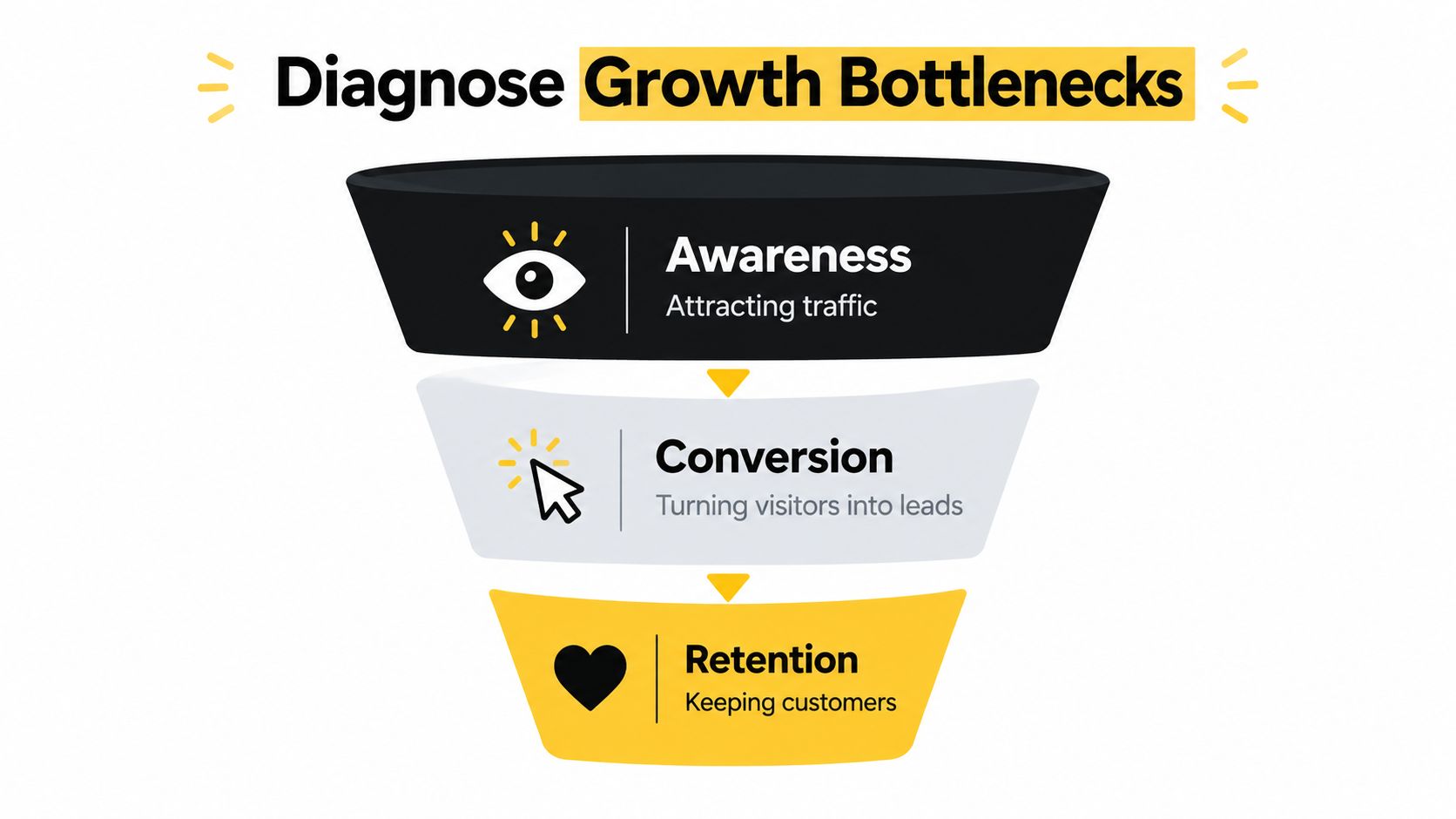
A startup can have an awareness problem, a conversion problem, or a retention problem. Those problems look similar in a dashboard because all of them eventually produce too few paying customers. The remedy is different in each case.
A company with low awareness needs access to the right audience. A company with weak conversion needs sharper positioning, stronger proof, or a simpler buying path. A company with poor retention has a product or onboarding problem that makes additional acquisition financially reckless.
The first audit should examine the ideal customer profile, or ICP. It should identify the buyer's role, company context, urgent problem, current workaround, buying trigger, and reason for rejecting alternatives. “Small businesses” or “growth teams” aren't useful ICPs unless the startup can explain which specific segment has the pain, authority, and budget to act.
Then compare the ICP with the language used across the homepage, sales deck, advertisements, and outreach. If the buyer describes a costly operational problem while the startup describes a list of features, positioning is probably the constraint. If prospects understand the offer but don't believe the outcome, the missing ingredient may be evidence, a clearer guarantee, or a lower-friction first step.
The failure data makes this diagnosis urgent. About 42% of startups fail primarily because of a lack of market need, 18% because of pricing issues, and 14% because of weak product-market fit, according to research on first startup sales. Those figures point to a commercial lesson: acquisition activity can't compensate for a product that the intended market doesn't value enough to buy.
Practical rule: If prospects can't repeat the problem the product solves in their own words, the team isn't ready to scale traffic.
A simple audit can separate an awareness issue from an offer issue:
A structured growth scan can help teams map this bottleneck across awareness, acquisition, activation, revenue, retention, and referral. For a more detailed B2B process, the B2B customer acquisition strategy resource offers a useful way to connect ICP definition with sales motion and channel selection.
The decision should be binary for the next sprint. If the offer fails to convert a qualified audience, fix the funnel. If the offer converts but the right audience isn't arriving, test distribution. If customers buy and quickly disengage, stop chasing volume and repair onboarding or product value first.
Channel selection becomes easier once the ICP and offer are specific. The question isn't which channel is fashionable. It's where the intended buyer already pays attention, searches for solutions, asks peers for advice, or accepts commercial outreach.
A B2B startup selling to a defined group of decision-makers may find direct outreach, expert partnerships, search content, or industry communities more useful than broad social advertising. An e-commerce brand may need a mix of creator distribution, paid discovery, search demand, lifecycle messaging, and conversion improvements. A product-led company needs channels that attract users who can reach the product's first meaningful outcome quickly.

A practical channel score can be built from four questions:
Each channel should earn a small experiment, not a large budget. A B2B team might test a focused outbound sequence aimed at one role, a landing page for one use case, and a partner introduction campaign. An e-commerce team might test one product angle across a narrow audience and compare completed purchases rather than clicks. An SEO-led team can publish content around a high-intent problem and add a clear conversion path instead of producing broad educational material without a commercial destination.
The b2b demand generation playbook can provide additional context for teams building a coordinated B2B demand motion. The Bullseye Framework for channel selection is also useful for narrowing a long list into a small set of channels worth testing.
A useful experiment has a named audience, a specific promise, one primary conversion event, and a clear stop condition. “Try LinkedIn” isn't an experiment. “Reach operations leaders in one industry with a message about reducing a defined workflow problem, then measure qualified replies and booked conversations” is.
Teams should track the complete path:
Cheap clicks can hide expensive failure downstream. A channel that produces fewer leads but more qualified activation may deserve priority over a channel that fills the CRM with people who never reach the product's value. Each test should end with one of three decisions: continue with a sharper version, pause because the evidence is weak, or stop because the channel doesn't fit the buyer.
Growth without economic discipline is only faster spending. A startup can report rising traffic, growing signups, and a busy sales pipeline while making every new customer less profitable than the last.
The essential metric is customer acquisition cost, or CAC. Teams calculate it by dividing total sales and marketing costs by the number of new customers acquired during the same period. The total should include media, salaries, commissions, software, creative production, sales support, onboarding effort, and other costs directly involved in winning customers. Omitting those costs creates a flattering but unreliable CAC.
A 2025 benchmark from First Page Sage's startup CAC report reported median CAC of $273 for SaaS B2B, $166 for SaaS B2C, $84 for eCommerce B2B, and $68 for eCommerce B2C. Higher-cost sectors such as higher education reached $1,424 B2B in the same benchmark.
These figures aren't universal targets. They show why blended company averages can mislead. A SaaS startup with a long sales cycle and high-touch implementation can't evaluate acquisition using the same expectations as a low-friction e-commerce purchase. Even within SaaS, customer size changes the economics. A mid-market contract may support a sales-assisted motion that would be irrational for a low-priced self-serve plan.
A second benchmark places SMB SaaS CAC around $200 to $700, mid-market CAC around $1,000 to $5,000, and enterprise CAC at $5,000 to $50,000 or more. Those ranges are reported by Prospeo's customer acquisition metrics reference, and they reinforce the need to segment CAC by ICP, channel, cohort, and sales motion rather than treating every customer as equivalent.
CAC only becomes useful beside lifetime value, gross margin, retention, expansion, and payback. A customer who costs more to acquire can still be attractive if the account stays longer, expands, pays quickly, and requires limited service. A low CAC can be destructive if the resulting customers churn, demand heavy support, or buy only at unsustainable discounts.
A common startup benchmark is an LTV:CAC ratio of at least 3:1, meaning customer value should be roughly three times acquisition cost, as described in HSBC Innovation Banking benchmark coverage. B2B SaaS teams often use stricter stage-based hurdles, with common expectations of 2:1 at seed, 3:1 at Series A, and 4:1 or higher at later stages, alongside payback windows typically under 12 months, according to Stackmatix's startup CAC guide.
The operating rule is straightforward: calculate CAC by channel and cohort, connect it to gross-margin-adjusted value, then increase volume only when the ratio and payback remain healthy. A useful customer acquisition cost framework helps teams identify whether the problem sits in targeting, conversion, pricing, retention, or cost control.
AI creates an advantage when it removes repetitive work from a sound acquisition process. It doesn't repair vague positioning, poor customer research, or a weak offer. Automating those problems only allows the team to produce irrelevant messages faster.
The most useful starting point is structured information. The team should capture customer segments, objections, buying triggers, successful messages, product usage signals, and sales outcomes in a shared system. AI can then help classify conversations, identify recurring language, draft audience-specific variations, summarize research, and flag leads that match the agreed ICP.
A practical workflow can connect five activities:
Human review remains necessary wherever context, reputation, or trust matters. AI-generated outreach should be edited for accuracy and relevance. Automated lead scoring should be checked against closed-won and closed-lost outcomes. Content should answer a real buyer question rather than fill a publishing schedule.
Recent startup data indicates that many founders use AI for product development, while teams that apply it to monetization and go-to-market systems can gain a distribution advantage because competitors still lag in automating acquisition workflows, as reported in Supabase's State of Startups. The opportunity isn't to replace the growth team. It's to let a small team research with greater depth, respond sooner, and test more focused variations.
A practical guide to scaling marketing with AI can help teams map automation to existing processes. Sprints & Sneakers is one example of a growth partner that combines data, creative, experimentation, and automation across the funnel.
A 90-day sprint should create evidence, not just activity. The right plan depends on maturity, available resources, and how clearly the startup understands its buyer.
For a pre-revenue startup, the sprint should prioritize validation. The first phase defines one ICP, conducts direct customer conversations, and tests a narrow offer. The middle phase uses manual outreach, founder-led selling, or small partnerships to observe objections and buying behavior. The final phase turns the strongest message into a repeatable landing page and sales process. Broad paid acquisition should wait until qualified buyers show consistent interest.
For an early-revenue startup, the sprint should prioritize conversion and channel evidence. The first phase reviews the funnel by source and cohort, then selects two plausible channels. The middle phase runs focused tests with different messages, audiences, or offers. The final phase documents the winning motion, improves activation, and removes activities that create volume without revenue quality.
For a funded startup with a working offer, the sprint should prioritize controlled scale. The first phase establishes channel-level CAC, activation, and payback baselines. The middle phase increases spend or capacity carefully while monitoring downstream conversion. The final phase expands the winning channel only if the economics hold at higher volume, while a second channel receives a smaller validation budget.
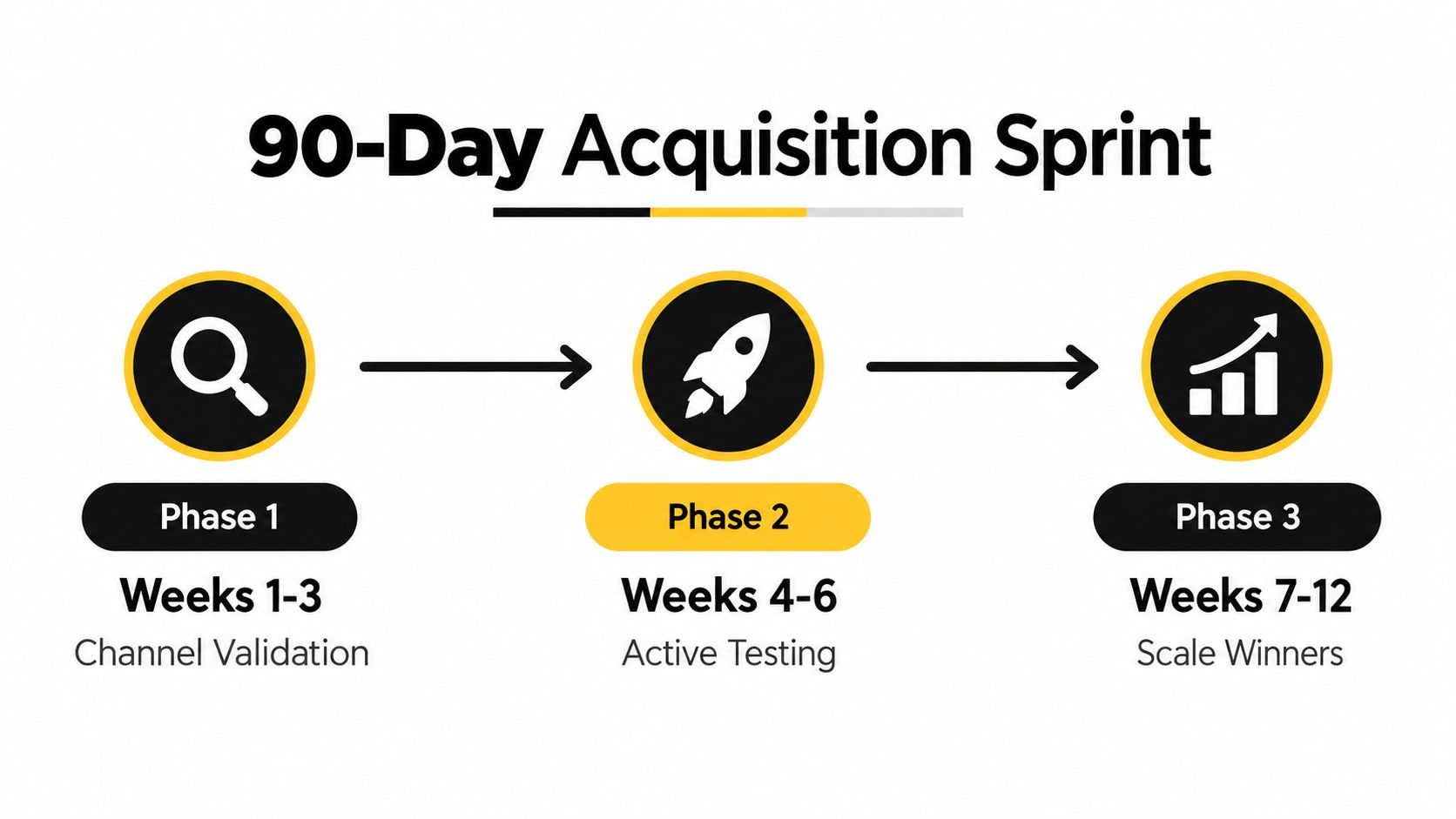
The timeline is simple: weeks 1 to 3 validate channels, weeks 4 to 6 test actively, and weeks 7 to 12 scale winners. Each phase should have one accountable owner, one primary outcome, and a written decision at the end.
A short explainer on marketing experiment examples can help teams turn broad ideas into testable actions.
The following video adds a practical visual guide to the sprint approach:
<iframe width="100%" style="aspect-ratio: 16 / 9;" src="https://www.youtube.com/embed/i_nlfhAVr3E" frameborder="0" allow="autoplay; encrypted-media" allowfullscreen></iframe>The sprint dashboard should show qualified demand, activation, new revenue, CAC by source, and the reasons prospects didn't buy. Vanity metrics can remain visible, but they shouldn't decide the next investment.
A 90-day sprint can reveal a channel, but it can't create a durable company by itself. Sustainable acquisition comes from a set of habits that keep the business close to customer needs while protecting the economics of growth.
One useful habit is a weekly customer evidence review. Sales, marketing, product, and customer success should examine a small set of recent wins, losses, support issues, cancellations, and activation failures. The discussion should focus on what buyers did and said, not on which team deserves credit or blame.
Consider a SaaS startup that discovers its best customers aren't the broad segment originally used in the business plan. Those accounts share a specific workflow, recognize the problem quickly, and need little explanation during onboarding. The growth team can narrow the ICP, rewrite the homepage around that workflow, build content for the triggering problem, and route similar prospects into a more relevant sales process.
That change may reduce the size of the apparent market, but it can improve the quality of every future interaction. A narrower message helps sales teams qualify faster, helps content earn more relevant attention, and helps product teams design onboarding around a real first outcome.
Retention should sit inside the acquisition conversation, not after it. A customer who never reaches value is an acquisition failure even if the original campaign produced a conversion. Teams should track the first meaningful action, time to value, repeat usage, expansion signals, referral behavior, and the reasons customers leave.
A healthy acquisition habit asks not only who signed up, but who became successful and why.
Each month, the team should keep a small portfolio of experiments across the funnel. One test might sharpen the ICP, another might improve the first-run experience, and another might change the offer or follow-up sequence. The point isn't to launch as many experiments as possible. It's to maintain a steady flow of informed decisions.
The strongest teams also document failed tests. A stopped campaign can still reveal that the audience was wrong, the promise lacked urgency, the buying process was too complex, or the channel couldn't support the required economics. That record prevents future teams from repeating the same expensive assumption.
International and self-serve readiness also deserve early attention. Stripe reported that startups in its 2025 data were incorporated across 169 countries, that 20% charged their first customer within 30 days, up from 8% in 2020, and that median time to first payment fell from 38 to 34 days. The same source reported an average of 242 customers in the first six months, as detailed in Stripe's 2025 startup review. These figures point to a commercial environment where onboarding, pricing, payments, and international demand can't remain late-stage concerns.
The next step is practical. Select one bottleneck, write one test, assign an owner, and define the evidence that will justify continuing. Then start the sprint before another week disappears into channel speculation.
Sprints & Sneakers helps B2B, SaaS, consumer, and e-commerce teams identify their biggest growth bottleneck and prioritize full-funnel experiments across acquisition, activation, revenue, retention, and referral. Visit Sprints & Sneakers to explore a growth scan and build a more predictable customer acquisition process.
Growth marketing, AI and automation, SEO, performance marketing, retention strategies, and sustainable business practices.
Weekly. Subscribe to our newsletter to get new articles straight to your inbox.
Absolutely. Everything we publish is designed to be actionable. Take it, test it, and make it your own.
Yes. We publish experiments with real numbers. What worked, what didn't, and what we learned.
Our growth team — strategists, performance marketers, data specialists, and AI builders who work on client campaigns every day.
We're open to it. Reach out via our contact page with your topic and we'll take a look.