
Master marketing automation for ecommerce with practical workflows, platform tips, and AI-driven strategies to scale revenue and boost customer lifetime value.
Most ecommerce advice still treats marketing automation as a polite way to save a few hours each week. Set up a welcome email, add an abandoned-cart reminder, schedule a win-back campaign, and move on. That approach misses the commercial decision underneath every workflow: which customer should receive attention, what message deserves production time, and which action is most likely to improve profitable customer value?
Marketing automation for ecommerce has become a revenue discipline, not an administrative shortcut. The global market reached $6.65 billion in 2024 and is projected to reach $15.58 billion by 2030, with a 15.3% CAGR from 2025 to 2030, according to this industry overview of ecommerce marketing automation growth. The brands that benefit most won't just create more triggers. They'll connect reliable customer data, useful content, and adaptive decisions across acquisition, conversion, and retention.
More automated messages do not automatically produce more profitable revenue. The true advantage comes from deciding who should receive attention, why the message is relevant now, and whether the expected return justifies the cost of the touch. A behavioral journey can respond when intent is visible, while a batch campaign treats every recipient alike.
Industry reporting in this ecommerce marketing automation statistics overview found that automated emails represented 2% of total sends in 2025 but generated 30% of email-attributed revenue. It also reported that automated emails earned 16 times more per send than scheduled campaigns. Those figures do not make every trigger worthwhile. They show why clean event data, sensible audience rules, and useful content matter more than merely increasing send volume.
Practical rule: Build a workflow only when a customer action creates a clear reason to communicate.
That rule changes the work required from a growth team. A welcome flow should help a new subscriber understand the product and move toward a first purchase. A cart flow should address friction while intent remains fresh. A post-purchase sequence can answer usage questions, prompt replenishment, or introduce a complementary product. Each workflow needs a commercial job, a defined audience, an exit condition, and a suppression rule.
The same standard applies to abandoned cart automation for Shopify. Connecting store behavior to a timely recovery message is only the setup. The operating question is whether the reminder helps the shopper, protects margin, and identifies customers who need an incentive rather than giving a discount to everyone.
A discount for every cart abandoner may recover orders while teaching customers to postpone checkout. A win-back message for every inactive buyer can create noise instead of reactivation. A loyalty message that ignores recent complaints or returns can damage trust.
Automation should therefore manage a portfolio of decisions, not just a portfolio of campaigns. Reliable customer data can help determine which behaviors signal urgency, while AI can prioritize retention spend and recommend the next useful action. Teams also need a content operating system that turns approved product information and objections into reusable, channel-ready assets. Fragmented briefs, reviews, and approvals often stall automation after the triggers are configured.
The profitable program is selective. It sends fewer irrelevant messages, reserves incentives for customers who may change their behavior, and tests content where the decision is uncertain. That makes lifecycle automation a commercial control system rather than a support function.
A shopper who abandons at payment needs a different recovery path from a first-time browser. The workflow should interpret behavior, timing, channel, and customer context before choosing the next message. That decision layer determines whether retention spend changes behavior or just subsidizes an order that was already likely.
A welcome journey should deliver the promise made at signup. Someone requesting product education needs clarity before a hard sell. Someone joining for an offer can receive product context before the incentive. The journey should also stop or change as soon as a purchase occurs.
A cart recovery sequence can then follow this pattern:
Exit logic protects the customer experience and the economics. A purchase should suppress recovery messages immediately. A refund, complaint, or delivery problem should route the customer into service communication before promotional content. A second cart event may justify different treatment from the first, particularly after the shopper ignored an incentive.
Automation also needs operational discipline. Approved product claims, objections, and offers should exist as reusable, channel-ready content. Otherwise, teams configure the trigger quickly but spend days rebuilding briefs and approvals for every variation. The workflow then runs, while the decision layer remains slow.
Post-purchase automation should reduce uncertainty before it tries to sell again. Send usage guidance, delivery expectations, care instructions, or a product feedback request. After the customer shows satisfaction or repeat intent, complementary recommendations become more credible and less intrusive.
Re-engagement flows need a specific reason to exist. “We miss you” is weak unless it connects to a product update, replenishment need, relevant category, or meaningful change in the customer's relationship with the brand. The lifecycle marketing strategy resource provides context for organizing journeys around customer stages rather than isolated campaigns. The profitable program is selective: it sends fewer irrelevant messages, reserves incentives for customers likely to change behavior, and tests content where the commercial decision is uncertain.
Automation does not create profitable personalization from incomplete customer records. If the system cannot determine whether two events belong to the same person, it risks serving the wrong message. Late or inconsistent purchase, consent, product, and service events create the same problem by firing workflows after the relevant customer moment has passed.
The bigger operational gap sits in the decision layer. Trigger emails may be easy to configure, yet retention spend still reaches customers who are unlikely to change behavior. Clean identity resolution and reliable event quality are strict prerequisites for privacy-first personalization, as outlined in this guide to ecommerce marketing automation infrastructure. The data layer must support a clear decision about who receives a reminder, an incentive, or no promotional message at all.
A practical data audit should answer four questions:
First-party and zero-party data require careful handling because customers provide them directly through behavior, preferences, forms, and conversations. The first-party data strategy resource offers a framework for collecting and activating that information without treating every interaction as equivalent. The record should also preserve the context needed to decide whether another message is commercially justified.
In audits, the most common stall is a product feed missing usable attributes or approval queues that delay message assembly past the intent window. A retention segment may be ready, but its specific objection has no approved response. A test can have a decision and audience, while creative production still takes too long to ship.
Build a modular content system around the workflow's decisions. Store product benefits, proof points, objections, usage guidance, offers, and calls to action in reusable blocks, with clear owners and approval states. That lets the team assemble messages by audience and intent instead of commissioning each variation from scratch.
Personalization needs limits. One accurate product detail can outperform several irrelevant recommendations. Every dynamic field needs a fallback, every audience needs a suppression rule, and every workflow needs an owner who reviews whether the content, timing, and retention spend still fit the customer experience.
Platform selection shouldn't start with a feature checklist. It should start with the journeys the business needs to run, the events those journeys require, and the decisions the team wants to make without engineering support.
A retailer with a simple catalog may need dependable event capture, segmentation, and message orchestration. A complex brand may need product-level logic, consent controls, service-state suppression, experimentation, and connections to warehouse or customer relationship data. The right choice depends on operational fit, not the number of buttons in a product demonstration.
Map each customer event from origin to action. For example, identify where a product view is recorded, where a cart is created, which system stores consent, how a purchase suppresses a promotion, and where revenue attribution is calculated. Any unexplained gap becomes a delivery risk.
Next, list the manual steps required to launch or change a flow. If a marketer needs a developer to create every audience, update every product condition, or repair every failed event, the platform may be technically capable but operationally restrictive.
Use the following matrix during evaluation:
| Evaluation Criteria | Why It Matters for Ecommerce |
|---|---|
| **Event reliability** | Timely, consistent events determine whether messages reflect current customer behavior. |
| **Identity resolution** | Unified profiles reduce duplicate messages and improve lifecycle decisions. |
| **Segmentation depth** | Teams need to combine behavior, purchase history, consent, service status, and value signals. |
| **Channel orchestration** | Email, SMS, push, and other permitted channels should follow one coordinated customer logic. |
| **Experimentation** | The system should support control groups, message tests, timing tests, and incentive tests. |
| **Content operations** | Reusable templates, product data, approvals, and fallbacks prevent creative delays. |
| **Access and governance** | Clear permissions, audit trails, and suppression controls protect the customer experience. |
| **Commercial model** | Pricing should remain understandable as contacts, events, channels, and message volume change. |
A vendor evaluation should include a working version of the most difficult workflow, not a polished demonstration. Ask the team to model a cart abandoner who has a service complaint, has opted out of SMS, and has purchased the product before. If the platform can't handle that scenario cleanly, basic flow creation won't solve the underlying problem.
The integration between customer relationship data and campaign activity also deserves attention. This marketing automation and CRM integration guide helps teams assess whether sales, service, and marketing actions can share enough context to prevent conflicting communication.
Automation should not stop at sending the next message. Its higher-value role is deciding which action has a credible path to profitable customer value, then applying that decision within clear operational limits.
For example, suppress discounts for customers with a return rate above 30% and route them to service content. Prioritize replenishment education for repeat buyers showing reorder signals within 7 days. Those rules connect customer behavior to margin protection instead of rewarding every conversion with an incentive.
The decision layer works from clean inputs such as order history, contribution margin, returns, service status, consent, and engagement. If those inputs conflict or arrive late, AI only makes a faster bad decision. Data quality and timing therefore matter as much as model selection.
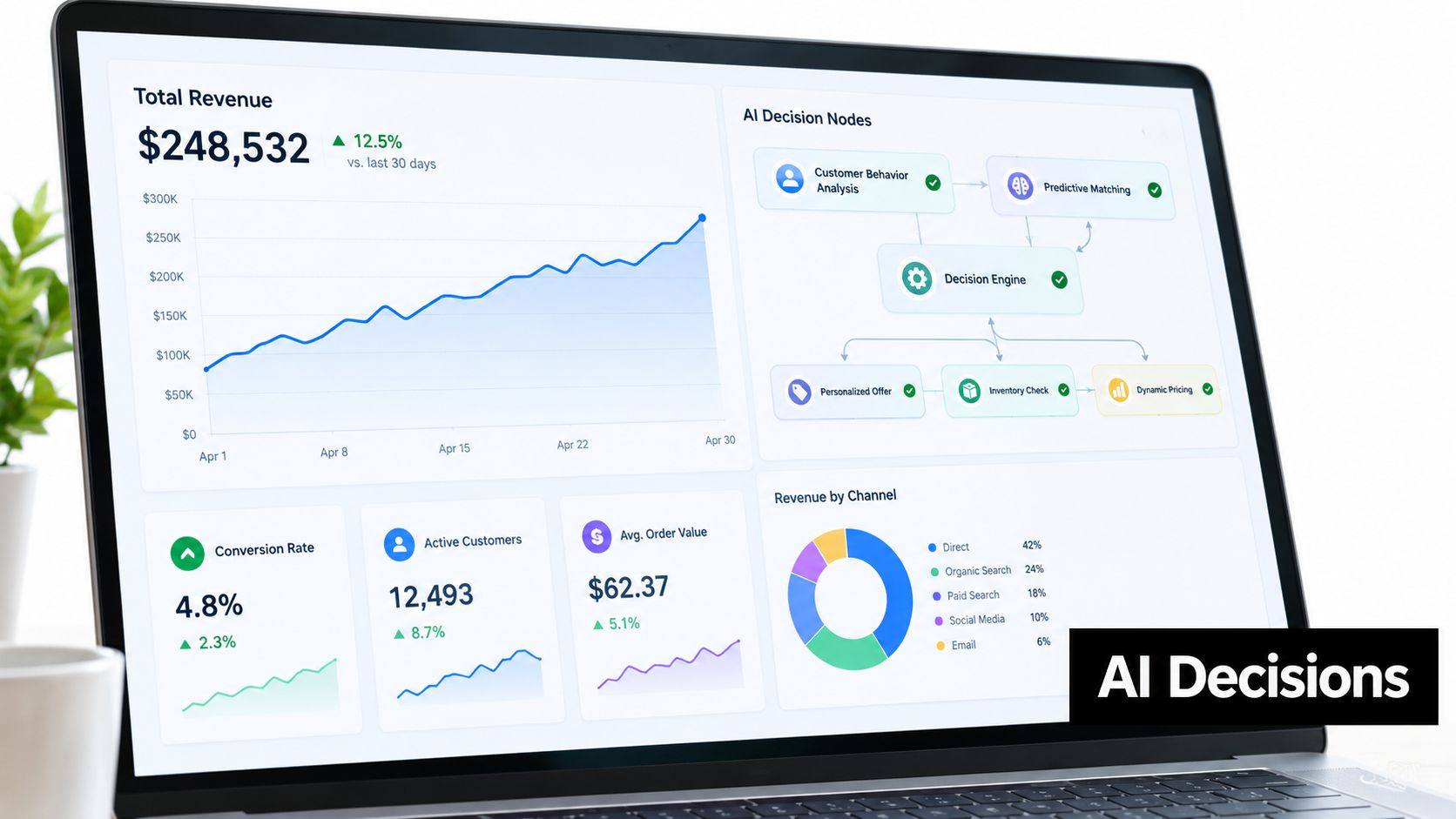
Fixed workflows remain useful for clear events such as signup, purchase, delivery, and cart abandonment. They become expensive when every customer receives the same treatment despite different intent, margin, purchase history, and channel behavior.
Adaptive systems can adjust timing, content, and channel selection for 90-day customer value, rather than optimizing only for first-purchase ROAS. The system should evaluate those choices against current evidence and update the next action when behavior changes.
Set the operating boundaries before enabling automated decisions:
A practical retention model estimates what the next action will change. It ranks candidates by expected response, contact cost, likely margin, and future purchase potential. That queue may favor a smaller high-intent audience over a large segment with impressive engagement but weak incremental value.
Content operations determine whether the decision layer can act. Product facts, replenishment guidance, service responses, and approved offers need structured fields and reusable modules. Without them, the model may choose the right audience while the workflow stalls in review or produces inconsistent content.
The marketing automation with AI resource offers a practical lens for connecting AI-assisted decisions with lifecycle execution. The objective is operational: allocate attention, incentives, and production time where the next action has the clearest route to profitable value.
Attributed revenue is not the same as revenue created by automation. Open and click rates diagnose delivery and engagement, but they cannot show whether a customer would have purchased without the message. A high-intent shopper may convert anyway, giving the workflow credit for demand it did not create.
Industry benchmarks often show automated emails outperforming standard campaigns on engagement and revenue per send. The email marketing statistics report can provide directional context, but benchmark averages should not determine budget or workflow decisions. Use them to identify unusual performance, then validate the result with a controlled comparison.
Record each flow's performance before changing its content, timing, or eligibility rules. Separate revenue attributed to the automation from total customer revenue. Document the audience definition, suppression logic, consent state, delivery rate, and attribution window so later results have a clear reference point.
A useful dashboard includes:
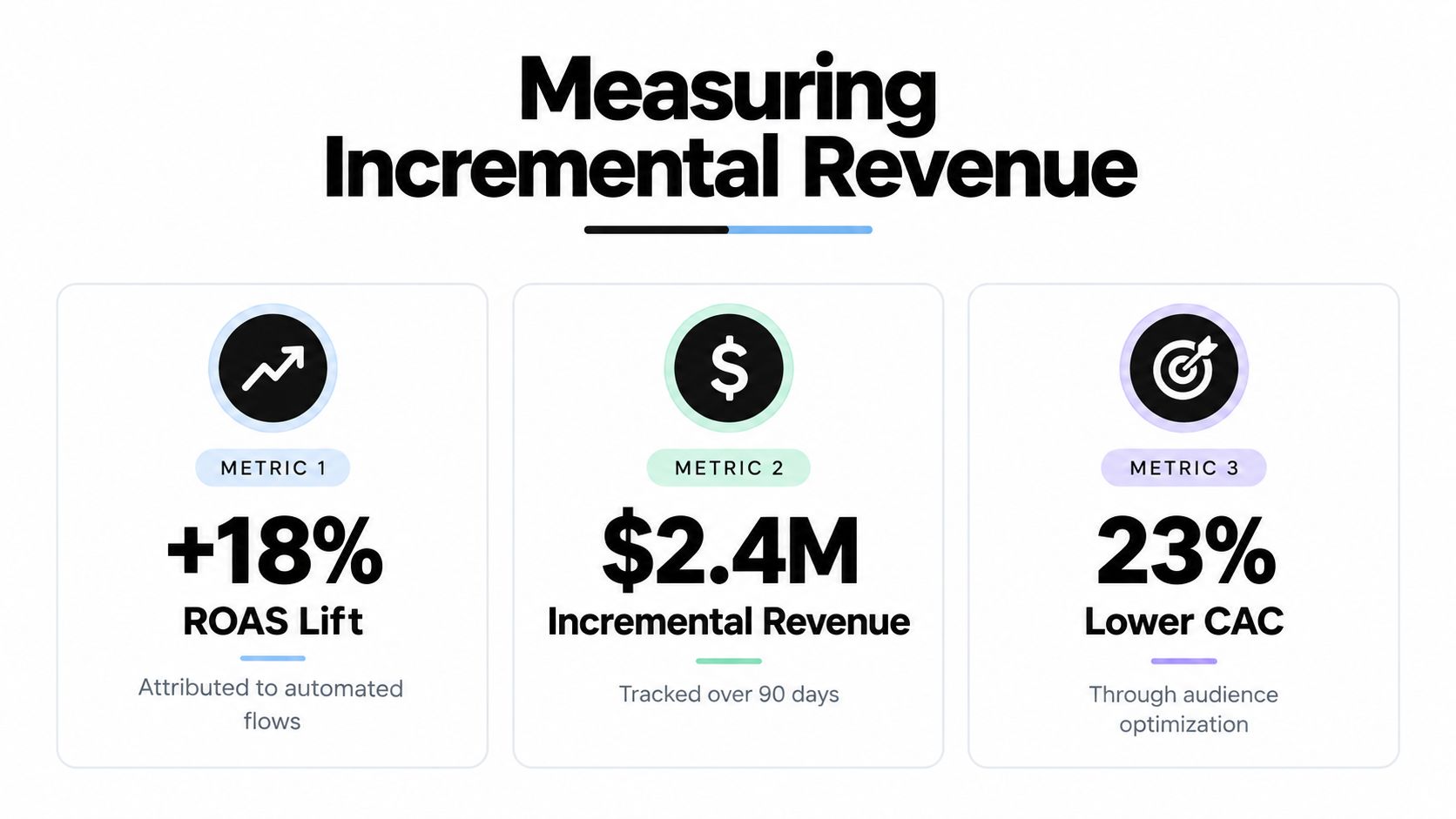
Subject-line tests are easy to run, yet a small engagement lift may produce no profitable growth. Test the decisions that control spend: message timing, incentive type, channel order, product recommendation, and audience eligibility. These tests show whether the decision layer is allocating retention effort to customers who can generate incremental value.
For example, hold out 10% of eligible cart abandoners for 7 days. Compare incremental conversion, contribution margin, and repeat purchase against the exposed group, rather than comparing attributed revenue alone. A reactivation test might compare product education with a promotional message. Each experiment needs one primary business outcome and guardrails such as margin, unsubscribe behavior, complaint rate, or discount use.
The marketing attribution guide helps distinguish reported credit from genuine contribution. Feed those results back into eligibility and timing rules. A workflow that contacts fewer customers can be the better program if it creates more profitable incremental orders and reduces unnecessary retention spend.
A practical rollout starts with a narrow commercial objective. A brand trying to improve repeat purchase shouldn't begin by rebuilding every lifecycle message. It should identify the customer state with the clearest value opportunity, verify the data required to recognize that state, and launch a controlled workflow that the team can monitor.
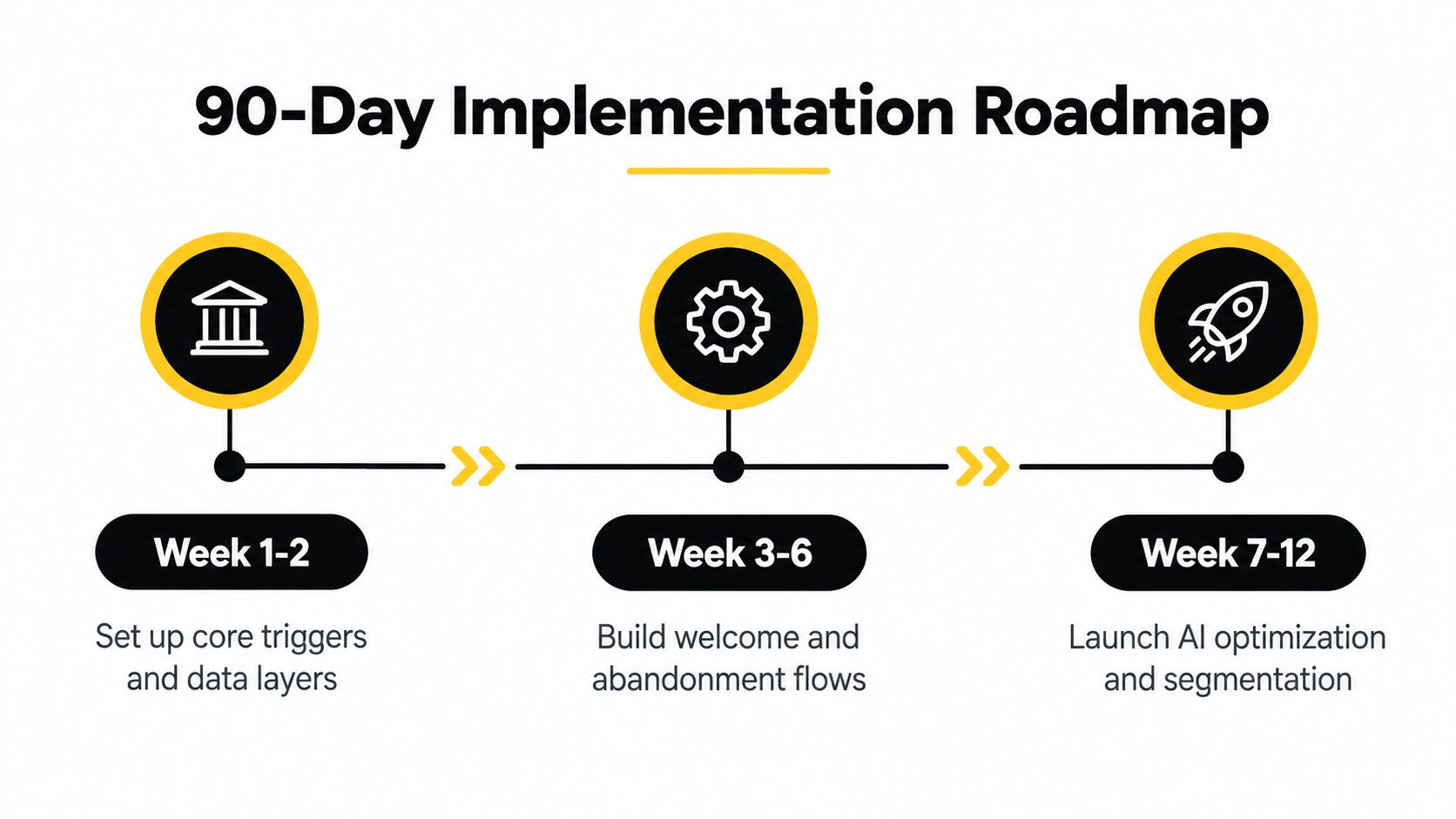
The first sprint should focus on visibility rather than volume. The team can document customer events, audit identity matching, confirm consent states, inspect suppression rules, and establish a baseline for existing campaigns. It should also choose the first three workflows based on commercial importance and implementation readiness.
A sensible first set usually includes a welcome journey, abandoned-cart recovery, and a post-purchase sequence. Each workflow needs an owner, an audience definition, an exit condition, a measurement plan, and a fallback message for missing data.
The next phase turns the map into working customer experiences. The team can launch the welcome flow first, then the cart flow, followed by post-purchase communication. Messages should be reviewed across mobile and desktop, and service events should suppress promotional content where necessary.
The rollout should remain deliberately small. A team that launches too many journeys at once won't know whether a performance change came from better timing, a new incentive, an audience error, or deliverability problems. Weekly reviews should examine both revenue and customer quality signals, including complaints, unsubscribes, returns, and support contacts.
Once the core events and flows are stable, the brand can introduce deeper segmentation and AI-assisted prioritization. The system might rank retention audiences, recommend a channel sequence, or identify which incentive test deserves production time. Each recommendation should remain subject to margin rules, consent requirements, and a holdout design.
The final phase should produce a repeatable operating rhythm. The team reviews flow performance, retires weak messages, refreshes product content, checks event quality, and documents decisions that can be automated safely. The result isn't a collection of set-and-forget emails. It's a controlled system that improves as the business learns.
<iframe width="100%" style="aspect-ratio: 16 / 9;" src="https://www.youtube.com/embed/KZLroOQKT-g" frameborder="0" allow="autoplay; encrypted-media" allowfullscreen></iframe>The fastest path forward is to audit the data and customer journeys before adding more campaigns. Sprints & Sneakers helps brands connect lifecycle marketing, automation, AI, experimentation, and full-funnel growth around measurable commercial priorities. Visit Sprints & Sneakers to discuss the bottleneck limiting ecommerce growth and turn the next automation sprint into a practical revenue plan.
Growth marketing, AI and automation, SEO, performance marketing, retention strategies, and sustainable business practices.
Weekly. Subscribe to our newsletter to get new articles straight to your inbox.
Absolutely. Everything we publish is designed to be actionable. Take it, test it, and make it your own.
Yes. We publish experiments with real numbers. What worked, what didn't, and what we learned.
Our growth team — strategists, performance marketers, data specialists, and AI builders who work on client campaigns every day.
We're open to it. Reach out via our contact page with your topic and we'll take a look.