

Master customer lifetime value marketing with practical formulas, retention strategies, and AI tools to drive predictable B2B and e-commerce growth.
The most popular advice about customer lifetime value marketing is also the most dangerous: calculate average order value, multiply it by purchase frequency and customer lifespan, then spend more to acquire anyone who appears valuable. That shortcut turns an uncertain forecast into a budget rule.
A customer who stays for years may buy only during heavy promotions, generate costly returns, or consume disproportionate support time. A newer account may look modest today but expand quickly, renew reliably, and require little service. Customer value is a contribution-margin forecast under uncertainty, not a reward for tenure.
The practical question is sharper: which customers, channels, and interventions are likely to create profitable future cash flow, and how much should the business invest to earn it?
Long tenure feels like proof of loyalty. It isn't proof of profitability.
Many teams still define customer lifetime value with a simple combination of average order value, purchase frequency, and lifespan. That framework is easy to explain, but it can encourage marketers to prioritize the customers who have stayed longest, regardless of margin, discount dependence, service burden, or future buying intent.
Peer-reviewed research found an uncertain relationship between customer lifetime and purchase behavior. Longer customer lifetimes don't necessarily produce higher CLV, while longer gaps between purchases can be associated with both larger orders and a higher risk of defection. The distinction matters because a customer who purchases less often may be preparing a valuable replenishment order, or may already be drifting away. The model has to tell the difference.

A retained customer can sit in several very different economic states:
These groups shouldn't receive the same budget or message. A blanket loyalty campaign can waste incentives on people who would've purchased anyway, while missing customers whose next action could materially change their future value.
A useful starting point is a margin-aware customer table. For each cohort or segment, track realized contribution, order or renewal cadence, discounts, returns, servicing cost, and the probability of the next profitable action. Teams looking for a broader measurement vocabulary can use this overview of customer lifetime value metrics as a reference point, then adapt the measures to their own economics.
Practical rule: A long relationship earns attention only when it produces healthy contribution and a credible next action.
The operating change is straightforward. Stop asking, “How long has this customer stayed?” Ask, “What has this customer contributed, what will the next action cost, and what intervention can improve the forecast?” That shift moves customer lifetime value marketing away from vanity retention and toward decisions finance can defend.
Revenue is not value. A CLV model should forecast discounted contribution-margin cash flow, not merely add up historical sales.
Expected CLV equals the probability-weighted future contribution from repeat purchases, renewals, cross-sells, and referrals, minus variable servicing and retention costs, discounted over time. The distinction changes acquisition decisions immediately. Two customers with identical revenue can have different CLV when one returns products frequently, needs intensive support, or buys only with discounts.
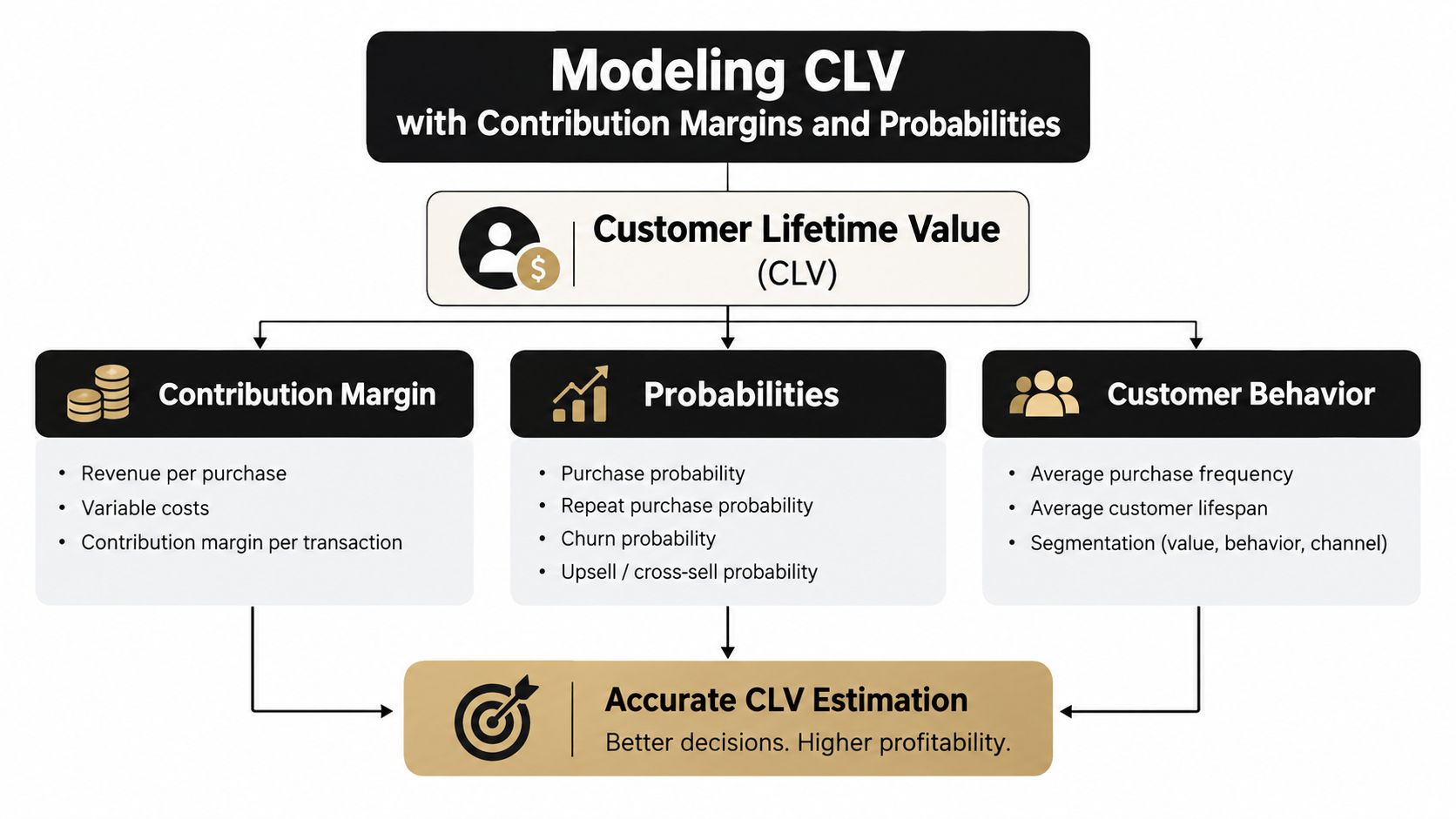
For noncontractual businesses such as e-commerce, Pareto/NBD-style models estimate two latent processes separately:
That separation is operationally useful. Merchandising, replenishment reminders, and onboarding can influence purchase frequency. Product quality, delivery experience, customer support, and proactive service can reduce dropout risk. A single blended “average lifespan” obscures those different levers.
A recent review reports that Pareto/NBD-family models perform consistently well across brands and evaluation metrics, while an empirical benchmark identified the Extended Pareto/NBD model as state-of-the-art in its comparison. The evidence supports probabilistic modeling, but it doesn't remove the need for local validation. A model can rank customers correctly while still overstating the cash they will produce.
For B2B SaaS, the cash-flow logic changes but the discipline remains. Include renewal probability, gross margin, expansion, contraction, implementation cost, customer-success effort, and discounting. An account that renews but requires extensive support may have a weaker contribution forecast than a smaller account that expands with minimal intervention.
A practical validation routine should include:
The customer lifetime value measurement framework should therefore end with a decision threshold, not a dashboard number. If the forecast isn't calibrated, acquisition budgets shouldn't move just because one channel has a higher modeled CLV.
Acquisition creates a customer. Retention determines how much economic value that customer can produce afterward.
Bain reports that, in the MBNA case, a 5% increase in retention grew profits by 60% by the fifth year. The same source connects loyalty with higher revenue and market share, alongside lower acquisition and service costs, as described in Bain's analysis of loyalty-based management. The implication isn't that every retention campaign will generate the same outcome. It's that retention changes multiple future contribution periods, while acquisition usually pays for access to a new relationship only once.
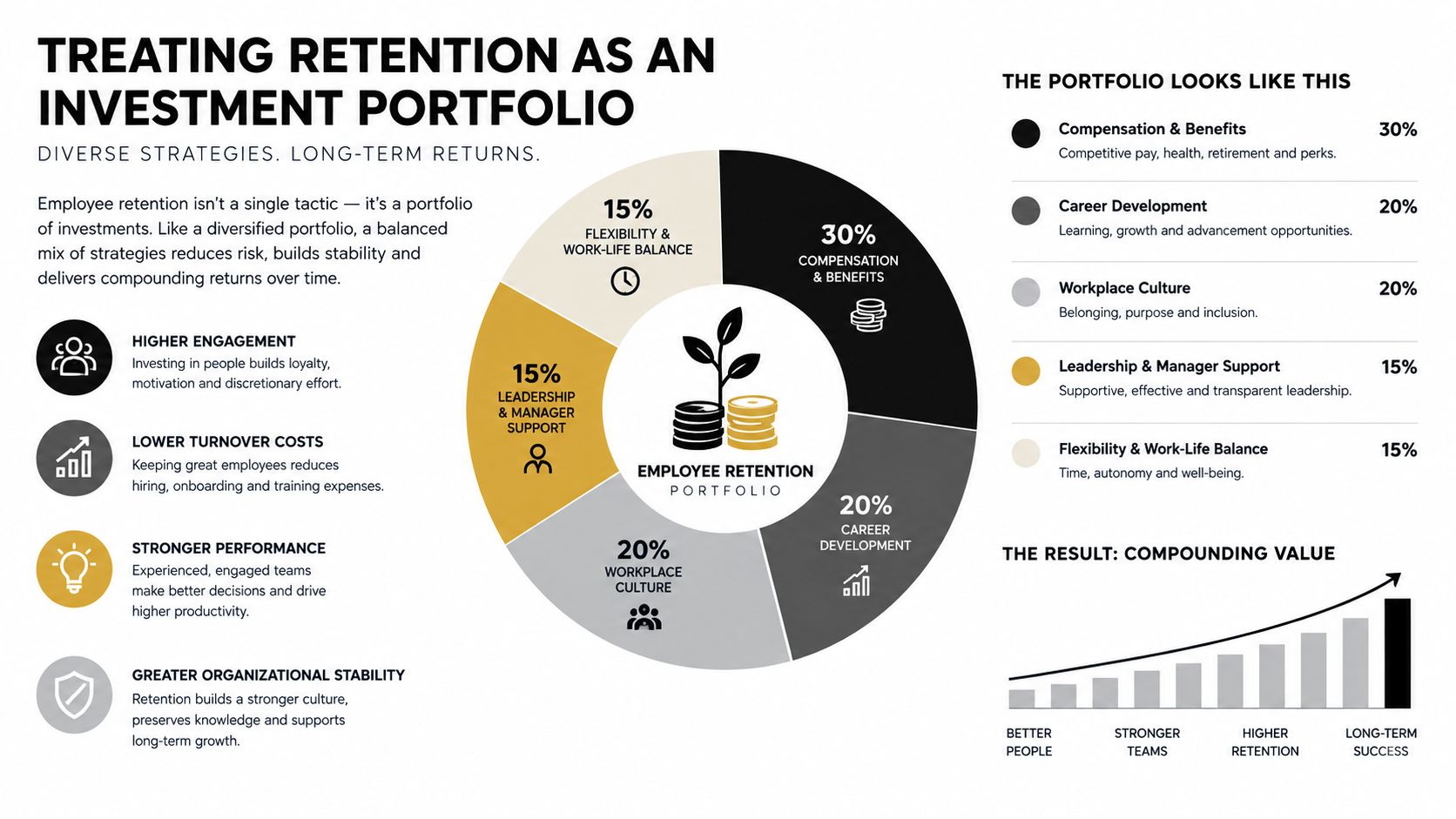
Retention deserves a portfolio structure. Each intervention should have an audience, an expected behavioral change, an incremental CLV estimate, and a fully loaded cost.
For a SaaS business, the portfolio might include activation improvements, renewal-risk outreach, customer-success coverage, usage education, and expansion campaigns. For e-commerce, it might include replenishment messaging, post-purchase education, service recovery, loyalty benefits, and carefully targeted incentives. The right question isn't whether an intervention increases retention in aggregate. It's whether the incremental contribution exceeds the intervention cost for the segment receiving it.
A retention lift among low-margin customers can destroy value when additional discounts, service time, or fulfillment costs exceed the recovered contribution. The same lift among high-margin, high-expansion accounts can materially improve customer equity.
A useful investment review pairs each program with:
| Decision field | What to examine |
|---|---|
| Target segment | Margin, lifecycle stage, product usage, order cadence, or renewal risk |
| Expected action | Renewal, repeat purchase, expansion, reactivation, or referral |
| Incremental value | Contribution expected because of the intervention |
| Fully loaded cost | Incentive, media, creative, technology, service, and operational effort |
| Test design | Holdout, randomized treatment, or credible incrementality comparison |
| Reallocation rule | The condition that earns more or less budget |
Retention work also needs clear ownership. Marketing may orchestrate lifecycle messaging, product may improve activation, sales may manage expansion, and customer success may handle risk. A practical guide to retention marketing strategies can help teams map these activities, but the financial decision still belongs in a shared operating process. The churn reduction framework should connect interventions to realized contribution rather than treating lower churn as the final objective.
A model becomes useful only when it changes a decision someone makes this week.
The first operational adjustment is to stop using one blended CAC target for every audience. If predicted contribution differs by channel, market, plan, or customer quality, the allowable acquisition cost should differ too. That doesn't mean paying any price for a supposedly valuable audience. It means setting a ceiling from a scenario range, then checking payback and realized performance as the cohort matures.
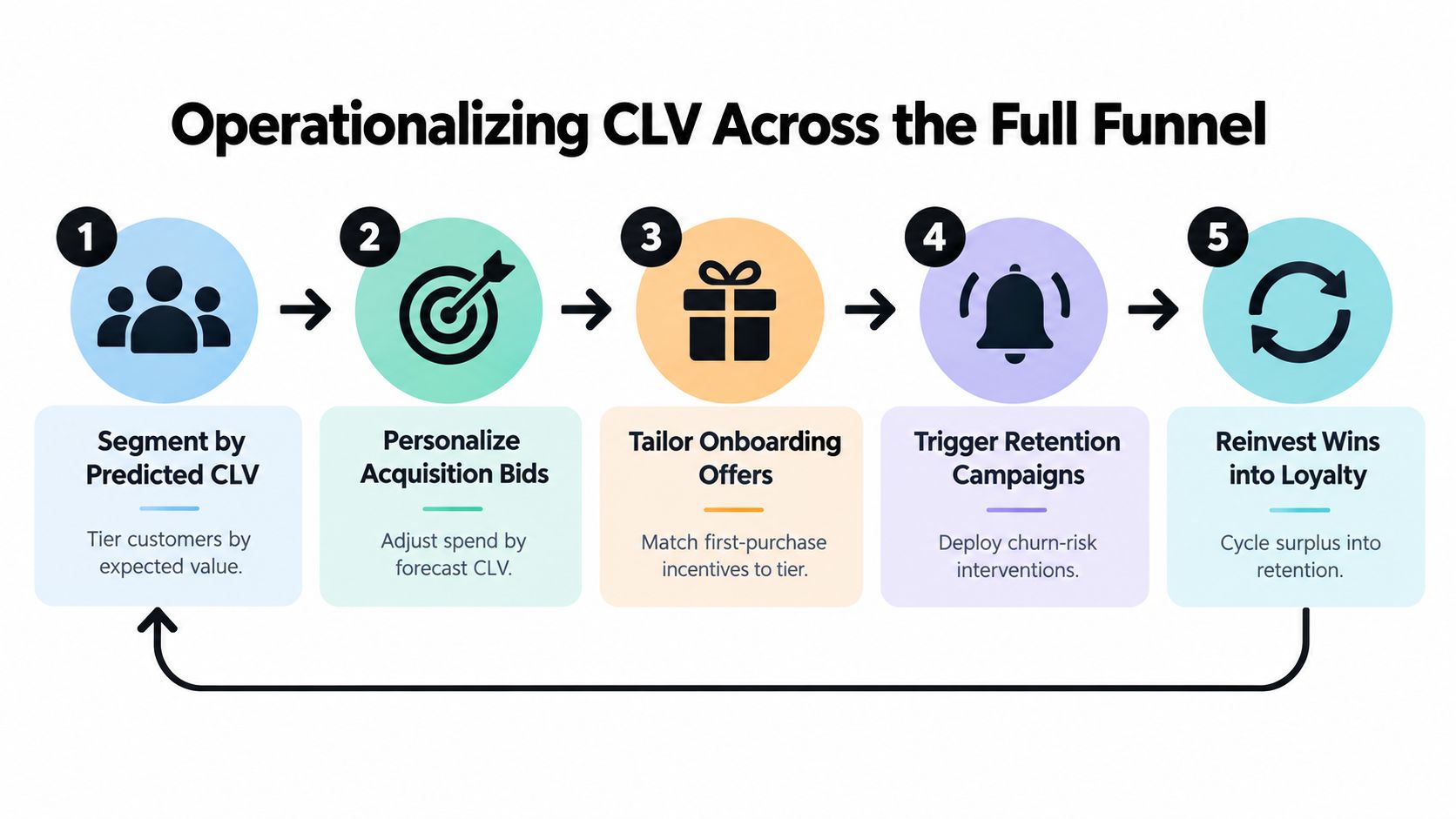
A full-funnel workflow can run as five connected decisions:
A lifecycle marketing strategy gives these decisions a place in the customer journey, but the model must remain accountable to outcomes across awareness, acquisition, activation, revenue, retention, and referral.
CLV:CAC ratios become fragile when cohorts are immature, lifecycles are incomplete, churn is modeled rather than observed, or blended CAC hides channel differences. Research identifies these measurement problems in noncontractual relationships, where many customers haven't completed an observable lifecycle, and another study finds that conventional CLV models can assume constant retention while failing to represent customer heterogeneity. The research on CLV measurement limitations supports a more cautious operating model.
Report three views together:
A channel shouldn't scale because it wins a spreadsheet ratio. It should scale when its contribution, payback, calibration, and incremental effect remain acceptable as the cohort develops.
<iframe width="100%" style="aspect-ratio: 16 / 9;" src="https://www.youtube.com/embed/x0L75CV5eSI" frameborder="0" allow="autoplay; encrypted-media" allowfullscreen></iframe>Historical averages describe what happened. Predictive analytics estimates what a specific customer is likely to do next.
A useful system can combine product usage, support-ticket frequency, billing behavior, feature adoption, renewal timing, engagement, order cadence, returns, and service interactions. The output shouldn't be a mysterious score. It should estimate an interpretable probability, such as the likelihood of renewal, expansion, repeat purchase, or profitable reactivation, alongside the contribution expected if that event occurs.
A product-usage decline may trigger education or customer-success outreach. Repeated support requests may signal an experience problem rather than a marketing opportunity. A strong adoption pattern across several teams may justify expansion messaging in a SaaS account. For e-commerce, a widening order gap paired with high historical margin may justify a reminder, while a promotion-heavy and return-heavy profile may call for a service or product-fit intervention instead.
Machine learning can identify interactions that simple rules miss, but prediction isn't persuasion. A model that flags risk without a defined owner, message, offer, or service action becomes another dashboard ornament.
The practical implementation should include:
Teams evaluating AI for business growth should treat governance as part of the product. Marketing can own activation and campaign execution, data teams can own model development, and finance can own the contribution definitions and reconciliation process. A steering group should agree on how much forecast error is acceptable before acquisition budgets change, how often models are refreshed, and what evidence is required to promote a prediction into a planning assumption.
A forecast earns trust when finance can reconcile it, marketers can act on it, and the business can measure whether the action changed the outcome.
The same CLV principles produce different decisions in contractual and noncontractual businesses.
A SaaS company can have two accounts with similar contracted revenue and very different future value. Account A renews but opens frequent support requests, uses little of the product, and shows no credible expansion path. Account B has lower current usage in one team but is adopting the workflow across departments, needs limited support, and has a clear adjacent-product use case.
A revenue-only model may favor Account A because its current contract looks safer. A contribution-margin model asks different questions:
Account A may need product education or service recovery before any upsell message. Account B may belong in an expansion sequence supported by relevant usage education and a sales follow-up. The marketing budget should follow expected incremental contribution, not the account's current label as “retained.”
An e-commerce brand may celebrate a frequent purchaser who orders during every promotion. That customer appears active, but discounts, returns, fulfillment, payment costs, and customer-service contacts can eliminate contribution. Another customer purchases less often, accepts full-price recommendations, returns little, and responds to replenishment content.
The brand can segment customers by realized contribution and predicted next profitable purchase rather than order count. A practical decision table might look like this:
| Customer signal | Likely action |
|---|---|
| Frequent orders, heavy discounts, high returns | Reduce blanket incentives and investigate product fit |
| Longer order gap, high historical margin | Test useful replenishment or product education |
| Strong recent purchase with low service burden | Recommend relevant next products without unnecessary discounts |
| Declining cadence after a service issue | Resolve the experience problem before promoting another order |
Neither scenario needs a single permanent CLV label. Customer economics change as product usage, support burden, order behavior, pricing, and costs change. The model should refresh often enough to capture meaningful behavior, while the decision process should avoid reacting to every noisy event.
A CLV dashboard should help a marketing leader decide where to add, remove, or redesign investment. It shouldn't function as a gallery of attractive ratios.
Start with cohort views. Show predicted versus realized CLV by acquisition cohort, channel, market, plan, customer segment, and margin band. Add the confidence range and the age of each cohort so an immature forecast doesn't sit beside a mature one without context.
A useful dashboard includes:
Refresh predictions when new behavioral information materially changes the forecast, and establish a review cadence that matches the business cycle. A contractual SaaS company may update around usage and renewal milestones, while an e-commerce business may respond to order cadence, margin, returns, and customer-service events. The exact schedule should follow decision latency, not a habit chosen for convenience.
The marketing analytics dashboard framework should give marketing, sales, customer success, product, and finance a shared definition of contribution and a common cohort view. Finance should reconcile realized value, marketing should own campaign decisions, and operating leaders should approve the rules for budget changes. That governance prevents every team from optimizing a different version of “high value.”
Customer lifetime value marketing works when the organization treats CLV as a living decision system. The next profitable customer isn't always the longest-lived one, and the best retention program isn't always the one with the largest response rate. Teams that connect probabilities, contribution margins, experiments, and ownership can compound customer equity without confusing activity for growth.
Sprints & Sneakers helps B2B and consumer brands connect acquisition, lifecycle marketing, retention, analytics, and experimentation to improve customer lifetime value. Visit Sprints & Sneakers to request a personalized growth scan and identify the single funnel bottleneck limiting profitable growth.
Growth marketing, AI and automation, SEO, performance marketing, retention strategies, and sustainable business practices.
Weekly. Subscribe to our newsletter to get new articles straight to your inbox.
Absolutely. Everything we publish is designed to be actionable. Take it, test it, and make it your own.
Yes. We publish experiments with real numbers. What worked, what didn't, and what we learned.
Our growth team — strategists, performance marketers, data specialists, and AI builders who work on client campaigns every day.
We're open to it. Reach out via our contact page with your topic and we'll take a look.