
Learn how to optimize Google Ads for real pipeline and profit, not vanity metrics. Practical steps for structure, bidding, creative, and measurement.
Most Google Ads advice starts in the wrong place. It tells teams to adjust bids, raise Quality Score, test a few headlines, and chase a lower platform-reported CPA. That approach can make the dashboard look healthier while doing nothing for pipeline or profit.
The core job is harder and more valuable: separate demand created by paid media from demand Google Ads merely claimed. A branded search, a remarketing click, and a high-intent product search don't carry the same incremental value, even when the platform assigns each a conversion. The account should scale the campaigns that create profitable demand, not just the campaigns that collect the most credit.
This guide shows growth teams how to optimize Google Ads around incremental profit, qualified pipeline, and trustworthy measurement, then use structure, creative, landing pages, and bidding to support those outcomes.
Clicking “optimize” inside Google Ads isn't a growth strategy. Neither is pushing a bid higher because an ad lost position, or treating a rising Quality Score as proof that the account is improving. Those actions can matter, but only after the account measures the business outcome that deserves optimization.
A platform-reported conversion is not automatically an ad-created conversion. Branded demand, remarketing audiences, and buyers already close to purchase can produce strong attributed results even when paid media adds little profit. A campaign can therefore show an attractive attributed ROAS while generating no meaningful incremental return.
Google describes incrementality testing as a randomized comparison between exposed and unexposed groups that produces incremental conversions and incremental cost per acquisition. Those metrics can differ materially from ordinary attribution results. That distinction should change how marketing leaders approve budgets.
Practical rule: Platform attribution is useful for operating campaigns. It isn't sufficient for deciding how much demand paid media actually created.
If a B2B campaign reports form fills but sales rejects most of them, automated bidding learns from the wrong signal. If an e-commerce campaign reports every transaction with equal value despite different margins, the platform can favor revenue that contributes little profit. In both cases, the account optimizes efficiently toward an economically weak target.
The operational consequence is blunt. Optimize the wrong number and the team scales the wrong campaigns, protects the wrong keywords, and cuts campaigns that may be creating new demand further down the funnel.
A better hierarchy starts with qualified opportunities, signed contracts, contribution margin, incremental revenue, or another validated business outcome. Micro-conversions still have diagnostic value, but they shouldn't inadvertently become the objective that controls spend.
For teams building a wider commercial system, this connects directly with revenue marketing principles, where acquisition is judged by its contribution to revenue rather than by activity inside an ad account.
By the next morning, a growth lead should be able to identify which conversions matter, isolate the campaigns most likely to be capturing existing demand, and create a test that measures whether paid media caused additional pipeline.
An account organized around product names usually hides the buying questions that determine performance. A stronger structure starts with intent, funnel stage, and business outcome, then maps keywords, ads, and landing pages to each cluster.
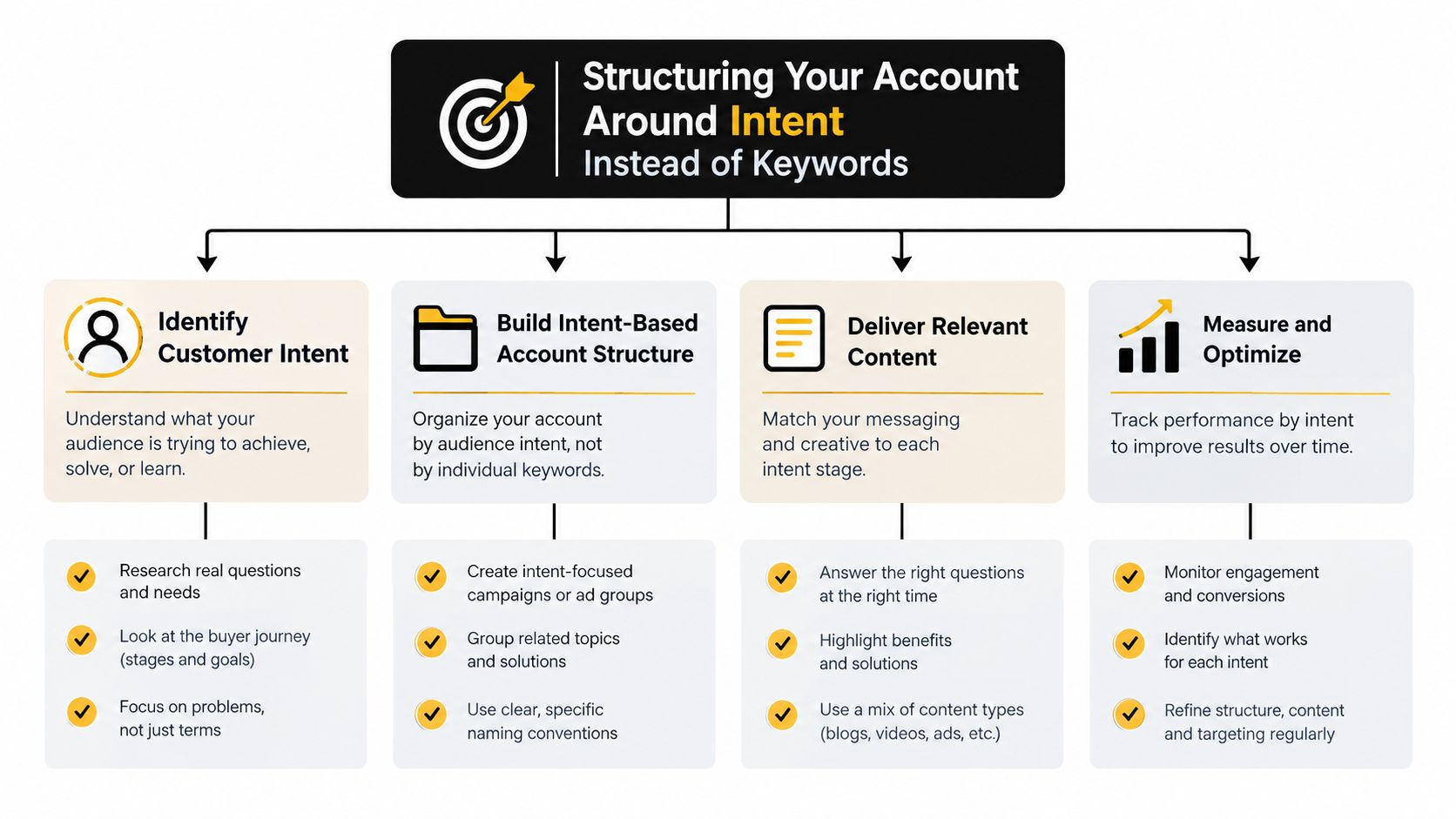
Separate campaigns when the business decision differs. Brand defense, non-brand acquisition, competitor comparison, high-intent service searches, and lower-funnel remarketing usually deserve different budget logic and different success criteria. A campaign that protects existing demand shouldn't compete for budget under the same rules as one that creates new demand.
Then group ad groups by a single intent cluster. A cluster might contain searches for implementation support, enterprise pricing, compliance requirements, or a specific product category. It shouldn't contain every keyword that happens to include the same product name.
Google's Ad Rank calculation considers the bid, auction-time ad quality, Ad Rank thresholds, search context, and the expected impact of assets such as sitelinks and callouts. Google also explains that improving relevance between the keyword, ad message, and landing page can improve eligibility and position without raising the bid, as detailed in its Ad Rank explanation.
A practical map looks like this:
Teams working on local demand should also distinguish location intent from generic service intent. The guide to dominating local search with keywords offers useful context for turning high-intent language into more disciplined campaign groupings.
Search-term review is where account architecture meets real customer language. Every review should identify irrelevant queries, low-value research terms, unsuitable locations, and searches that belong in a different campaign. Add negatives at the narrowest useful level, then keep a shared list for exclusions that apply across the account.
Don't use negatives to hide a structural problem. If a search repeatedly appears in the wrong ad group, rebuild the intent grouping instead of endlessly patching the symptom.
The full-funnel marketing strategy perspective is useful here because the same query can represent different commercial roles depending on whether the buyer is discovering a category, comparing vendors, or ready to act. Account structure should reflect that progression.
Responsive search ads only improve decisions when their assets express different commercial arguments. Rephrasing the same benefit across several headlines creates volume, not useful choice. Build each asset to answer a distinct question: Why this solution? Why now? Why trust it? What happens next?
A responsive search ad can contain up to 15 headlines of up to 30 characters and up to 4 descriptions of up to 90 characters. The system tests combinations of those assets over time, according to Google's responsive search ad guidance.

Use five message angles as a drafting rule:
Keep every angle aligned with the same intent and landing page. Descriptions should add qualification, process detail, and a direct next step. They should not repeat a headline at greater length. Someone searching for enterprise implementation support needs a different answer from someone seeking a low-cost self-service plan, even if both searches contain the same category term.
Pinning every asset restricts the combinations you are asking the system to evaluate. Pin only a legal requirement, brand rule, or necessary qualification. Otherwise, provide strong alternatives and preserve a coherent message across possible combinations.
Judge assets against business outcomes, not labels alone. An asset marked “Low” after limited impressions has not produced enough evidence for a confident decision. Pause it when it repeatedly attracts the wrong intent, sends users into a weak conversion path, or underperforms after meaningful exposure.
After two weeks, inspect search terms, combination reporting, qualified conversion rate, and landing-page behavior. The paid search optimization resource connects ad testing with query selection, tracking, and budget decisions, rather than treating copy as an isolated exercise. This review matters because a high-click combination can still produce poor incremental revenue if it attracts low-quality demand.
A practical launch workflow is short: write the five angles, add supporting descriptions, verify every claim, confirm the landing-page match, and remove near-duplicate language before launch.
Smart Bidding isn't magic and manual bidding isn't automatically disciplined. The correct choice depends on whether the account has enough reliable data, whether the conversion column represents commercial value, and whether the team can tolerate the strategy's learning period.
Smart Bidding uses auction-time signals to optimize toward conversions or conversion value. Google advises waiting through several conversion cycles after conversion tracking is configured before changing bid strategy, because a conversion cycle includes click-to-conversion time plus reporting delay for imported conversions, as described in its Smart Bidding guidance.
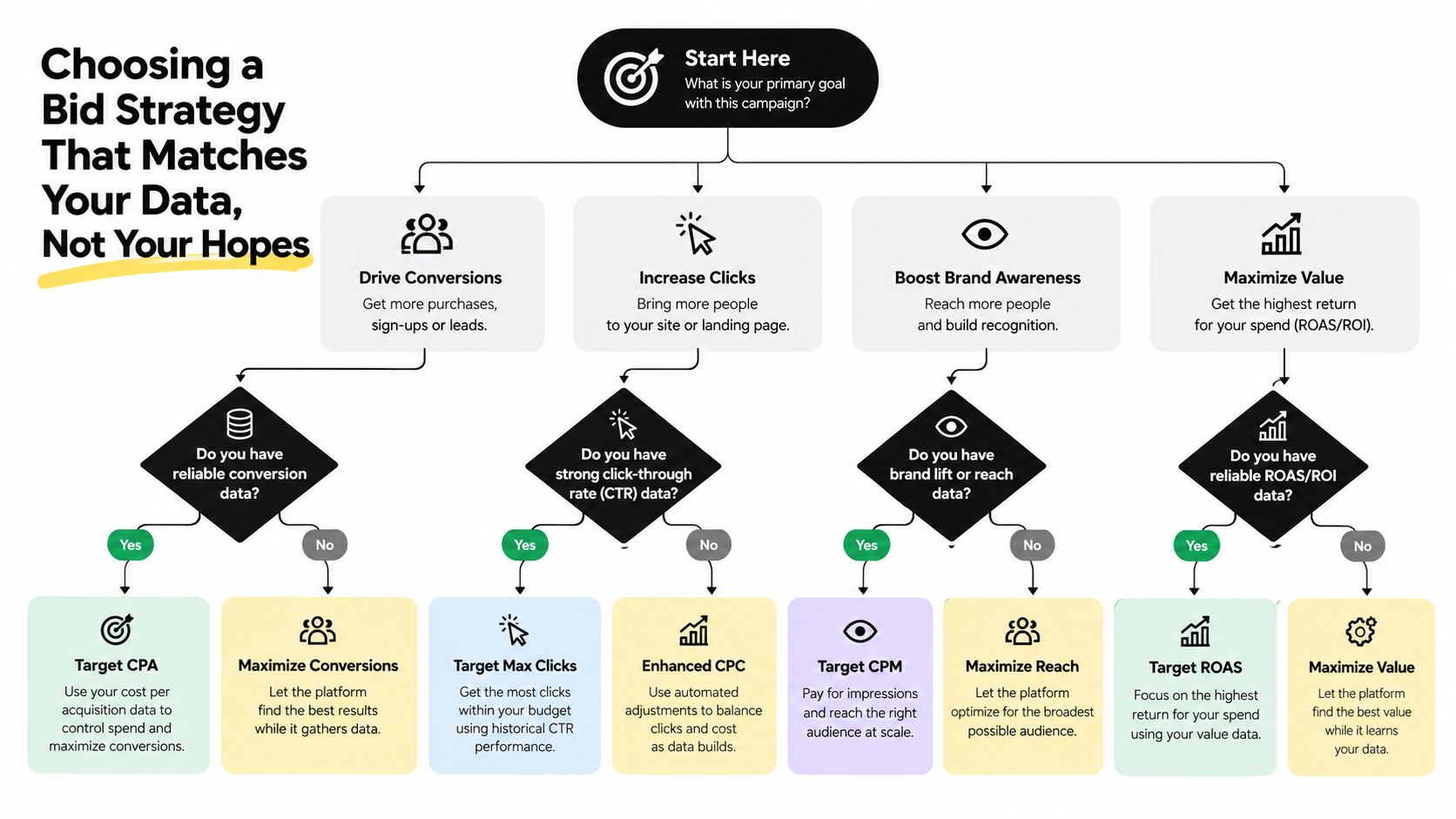
Use Maximize Conversions when the primary conversion is trustworthy and the campaign has enough consistent signal for automation to learn. It can be a sensible starting point when conversion value isn't yet reliable, but it shouldn't become a permanent excuse to ignore lead quality.
Use Target CPA when the conversion definition is stable and the business has a defensible acquisition cost. For B2B, that target should relate to qualified pipeline rather than every completed form.
Use Target ROAS when conversion values reflect revenue or margin differences. A revenue target without margin logic can push spend toward sales that look large in the platform but contribute little commercially.
Manual CPC has a role in thin-data launches, controlled brand campaigns, and experiments where the team needs clean directional evidence before automation takes over. It isn't a badge of rigor. It becomes a problem when it keeps a mature campaign from using useful auction-time signals.
<iframe width="100%" style="aspect-ratio: 16 / 9;" src="https://www.youtube.com/embed/h9uRxKkAyx0" frameborder="0" allow="autoplay; encrypted-media" allowfullscreen></iframe>| Conversion Volume per Month | Primary Conversion Definition | Recommended Starting Bid Strategy |
|---|---|---|
| Limited or inconsistent | Validated lead or early funnel event | Manual CPC or controlled conversion-focused bidding |
| Consistent, with reliable lead quality | Qualified opportunity or approved pipeline event | Maximize Conversions, then evaluate Target CPA |
| Consistent, with trustworthy values | Revenue, contribution margin, or pipeline value | Maximize Conversion Value, then evaluate Target ROAS |
| Brand or controlled defense campaign | Incremental demand under active testing | Manual CPC or conservative conversion-focused bidding |
The rollback rule matters as much as the launch rule. If conversion volume rises while qualified rate falls, stop changing targets and inspect the conversion action first. Roll back to the last trustworthy setup, preserve the historical structure where possible, and fix the signal before asking bidding automation to learn faster.
A landing page can waste paid traffic even when the account structure and bids are sound. Treat it as part of the measurement architecture: the page must turn a click into an action that reflects commercial intent, not merely inflate the platform's conversion count.
Quality Score is a keyword-level diagnostic from 1 to 10 covering expected click-through rate, ad relevance, and landing-page experience. Google rates each component Above average, Average, or Below average against ads shown for the same searches during the previous 90 days, according to its Quality Score documentation. Use the score to locate friction, not as the revenue KPI. A Below average landing-page component warrants an investigation into message match, usability, and page behavior.

Start with the exact search query. Read the ad that served, then the page headline. The problem, offer, and next action should remain recognizable across all three. An ad promising implementation support should not send visitors to a generic company introduction. That mismatch creates friction before the buyer can judge the offer.
Use this audit order:
A B2B SaaS page for “qualified pipeline analytics” needs a headline about pipeline analytics, supporting copy that explains the evaluation process, and a concrete next step such as a product walkthrough or diagnostic review. A broad homepage obscures intent and makes conversion data less useful.
The fastest test takes ten minutes. On mobile, open a fresh session, read the first screen without scrolling, tap every primary button, and submit a test form. Remove anything that blocks the promised action. Then compare the page with the search term and exact ad combination that produced the visit.
For a repeatable prioritization method, review this guide to conversion rate optimization for landing pages. Fix message match and friction before commissioning a full redesign. A cleaner path to the existing action usually produces better evidence than a wholesale visual change.
Google Ads cannot optimize for profit it never receives as a signal. If a weak lead counts as a conversion, automated bidding will become better at finding weak leads. Fix the measurement architecture before changing bids.
Start by separating outcomes into two operating layers. Primary conversions should represent actions the business wants to buy more often, such as a qualified demo, accepted opportunity, or signed contract for a B2B company. E-commerce teams may need contribution margin or incremental revenue instead of gross sales alone.
Micro-conversions belong in diagnosis. Page views, content downloads, button clicks, and early form starts can expose friction, but they should not steer bidding without a demonstrated relationship to profit. Keep them visible for analysis while preventing cheap activity from dominating acquisition decisions.
Assign values using margin, pipeline quality, or expected commercial contribution. If the commercial outcome occurs outside the website, import offline actions such as qualified opportunities, completed applications, signed contracts, or closed revenue. Bidding then receives feedback from the customer journey rather than stopping at the initial form submission.
Record the rules in a conversion governance table:
Keep ownership explicit. A conversion definition without a validator will drift as sales qualification changes. Teams defining goals can review Reddog on Google Analytics goals, then document which events are diagnostic and which may control spend.
First-click, linear, time-decay, and position-based attribution models are no longer supported, according to Google's attribution model guidance. Affected conversion actions were upgraded to data-driven attribution, which distributes credit using historical conversion-path data.
The selected model changes the conversions column and can therefore change bidding decisions. Customer behavior may stay stable while reported campaign contribution shifts. Document every conversion-action and attribution change, then monitor conversion lag, lead quality, and CRM outcomes.
Use platform attribution to operate bids. Validate budget decisions with CRM revenue analysis and incrementality testing. No single report is ground truth.
For a practical framework on separating campaign credit from revenue accountability, review this guide to marketing attribution measurement. That separation is the control that keeps reported efficiency from masquerading as profitable growth.
Optimization fails when teams treat it as a burst of dashboard activity. A durable cadence gives each change enough time to produce evidence, while still catching tracking failures and obvious waste quickly.
Reserve one focused review slot for four checks:
Weekly work should improve the account's inputs. It shouldn't trigger a new bid target every time performance moves. Frequent target changes can make it impossible to distinguish the effect of bidding from the effect of demand, tracking, or landing-page changes.
Once per month, compare campaign results with the company's marginal-profit threshold. Review conversion lag before judging recent performance, especially when the sales cycle extends well beyond the click. Run one major experiment at a time with a fixed observation window, stable conversion definitions, and unchanged targeting unless the test explicitly requires otherwise.
A randomized lift test can compare exposed and unexposed groups and reveal incremental conversions and incremental cost per acquisition. For a B2B business, the downstream metric may be qualified pipeline or signed contracts. For e-commerce, it may be incremental revenue or contribution margin.
Break the cadence immediately when:
A 2025 analysis of more than 16,000 US PPC campaigns running from April 2024 through March 2025 reported an average CTR of 6.66%, CPC of $5.26, conversion rate of 7.52%, and cost per lead of $70.11, according to the PPC benchmark analysis. Those figures describe aggregated US PPC campaigns, not a universal Google Ads target.
A campaign below the benchmark isn't automatically broken. A campaign above it isn't automatically profitable. Use the numbers to form questions about intent, conversion quality, geography, funnel stage, and landing-page relevance, then make the next test answer one question.
Sprints & Sneakers helps B2B and B2C teams connect Google Ads structure, landing-page testing, conversion tracking, and incrementality to qualified pipeline and profitable growth. Visit Sprints & Sneakers to arrange a growth scan and identify the measurement bottleneck that should be fixed before the next budget increase.
Growth marketing, AI and automation, SEO, performance marketing, retention strategies, and sustainable business practices.
Weekly. Subscribe to our newsletter to get new articles straight to your inbox.
Absolutely. Everything we publish is designed to be actionable. Take it, test it, and make it your own.
Yes. We publish experiments with real numbers. What worked, what didn't, and what we learned.
Our growth team — strategists, performance marketers, data specialists, and AI builders who work on client campaigns every day.
We're open to it. Reach out via our contact page with your topic and we'll take a look.