
SEO Strategy for Startups: A 90-Day Playbook for 2026
Build an SEO Strategy for Startups in 90 Days: audit fixes, keyword picks, tests and KPIs tied to pipeline, not just traffic.
The startup has launched, paid campaigns are consuming budget, and the content backlog keeps growing. Someone suggests publishing more articles, but the founder still can't answer a basic question: which search pages could bring the next qualified customer?
A useful SEO strategy for startups starts with that question, not a publishing quota. The team treats each page as a pipeline experiment, gives it a measurable job, and expands only when the evidence supports more work.
Table of Contents
- Your 90-Day SEO Roadmap at a Glance
- How to Audit Your Site Before Writing Anything
- Measuring SEO Against Pipeline Instead of Rankings
- Choosing Keywords That Win Before Your Brand Is Known
- Core Web Vitals and Technical Fixes That Pay Off First
- Content and Link Experiments You Can Ship This Month
- When Not to Invest in SEO Yet
- Pick One Page and Ship It This Week
Your 90-Day SEO Roadmap at a Glance
90-day SEO roadmap by phase
| Weeks | Focus | Concrete output | Owner |
|---|---|---|---|
| 1-2 | Measurement and audit | Search Console and analytics connected, one primary conversion defined, indexability report finished | Founder or growth lead |
| 3-4 | Technical blockers and keyword scoring | Crawl and index errors fixed, poor Core Web Vitals URLs listed, top 15-25 keyword candidates scored | Developer and marketer |
| 5-8 | Publish a focused set | Five to eight high-intent pages, each with one original asset and linked from existing indexed pages | Writer with a subject-matter expert |
| 9-12 | Refresh and test | Pages ranking 4-20 updated, two experiments logged against the week 2 baseline, KPI review completed | Growth lead |
This is a proposed operating schedule, not a forecast of when rankings or revenue will arrive. The order matters: fix before publishing. Otherwise, the team can spend its writing budget on pages that search engines can't access or analytics can't measure.
Give every phase an acceptance test
During measurement and audit, the growth lead should test an actual conversion rather than merely confirm that analytics is installed. A demo submission should appear in the reporting system with its landing page and acquisition source intact. Internal test submissions need a clear label so they don't inflate results.
The technical phase ends when blockers have owners and important pages are accessible. Keyword scoring should happen alongside these repairs, allowing the writer to prepare briefs without adding more broken pages to the site.
Publication requires more than an approved draft. Each page needs a distinct customer question, a relevant conversion event, an original asset, and a place in the existing site structure. A workflow screenshot should explain the process, not decorate otherwise generic copy.
Practical rule: Publication is an output. Evidence that the intended customer found the page and took a useful action is progress.
Reserve time for decisions
The final phase shouldn't become another production sprint. The growth lead should examine which pages gained relevant impressions, which attracted the wrong audience, and which visitors moved toward a purchase.
Refresh work should address a specific weakness: missing proof, unclear positioning, an incomplete answer, or an unsuitable next step. Changing everything at once makes the result difficult to interpret.
The suggested page counts are capacity limits, not success targets. A startup publishing fewer than ten measured pages can learn more by day 90 than one shipping fifty untested articles, because the smaller programme leaves time to investigate outcomes.
Before the team proceeds, the founder should write down the single conversion that matters most for the product. That choice should govern the keyword shortlist, page briefs, and reporting.
How to Audit Your Site Before Writing Anything
Discovery comes first. Google's explanation of how Search works separates crawling, indexing, and serving results, and states that Google primarily discovers pages through links from pages it has already crawled. Publishing a URL doesn't guarantee that it will appear in search.
The audit should follow the route from discovery to eligibility, then separate technical failures from content problems.
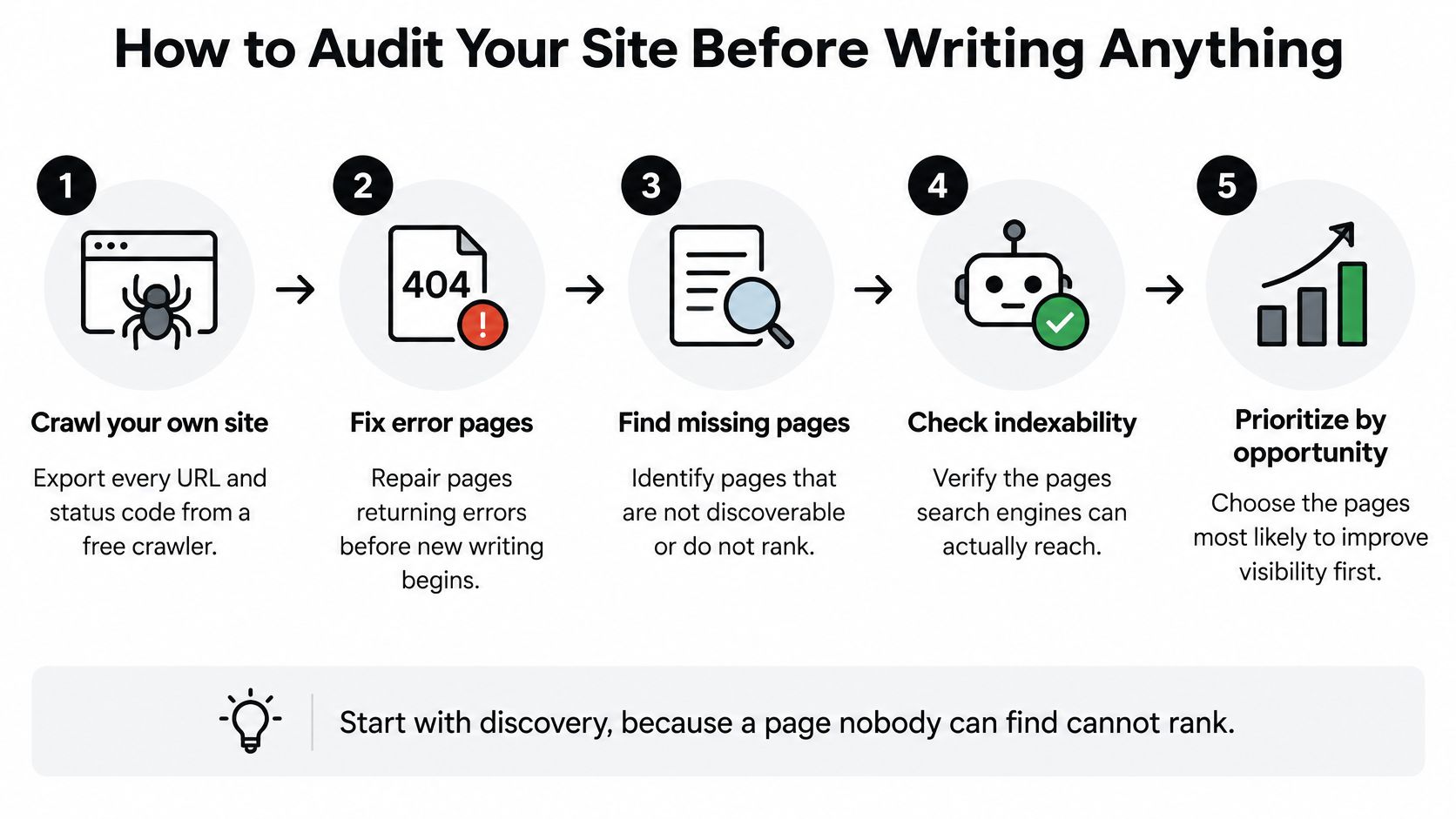
Follow the page through the system
-
Crawl the site and export status codes. A free website crawler can produce a URL inventory showing successful responses, redirects, and errors. Repair broken destinations and simplify redirect chains to a single hop wherever possible; checking only the homepage misses faults inside product and article templates.
-
Inspect robots.txt and noindex directives. Commercial pages intended for search need appropriate crawling and indexing permissions. An easy launch mistake is leaving staging restrictions active on the production site, especially when a shared template controls many pages.
-
Reconcile the XML sitemap with the crawl. The sitemap should contain canonical pages intended for search, not staging URLs, thank-you pages, or redirected addresses. Automatically generated doesn't mean accurate, so the marketer should review its contents after major site changes.
-
Check internal discovery routes. As an operating rule, each target page should receive at least two relevant links from already indexed pages. Descriptive HTML links are preferable to vague labels, and a campaign landing page shouldn't remain accessible only through its direct URL.
-
Inspect the rendered page. In Search Console's URL Inspection tool, the developer should check that the rendered HTML includes the main copy, headings, and internal links. A page looking complete in a normal browser isn't sufficient evidence when essential scripts or resources are blocked.
-
Resolve duplicate URL signals. Filtered, parameterised, and near-duplicate versions need a deliberate canonical choice. A frequent mistake is pointing a distinct commercial page to a broader page, creating conflicting instructions about which URL matters.
Make the findings assignable
The issue sheet should include the affected URL, evidence, recommended fix, owner, and verification status. Descriptive titles and accessible CSS and JavaScript belong in that review, not in a later cosmetic clean-up.
For teams wanting a broader maintenance companion, UpTime Web Hosting's website audit checklist for Australian businesses provides a useful starting point for reviewing website health alongside the search-specific checks.
The growth lead should finish with separate lists: technical barriers that prevent appearance and relevance weaknesses on pages already appearing for unsuitable queries. Rewriting copy before resolving an indexing barrier spends effort on the wrong problem.
Measuring SEO Against Pipeline Instead of Rankings
Clicks alone no longer prove SEO works. A Pew Research Center analysis reported by The Daily Star found that users clicked a conventional result in 8% of searches with an AI Overview, compared with 15% without one, across nearly 69,000 Google searches from 900 U.S. adults. Rankings and website visits therefore need separate interpretation.
The measurement model should follow the customer's progress toward revenue.
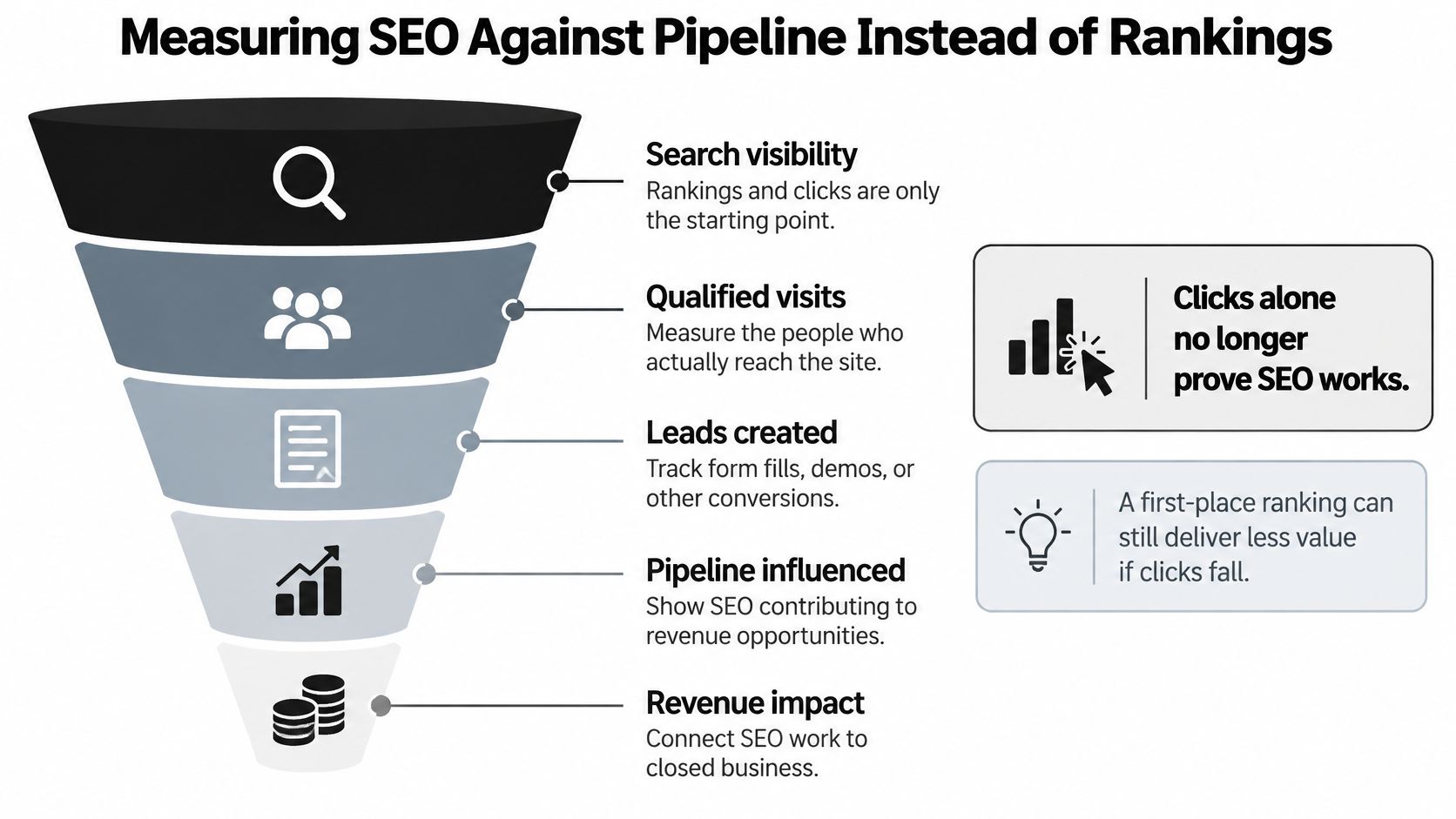
Connect visibility to commercial outcomes
At the top, the marketer tracks impressions and non-branded clicks for the selected query groups. Manual checks should also record whether AI answers appear and whether the company receives a citation, without treating a citation as proof of a visit.
In the middle, analytics should distinguish qualified organic sessions from all sessions. The qualification rule might use target-market geography, relevant product engagement, or a completed trial setup, provided it matches the business rather than an arbitrary engagement score.
At the bottom, the CRM should preserve source information through sales acceptance, opportunity creation, and closed revenue. Assisted journeys matter too: a prospect may discover a guide, return through branded search, and request a demo later.
Five numbers to track per page
| Metric | Source | How to read it |
|---|---|---|
| Impressions and non-branded clicks | Search Console | Compare with the week 2 baseline |
| Qualified conversions per page | Analytics and demo or trial tool | Compare acquisition cost with equivalent paid-search activity |
| Sales acceptance rate | CRM | Check whether organic leads meet the agreed customer criteria |
| Pipeline value from organic leads | CRM with source tag | Review monthly alongside opportunity quality and progression |
| Time to first ranking | Search Console | Count from the publish date and distinguish it from time to revenue |
Interpret fewer clicks carefully
Branded search and direct returns after a guide visit can indicate growing interest, but they don't prove SEO caused it. Product launches, outbound activity, and paid campaigns can influence those signals too.
A marketing ROI framework helps separate useful activity from profitable acquisition. An equivalent paid click provides an opportunity-cost reference, but the comparison should ultimately use qualified acquisition cost, including content and development effort.
A page producing fewer visits but stronger sales acceptance may deserve expansion. A page attracting irrelevant visitors needs a different query, offer, or purpose, not another celebratory traffic report.
Choosing Keywords That Win Before Your Brand Is Known
A prospect asks how to stop trial users disappearing during onboarding. That question is a better starting point than a keyword tool's largest volume estimate because it identifies a customer, a problem, and a possible product connection.
Sales recordings, support tickets, and an initial review of twenty sign-ups can supply a practical candidate list. Those numbers describe a suggested research sample, not a requirement for statistical confidence.
Score the question, not just the volume
The growth lead can use a simple editorial scoring system, assigning each factor a score from one to five:
- Ranking feasibility: Can the company produce a more useful answer than the current results?
- Search demand: Does the available evidence justify a dedicated page rather than a paragraph elsewhere?
- Distinctive proof: Can the team contribute data, a documented process, or a customer account?
- Business value: Could the intended visitor plausibly become a qualified customer?
The calculation is (feasibility + demand + proof) × business value. Business value acts as the multiplier so that broad demand doesn't automatically beat commercial relevance.
In a hypothetical example, a founder hears the onboarding question during three sales calls. Feasibility scores 4, demand 2, and proof 5, giving a subtotal of 11; multiplied by business value 5, the result is 55.
A broad project-management category term might score feasibility 1, demand 5, and proof 1. Its subtotal of 7, multiplied by business value 3, produces 21. These are planning scores, not measured market facts.
Match intent to the next action
Intent segments, page types and conversion events
| Intent segment | Example query type | Page type | Conversion event |
|---|---|---|---|
| Branded | Product or founder name | Homepage or brand page | Demo request |
| Problem-aware | How to reduce onboarding drop-off | Guide with original data | Newsletter or trial signup |
| Solution-aware | Software for a specific team size or workflow | Comparison or use-case page | Demo request |
| Transactional | Pricing for a category tool | Pricing or plan page | Trial start |
A competitor analysis for marketing should examine the actual search results, not merely the companies sales teams consider rivals. A specialist guide, community discussion, or category directory may compete for the same query.
The proposed first-quarter shortlist is fifteen to twenty-five candidates, with the rest parked in a backlog. Similar questions should share a page when the intent and answer substantially overlap.
The strongest differentiator is often evidence. A hypothetical SaaS team with six months of onboarding records could explain where users abandon setup, how the team diagnosed it, and what changed, rather than publishing another generic retention checklist.
Core Web Vitals and Technical Fixes That Pay Off First
Core Web Vitals thresholds
| Metric | Good | Poor |
|---|---|---|
| Largest Contentful Paint (LCP) | Within 2.5 seconds | Above 4 seconds |
| Interaction to Next Paint (INP) | Below 200 milliseconds | Above 500 milliseconds |
| Cumulative Layout Shift (CLS) | Below 0.1 | Above 0.25 |
These thresholds come from Google's Core Web Vitals report documentation, which evaluates report groups using the 75th percentile of real user visits. Local testing helps diagnose a problem, but it isn't a substitute for field performance.
Fix templates before isolated URLs
The developer should export pages marked poor and group them by template. A shared product template deserves attention before an isolated campaign page when it affects the company's most commercially important destinations.
Each metric needs a different investigation:
- LCP requires loading diagnosis. Compress an oversized hero image, serve an appropriate image size, and consider preloading the genuine largest above-the-fold asset. Slow server response also deserves inspection before the team blames the image alone.
- INP requires interaction diagnosis. Inspect JavaScript running during taps, clicks, and typing. Heavy widgets and unnecessary tags should be deferred or removed, then tested on a mid-range phone.
- CLS requires layout discipline. Reserve dimensions for images, embeds, and advertising slots. Late-loading interface elements shouldn't push a pricing button or form field away from the user.
Changes need a date, an affected template, and before-and-after evidence. Real-user reporting may lag local improvements, so the team should avoid repeatedly changing an implementation before enough field evidence is available.
Keep the development brief narrow
Rendering problems require a different conversation from image compression. A review of server-side versus client-side rendering can help the growth lead describe whether essential content is available reliably, rather than requesting a framework migration without a diagnosis.
When internal engineering capacity is unavailable, teams considering whether to hire developers from latin america through HireDevelopers.com should prepare a bounded technical brief first. The assignment should name affected templates, reproduction steps, acceptance criteria, and rollback requirements.
A faster low-value page isn't automatically a better investment than a usable, accessible page that supports qualified demand.
The developer should verify a representative template before repeating the fix elsewhere. Performance work belongs in the same prioritisation system as content: customer impact, commercial importance, implementation effort, and confidence in the diagnosis.
Content and Link Experiments You Can Ship This Month
AI can accelerate preparation, but it doesn't excuse interchangeable pages. Google's spam policies identify scaled content abuse as producing many pages primarily to manipulate rankings rather than help users, whether automation, people, or both produce them.
The editorial review should focus on evidence and usefulness, with the writer and subject specialist examining the page together.

A useful publishing standard requires an original asset: product data with appropriate permission, a documented experiment, an interview quote, or a real workflow screenshot. A draft that merely swaps an industry or location name should return to the writer.
That asset still needs interpretation. A screenshot without instructions or a customer quote without context doesn't explain how the reader should make a decision.
Test distribution with explicit hypotheses
The following are proposed experiments, each using a thirty-day observation window rather than a promised results deadline.
Digital PR test. The hypothesis is that a distinctive product finding will earn relevant editorial attention. The marketer pitches one original data point to three category journalists or newsletters, explains the methodology, and records responses, relevant referring domains, referral visits, and qualified actions.
Partner test. The hypothesis is that customers researching an existing integration will respond to a concrete workflow page. Both companies publish useful implementation information and link where it helps customers; the team measures qualified referrals and integration-related conversions rather than counting reciprocal links as success.
Comparison test. The hypothesis is that buyers considering an established alternative need clearer trade-offs. The page should explain suitability, limitations, switching work, and circumstances where the other option remains preferable, then measure sales acceptance and demo quality.
A video can serve as optional context during the team's experiment-planning session.
<iframe width="100%" style="aspect-ratio: 16 / 9;" src="https://www.youtube.com/embed/Qp7Ibw18xa4" frameborder="0" allow="autoplay; encrypted-media" allowfullscreen></iframe>Decide what earns another iteration
Useful marketing experiment examples start with a hypothesis and a decision rule. The log should capture the target page, launch date, expected signal, production effort, and outcome against the baseline.
The team can run the proposed tests in parallel when capacity allows, or select a smaller pair for the roadmap. A limited observation window can reveal promising signals without establishing causation or final revenue impact.
An experiment deserves another iteration when relevant customers respond or commercially useful behaviour improves. No response may mean weak distribution, an unconvincing asset, or an unsuitable audience, not necessarily that the entire channel should be abandoned.
When Not to Invest in SEO Yet
Not every customer question deserves a search page this quarter. A team that needs immediate sales, keeps changing its target buyer, or can't maintain its website may gain more from direct customer conversations and faster acquisition tests.
A market opportunity assessment should precede a large publishing commitment. The practical decision is whether search addresses the current growth constraint.
Apply a rejection test
- Customer evidence: Has a paying customer, credible prospect, or support conversation raised the question recently? Without that evidence, the topic stays provisional.
- Search-result conditions: The marketer should inspect a private-window search, note AI answers, and record the leading domains. Private browsing doesn't remove location effects, so the check should reflect the target market.
- Ability to improve the answer: If established publishers already provide strong answers and the startup has no distinctive evidence or process, the topic should wait.
- Commercial relevance: If the intended visitor has no plausible route to a trial, demo, or sale, the question may be useful editorial research without being a traffic target.
A proposed parking rule is to defer a candidate that fails two checks until the next quarterly review.
The evidence doesn't justify declaring all AI-exposed queries worthless. A Semrush analysis described in usability.de's AI Overview study discussion found AI Overviews on 6.5% of queries in January 2025, nearly 25% in July, and below 16% by November; matched-keyword zero-click rates fell from 33.75% to 31.53%.
The company's own query mix should determine investment, not a market-wide average treated as a forecast.
Pick One Page and Ship It This Week
A new startup site may have too little search history to identify a page by impressions. Start with the customer question most closely tied to a business outcome. If the site has useful search data, choose a page with relevant impressions and a clear path to conversion.
Write the brief in one line: primary query, intended conversion, original asset. If any part is vague, narrow the page before writing.
Ship a focused page release
Set a seven-day deadline. Make the page eligible for search, fix or schedule performance issues, add relevant internal links, and publish or update content that gives the intended customer a useful next step.
Use the acceptance test from the roadmap to check that the release is ready. Then record three things:
- Baseline: Impressions, average position, and conversion rate, with missing or limited data identified.
- Verification: Whether the live page, form, internal links, and conversion tracking work.
- Review decision: What evidence will prompt the team to expand the topic or change the page.
Wait for this page's early visibility or conversion evidence before choosing the next one. If it stays quiet, diagnose the page before adding a companion article.
The Sprints & Sneakers onboarding process makes measurement operational: the client connects their website, shares data, and states their goals. The full SEO infrastructure is set up within one working day.
The release is ready when it serves a defined audience, has a clear evidence baseline, works as intended, and has a named owner.
Sprints & Sneakers offers SEO for B2B, SaaS, and e-commerce businesses, covering technical SEO and content with AI and senior strategists. Prospects can book a free SEO session to discuss their site and keyword priorities. Visit Sprints & Sneakers with a candidate page, customer question, and conversion goal to shape a focused starting point.
Related articles


Frequently asked questions
Growth marketing, AI and automation, SEO, performance marketing, retention strategies, and sustainable business practices.
Weekly. Subscribe to our newsletter to get new articles straight to your inbox.
Absolutely. Everything we publish is designed to be actionable. Take it, test it, and make it your own.
Yes. We publish experiments with real numbers. What worked, what didn't, and what we learned.
Our growth team — strategists, performance marketers, data specialists, and AI builders who work on client campaigns every day.
We're open to it. Reach out via our contact page with your topic and we'll take a look.