
Why Is Customer Lifetime Value Important for Growth
Why is customer lifetime value important? Learn how CLV shapes acquisition budgets, retention priorities, and forecasting to drive sustainable business growth.
A founder checks the growth dashboard before a weekly finance review. New customers are up, the pipeline looks busy, and acquisition campaigns are producing conversions. But revenue is flat, margins are under pressure, and the finance team wants to know which customers pay back.
That gap isn't solved by another conversion report. It's solved by understanding customer lifetime value (CLV): the expected contribution a customer generates across the relationship, not just the amount they spend at the start. If the team is asking why is customer lifetime value important, the practical answer is that CLV changes what gets funded, which customers deserve attention, and whether growth is creating durable profit.
Table of Contents
- The Growth Decision Most Teams Get Wrong
- What Customer Lifetime Value Actually Means
- Why Retention Moves the Needle More Than Acquisition
- Acquisition Versus Retention Budget Allocation
- The Ratio Rule That Misleads Most Teams
- Pricing, Product, and Forecast Decisions Driven by CLV
- A Practical Plan to Measure and Improve CLV This Week
The Growth Decision Most Teams Get Wrong
Most marketing leaders can tell you how many leads arrived, how much a campaign spent, and how many customers converted. Far fewer can show whether those customers will generate enough contribution margin to repay what the business spent acquiring and serving them.
That missing perspective can make a healthy-looking dashboard misleading. A channel that wins inexpensive first purchases may attract customers who never return. Another channel may look weaker on immediate conversion but bring in buyers who renew, purchase again, or expand. Last-click attribution adds to the problem when it awards credit to the final interaction and ignores the earlier work that introduced, activated, or retained the customer.
Follow the money beyond the first conversion
The fix is to connect acquisition performance to later customer behavior. Start by comparing customers from each channel or campaign, then track what they contribute after acquisition costs, product costs, and service costs. Look at cohorts rather than a single blended average, since a strong segment can hide a weak one.
Practical rule: Don't scale a channel just because it produces customers cheaply. Scale it when those customers show a credible path to profitable payback.
This doesn't mean acquisition metrics are useless. Conversion rate and cost per lead help diagnose the funnel. They just can't answer whether a customer relationship creates value over time. CLV gives those short-term measures a financial context.
Make this week's budget decision sharper
A growth team can apply the idea immediately. For each major channel, compare acquisition cost with the contribution margin and retention behavior of the customers it brings in. If one channel produces many first purchases but weak repeat behavior, pause expansion until the team understands why. If another brings in fewer customers who activate well and keep buying, protect that budget while gathering more cohort evidence.
The goal isn't to replace every dashboard metric with one lifetime number. It's to make CLV a decision system that connects acquisition, activation, revenue, retention, and referral. Used well, it helps the team decide what to fund this week rather than merely describe what happened last week.
What Customer Lifetime Value Actually Means
CLV isn't the total revenue a customer has generated. A useful growth model estimates the discounted present value of expected contribution margin across future periods, accounting for churn probability, retention expenses, and the discount rate, as described in Bain's guidance on loyalty-based management.
In plain English, contribution margin is what remains after the variable costs of serving the customer. Discounting recognizes that money expected later isn't worth exactly the same as money available now. Churn probability accounts for the possibility that a customer leaves before producing all the value the business expects.
Revenue is not profit
A revenue-only CLV can flatter customers who generate large orders but require steep discounts, costly support, or expensive fulfillment. A margin-adjusted estimate forces the team to subtract the costs that rise with each customer relationship. That's the version finance can use to judge how much acquisition spending is economically sensible.
Consider two customers who place the same first order. Their first-purchase revenue is identical, but one never buys again, while the other returns and makes additional purchases. If their margins and service costs are comparable, the repeat buyer's contribution grows with each profitable order.
| Two Customers With the Same First Order | Customer A (one-time buyer) | Customer B (repeat buyer) |
|---|---|---|
| First order | Same revenue as Customer B | Same revenue as Customer A |
| Later behavior | No further purchases | Makes additional purchases |
| CLV implication | Value depends on the first order's contribution after costs | Further profitable purchases add to expected contribution |
To make a simple spreadsheet version, create a row for each cohort and estimate future contribution by period. Apply a retention or churn assumption to each period, subtract relevant variable and retention costs, then discount the expected contribution. The estimate should change when behavior changes. A first order, repeat purchase, renewal, inactivity, refund, or cancellation can all update the forecast.
For teams working on repeat-purchase behavior, this guide to Shopify customer retention offers practical context for thinking about customer journeys after the first sale.
CLV isn't a permanent label attached to a customer, and it isn't a vanity metric that should be optimized without regard to margin. Nor is it identical to customer equity, which refers to the combined value of customer relationships across a business. Use CLV to guide a decision, then update it as evidence changes.
Why Retention Moves the Needle More Than Acquisition
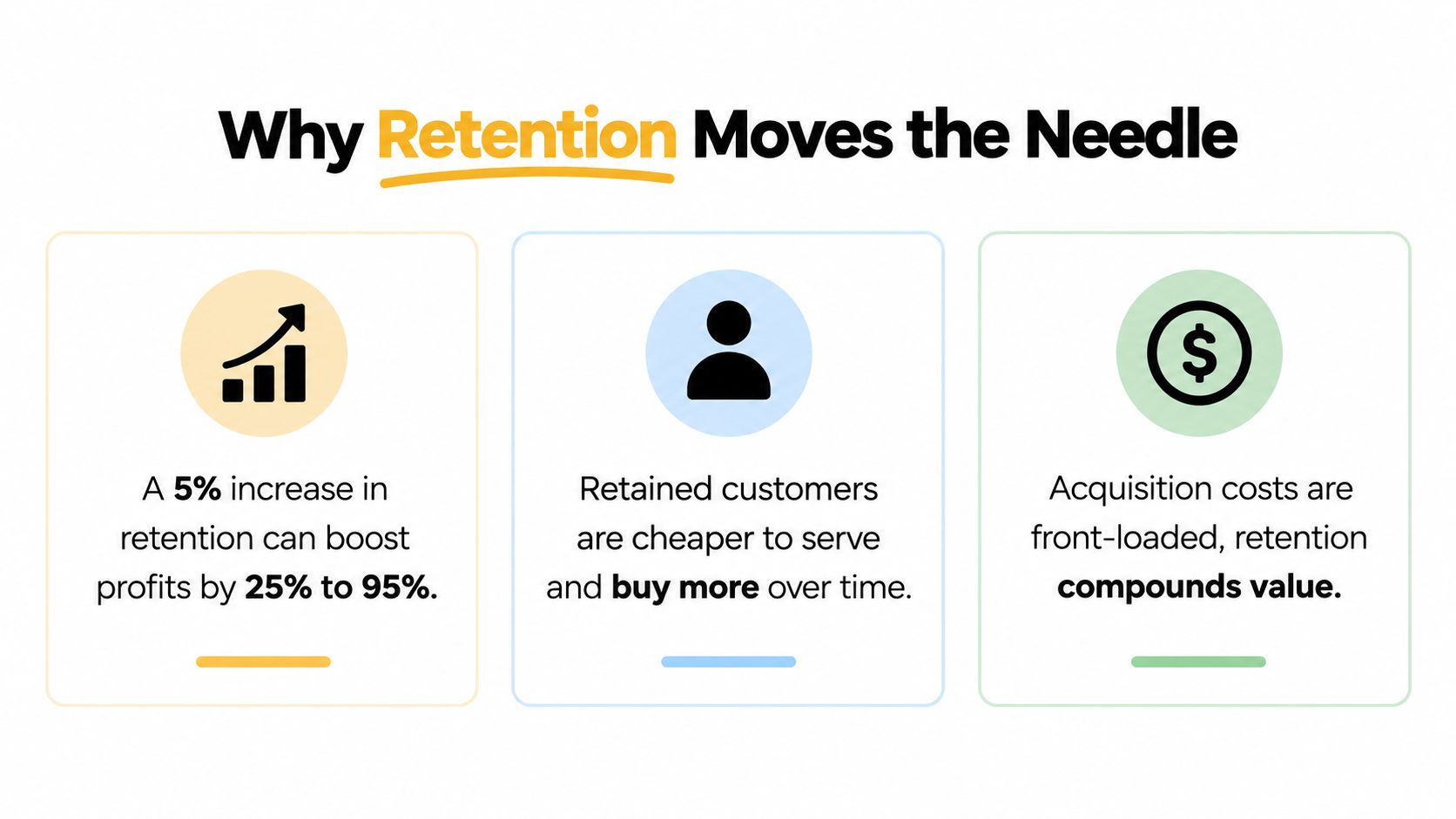
Retention matters because it preserves the possibility of future contribution instead of forcing the business to replace every lost customer with a new acquisition. Bain's foundational retention research found that a 5% increase in customer retention can raise profits by 25% to 95%, depending on industry and business model (Bain's loyalty research).
That finding isn't a guaranteed forecast for any particular company. It's a reason to model retention as an economic lever rather than treat churn as a customer-success metric with no connection to the P&L.
Why the economics can compound
Three mechanics explain why retention can have an outsized effect:
- Fewer replacement costs: When fewer customers leave, the business has less lost revenue to replace through new acquisition.
- More repeat behavior: Customers who continue buying or renewing can generate further contribution without starting every relationship at zero.
- Changing service needs: Loyal customers may become more familiar with a product or process, which can reduce the effort required to serve them. Teams still need to validate this in their own cost data.
A simple comparison makes the logic concrete without pretending to predict a universal result. Suppose a business evaluates two proposals: a retention change that lifts retention by 5%, and an acquisition push that lifts new customer volume by 5%. It shouldn't assume either proposal produces the same profit lift. Instead, estimate each proposal's expected contribution after its costs, then compare those results over the same period. The retention proposal may preserve later purchases or renewals; the acquisition proposal may add customers who still need onboarding and may not remain. The answer depends on actual margins, churn, and acquisition economics.
Treat churn as an operating signal
Retention isn't owned by one team. Product adoption, onboarding, service quality, pricing, and customer success can each affect whether customers stay and what they contribute. Teams should identify where customers leave, then test a specific intervention against a defined cohort instead of launching broad retention activity without a financial hypothesis.
For practical ways to diagnose and address the causes of churn, this resource on how to cut customer churn can help teams organize the work. The important discipline is to measure whether an intervention improves incremental contribution, not merely whether it generates more activity.
For a concise visual overview of the retention economics, the infographic above summarizes the main mechanisms. The business decision remains specific to each company: fund the retention play when its expected contribution lift exceeds its full cost.
Acquisition Versus Retention Budget Allocation
Growth budgets often follow last quarter's plan, an old channel mix, or whoever has the strongest pipeline target. CLV offers a more defensible test: compare the cost of acquiring customers with the contribution those customers are expected to generate, then compare that opportunity with the value of improving existing relationships.
Three measures belong in the same decision:
- Blended CAC: The acquisition cost across the relevant customer group, not a channel number stripped of overhead.
- Contribution-margin CLV by cohort: Expected customer contribution after variable costs, segmented so profitable accounts don't hide weak ones.
- CAC payback period: How long the business expects to wait before customer contribution recovers acquisition cost.
A widely circulated estimate says acquiring a new customer costs 5 to 25 times more than retaining an existing one, though the actual ratio depends on industry and channel mix (Thematic's overview of customer experience statistics). Treat that as a broad benchmark, not a rule for setting a budget. A company's own cost and margin data should decide.

Compare the same budget against two uses
Take a team considering whether to add more top-of-funnel advertising or use the same planned spend to improve onboarding and lifecycle communication. The acquisition-heavy option could bring in more new customers, but its payback depends on their future contribution and retention. The retention-oriented option could improve activation or encourage repeat purchases among customers already acquired, but it has costs and may not work for every segment.
Don't invent a lift estimate to make either option look attractive. Build a forecast from cohort data: define the customers affected, estimate the expected margin change, include the cost of the intervention, and compare the result over the same planning horizon. Then record actual outcomes and forecast error. If the retention forecast repeatedly misses, update its assumptions rather than defending a favorite program.
Decision test: Fund the option with the stronger expected incremental contribution, provided the team can measure its effect and the business can support the work.
Acquisition can still be the right priority. A new product, geographic expansion, or an aggressive growth phase may require customer acquisition before a mature retention base exists. The point isn't to shift every dollar toward retention. It's to stop allocating by habit and make the trade-off visible.
The Ratio Rule That Misleads Most Teams
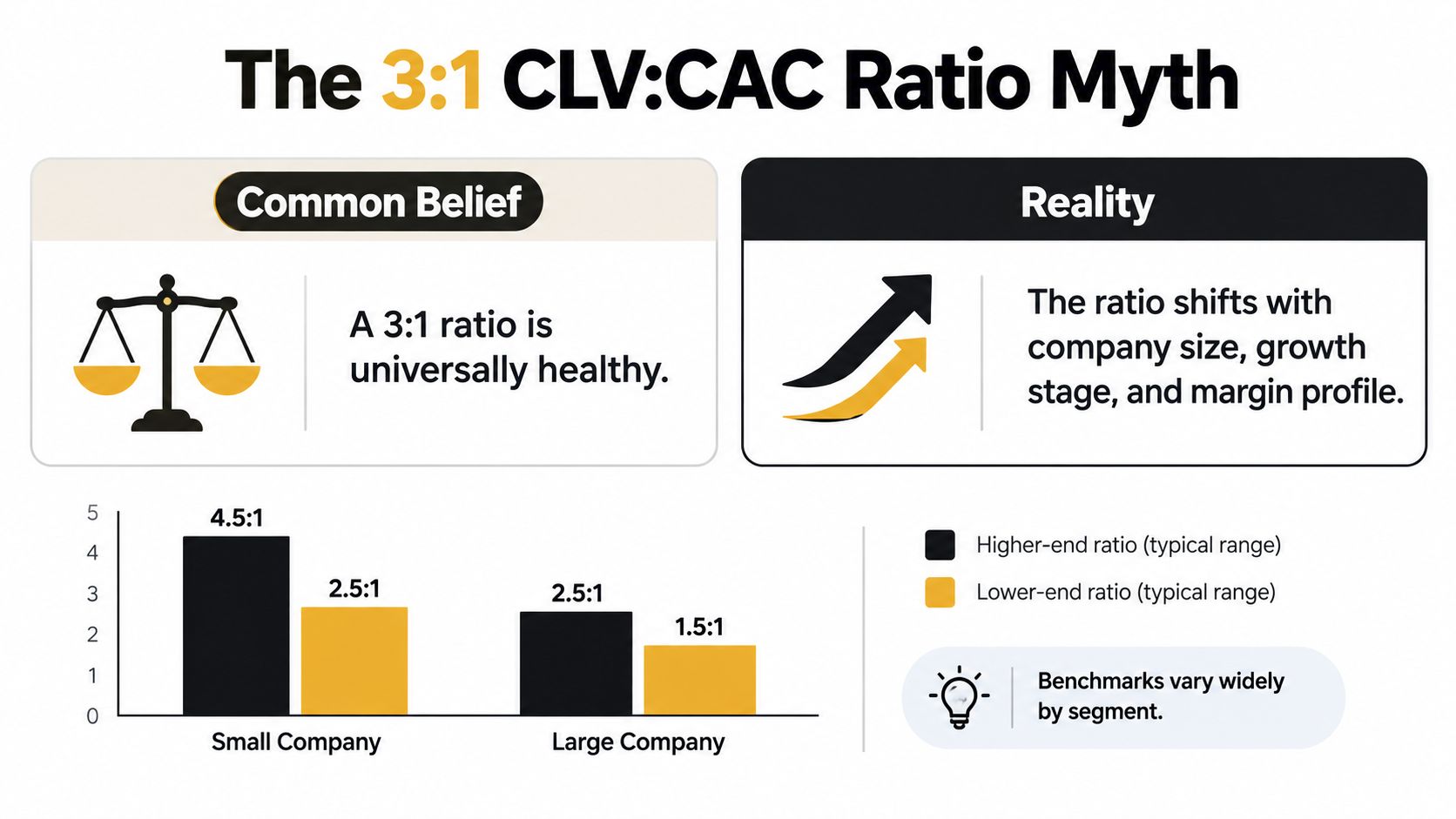
A CLV:CAC ratio can summarize customer economics, but a single target can't diagnose them. The familiar 3:1 rule is often treated as a universal benchmark, even though the right interpretation changes with company size, annual contract value, gross margin, churn, average revenue per account, and expansion revenue.
SaaS Capital's 2025 benchmark of more than 1,000 private B2B SaaS companies reported median gross revenue retention of 91% and median net revenue retention of 101%. Those measures describe different things: gross retention tracks retained revenue before expansion, while net retention includes the effect of expansion. A company can lose some customers or revenue and still grow the starting base through expansion.
Read the shape of the economics
A falling CLV:CAC ratio doesn't automatically mean growth has become unhealthy. A larger company may invest more in enterprise sales, serve a different customer mix, or accept different payback expectations as it scales. Equally, an attractive blended ratio can conceal weak small-business retention if a few large accounts dominate the average.
Report gross-margin-adjusted CLV against CAC alongside payback period, gross retention, net revenue retention, and expansion contribution. Break those measures out by cohort, channel, customer size, and maturity. That makes it harder for high-revenue accounts to disguise discounting or a heavy service burden that erodes profit.
Revenue alone can also mislead campaign decisions. A customer who buys at a deep discount and requires costly support may contribute less than a smaller account with stronger margins. The team should inspect what remains after costs, not just what appears on the invoice.
Don't optimize for customer lifespan alone
The contrarian point is simple: a long-lived flat customer can be less valuable than a shorter-lived expanding customer. If one account stays for a long time but never expands and consumes substantial support, while another grows quickly and contributes more margin over a shorter relationship, lifespan alone points to the wrong priority.
That doesn't mean teams should chase expansion at any cost. Discount-led expansion can damage margin, and aggressive selling can weaken trust. The useful question is whether a specific segment creates more contribution after acquisition, service, and retention costs. CLV works best as a decision system, not a trophy ratio.
Pricing, Product, and Forecast Decisions Driven by CLV
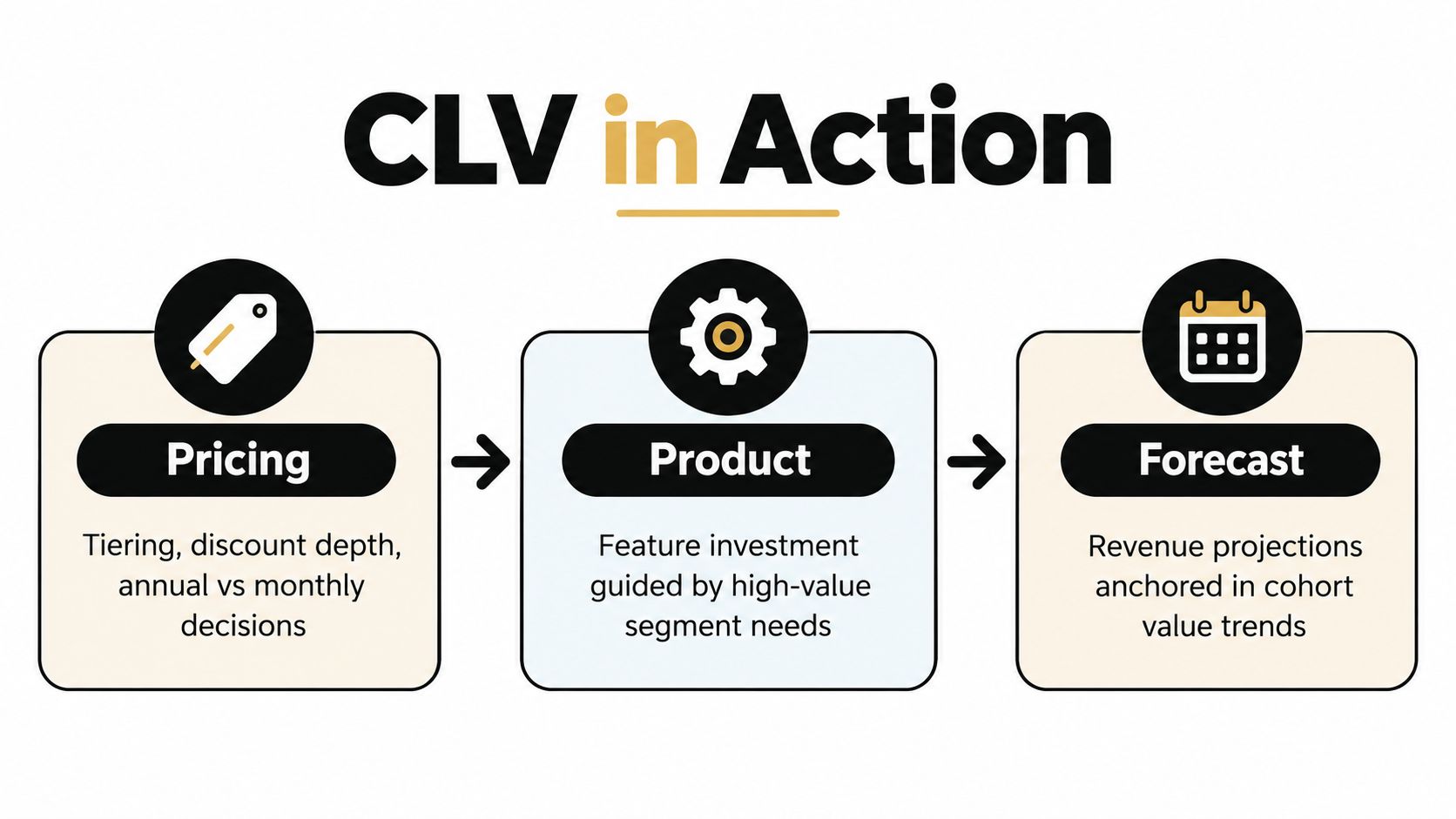
A trusted CLV model changes more than campaign budgets. It gives pricing, product, and finance teams a shared way to compare customer contribution over time. Research using public data from firms including Amazon, eBay, and Capital One found that customer-based valuations were reliable proxies for firm value in three of the five companies studied (the research on customer-based valuation).
That doesn't make CLV a replacement for financial reporting. It does show why customer economics can help leaders assess future value that a backward-looking revenue figure may not capture.
Use the same model to test three decisions
Pricing: Compare tiers, discount depth, and payment terms by segment. A price change may lift margin while increasing churn for one group, yet have little effect on another. The team should test the expected contribution trade-off by cohort rather than apply one price decision to the whole base. For a business exploring loyalty mechanics, stamp card pricing packages provide context for how a repeat-purchase offer can be structured; any such offer still needs to be judged on margin and customer behavior.
Product: Prioritize features that change customer behavior linked to value, such as activation, adoption, renewal, or expansion. A feature that looks good in a launch announcement but doesn't change those outcomes may deserve less investment than an unglamorous onboarding improvement.
Forecasting: Build projections from customer cohorts and their expected contribution patterns. When actual renewal, repeat purchase, or expansion differs from forecast, treat the gap as a signal to revise the model or investigate the customer experience.
Consider a SaaS business reviewing two customer segments. One segment has low initial revenue but strong adoption and expansion potential; another has larger starting contracts but weak renewal behavior. A first-order-only view may protect the larger initial sale and miss the smaller segment's future contribution. A CLV view lets the team test a price increase for the segment that can absorb it while protecting the one at greater churn risk. That's a decision to validate with actual cohort behavior, not an invented result.
A Practical Plan to Measure and Improve CLV This Week
Start with two cohorts: customers acquired through the largest channel and customers who renewed or made repeat purchases. Track acquisition source, revenue, contribution margin, service or retention cost, churn or repeat behavior, and expansion where relevant. Keep cohort definitions consistent so the team can compare results without letting averages blur the differences.
| Step | What to Build | Owner | Done When |
|---|---|---|---|
| Define cohorts | Acquisition-channel and renewal or repeat-purchase groups | Growth and finance | Each customer has a consistent cohort label |
| Calculate CLV | Expected contribution after variable costs, adjusted for retention and discounting | Finance or analytics | Assumptions are visible and reviewable |
| Ship a dashboard | Cohort CLV, CAC, payback, churn, expansion, and forecast error | Analytics | Leaders can compare customer economics by segment |
| Run experiments | Test an onboarding fix and a targeted expansion or cross-sell motion | Product, growth, and customer success | Each test has a hypothesis, cost, and contribution-based success measure |
Don't wait for perfect data. Start with a transparent model, label uncertain assumptions, and improve it as customer behavior arrives. Sprints & Sneakers helps growth teams measure CLV alongside acquisition cost, margin, and retention, then prioritize full-funnel experiments across acquisition, activation, revenue, retention, and referral.
Sprints & Sneakers helps B2B and consumer growth teams identify funnel bottlenecks, measure customer economics, and prioritize experiments that can build more predictable growth. Visit Sprints & Sneakers to explore how a growth scan can help clarify what to fund next.
Related articles



Frequently asked questions
Growth marketing, AI and automation, SEO, performance marketing, retention strategies, and sustainable business practices.
Weekly. Subscribe to our newsletter to get new articles straight to your inbox.
Absolutely. Everything we publish is designed to be actionable. Take it, test it, and make it your own.
Yes. We publish experiments with real numbers. What worked, what didn't, and what we learned.
Our growth team — strategists, performance marketers, data specialists, and AI builders who work on client campaigns every day.
We're open to it. Reach out via our contact page with your topic and we'll take a look.