
Generative engine optimization agency: get named in ChatGPT and AI Overviews
We optimise your brand and content for ChatGPT, Perplexity, Gemini and Google AI Overviews, so AI mentions your brand the moment your potential customers ask a question.
43 reviews on Google
SEO and GEO with AI
What is a generative engine optimization agency?
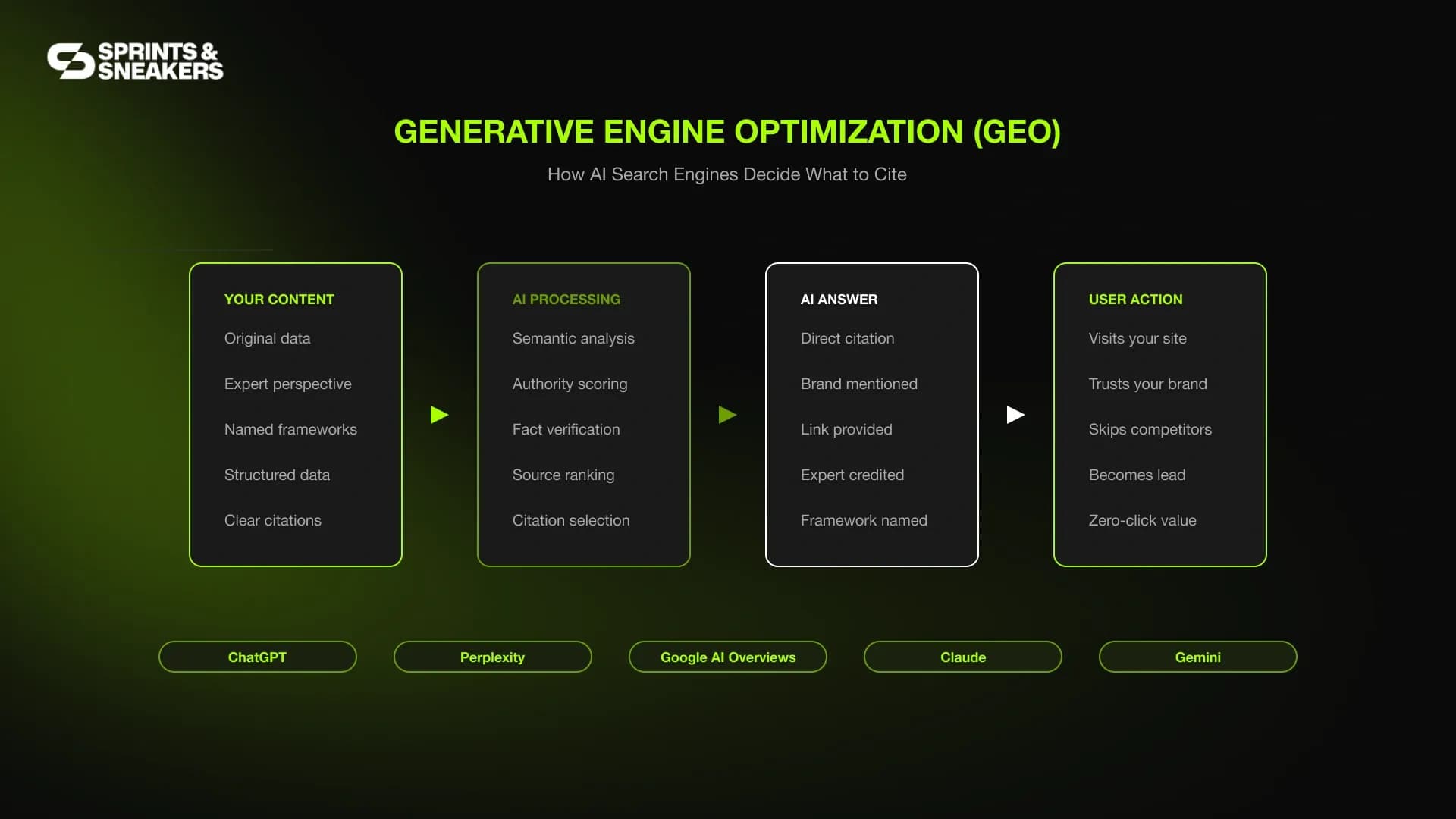
Generative engine optimization (GEO) makes sure AI search engines such as ChatGPT, Perplexity, Gemini and Google AI Overviews name your brand and cite your site as a source. SEO is about your position in Google, while GEO is about appearing in the answer itself. A generative engine optimization agency, or GEO agency, does that work for you: it finds the questions your buyers ask AI, makes your content easy to quote and builds authority on the sources AI draws from.
Sprints & Sneakers is a B Corp-certified growth marketing agency in Amsterdam that helps B2B and B2C brands grow with senior strategists, AI agents and monthly sprints. Our GEO work builds on SEO with AI: the same foundation, plus content and authority that AI systems pick up.
What our GEO work covers: strategy, content and authority
More and more of your customers get their answer from ChatGPT or Perplexity instead of a link in Google. We make sure your brand shows up in that answer, and we build authority in the places where a growing share of people now look for answers.
Full-funnel GEO strategy
From the first exploratory question to the moment someone is ready to buy, we make sure your brand shows up at every stage where your customer uses AI to search.
AI-proof content
Content structured the way AI picks it up: short and clear enough to summarise, with the information AI looks for before it recommends anything.
Scalable visibility
More presence in AI answers, without you having to update content yourself every month.
Authority that builds on itself
We build a content structure that keeps pointing AI to your brand as the place for answers on your topic. Each piece supports the next one, so your authority keeps growing after the first articles go live.
How it works
From analysis to real visibility in AI search, in three steps.
Intake and analysis
We review your current content and look for where your growth sits in AI search results. Which questions do your competitors already get named for, and which ones are you missing?
Strategy and optimisation
Based on that analysis we build a GEO strategy and optimise your content, so AI systems pick up your brand sooner and include it in their answers.
Growth and visibility
Your brand appears in more AI answers and your authority grows. The content and mentions we build stay in place, so your visibility keeps growing over time and competitors need longer to catch up.

How do you measure visibility in AI search engines?
There is no single ranking for AI visibility, so you look at two signals on each platform.
Mentions
Does the AI name your brand when your audience asks its questions? That decides whether you make the shortlist.
Citations
Does the AI link to your website as a source? Citations bring in traffic and strengthen your authority for the next question.
Per platform
ChatGPT, Gemini, Perplexity and Google AI Overviews each pick their sources differently, so you check per platform where you show up and where you don't.
Further reading
Frequently asked questions
A generative engine optimization agency makes sure AI tools name your brand when your audience asks a question. At Sprints & Sneakers we work out which questions matter, make your content easy for AI to quote and build authority on the sources AI draws from, always alongside SEO.
Generative engine optimization (GEO) means optimising your brand and content so AI search engines such as ChatGPT, Perplexity, Gemini and Google AI Overviews mention you and cite you as a source. SEO is about your position in Google, while GEO is about appearing in the answer itself.
GEO gets your brand into the answers of AI tools such as ChatGPT, Perplexity and Google AI Overviews. That brings more qualified traffic, stronger authority and more conversions, and you don't need to raise your ad budget to get there.
SEO gets you ranking in Google's search results, and GEO gets you named in the AI answer itself. With SEO, people click a link to your site. With GEO, a tool like ChatGPT, Perplexity or Google AI Overviews mentions your brand in its answer. Those AI tools choose their sources in their own way, so GEO needs a different approach from SEO.
You measure AI visibility per platform, using two signals: mentions (does the answer name your brand) and citations (does it link to your website as a source). ChatGPT, Gemini, Perplexity and Google AI Overviews each work differently, so you check per platform and per question.
Any business that relies on being found online. Whether your customer googles or asks ChatGPT, you want to be there while they are weighing their options.
That depends on your starting point and your niche, so we don't promise a timeline. We measure your AI visibility from the start and report on it in every monthly sprint, so you can see where you show up and what changes.
Not necessarily. SEO and GEO do strengthen each other, and a solid SEO foundation makes your GEO results come faster and go further.
No. B2B and B2C brands both benefit, because people ask AI about everything from business software to holiday destinations to baby gear.
Every proposal is custom. The investment depends on your goals, your market and how visible you already are in AI search engines. In a GEO session we map your opportunities and you get a proposal that fits.
Sprints & Sneakers is a B Corp-certified growth marketing agency in Amsterdam that helps B2B and B2C brands grow with senior strategists, AI agents and monthly sprints. For GEO and SEO we pair AI with senior strategists.
Articles about this topic

AI SEO agents: How autonomous SEO will change search in 2026
AI SEO agents perform keyword research, technical audits, content creation, and rank monitoring independently. But strategy remains a human endeavor. How autonomous SEO will work in 2026, what agents can and cannot do, and why you can no longer view SEO and GEO as separate entities.