
Facebook Ads Optimization: A Playbook That Works
Facebook ads optimization made practical. Diagnose bottlenecks, run clean tests, refresh creative, and scale winners without burning budget.
Most Facebook Ads advice starts in the wrong place. It says to test more audiences, increase budget, launch more campaigns, and let the algorithm figure it out. That's backwards.
When an account underperforms, the first job isn't to push harder. It's to identify which signal broke first. Facebook ads optimization works when each lever is conditional. Creative comes first if attention is weak. Landing page comes first if click quality is fine but conversion falls apart. Tracking comes first if reported performance looks too good or too bad to trust.
That diagnostic matters because Meta is a mature auction, not a cheap traffic loophole. Traffic campaigns across industries averaged a 1.71% click-through rate in 2025, with an average $0.70 cost per click, while lead-generation campaigns averaged about $1.92 CPC according to these benchmark figures. In a market that tight, sloppy decisions get expensive fast.
Table of Contents
- Why Most Facebook Ads Optimization Efforts Stall Before They Start
- The Diagnostic First, the Tactics Second
- Setting KPIs and Budgets That Survive the Learning Phase
- Running Creative and Audience Tests You Can Actually Trust
- Reading Creative Fatigue Before Your Dashboard Screams About It
- Bidding, Budgets, and When to Hand Delivery to the Machine
- Attribution, Incrementality, and Measuring What Actually Moves
Why Most Facebook Ads Optimization Efforts Stall Before They Start
Facebook ads optimization usually fails before the first real decision gets made. The team starts changing things before anyone proves what broke.
A campaign dips for three days, and the response is predictable. Raise budget. Duplicate ad sets. Broaden targeting. Launch fresh creatives, new audiences, and a new offer in the same week. That is not optimization. It is loss of control.
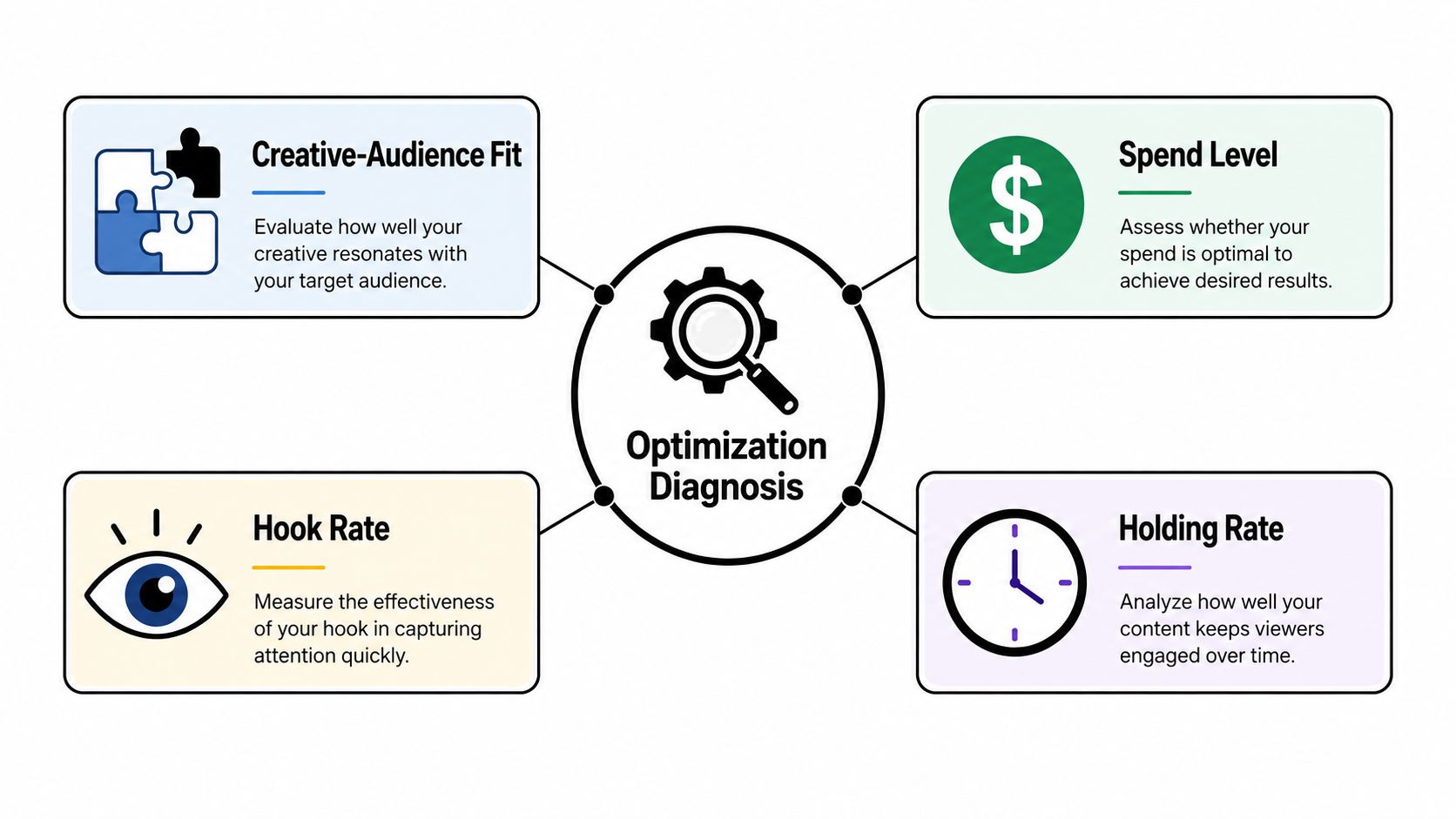
Accounts stall early because teams treat every lever as equal. It is not. One broken constraint usually explains the decline, and until you isolate it, every extra edit makes the read worse.
The four bottlenecks that show up again and again are:
- Creative-audience mismatch. The offer is fine, but the angle misses the buyer, or the buyer is right and the message is wrong.
- Weak hook. People do not stop, so the auction keeps serving impressions without earning attention.
- Poor holding rate. The opening gets the click or the view, but the ad loses momentum before the core claim lands.
- Broken post-click flow. CTR looks healthy enough, then the landing page wastes the intent you paid for.
Here is the rule. Name the first broken signal before you touch budget, bids, audiences, or creative volume.
If your team cannot answer, in one sentence, where performance breaks between impression and conversion, stop editing the account.
That is what separates real optimization from dashboard superstition. Real data-driven marketing means deciding which evidence overrides opinion, then making one change that matches that evidence.
Auction pressure makes this discipline more important, not less. Meta is a crowded paid channel, and crowded channels punish random testing fast. If you solve the wrong problem first, you do not just waste time. You train the account on noisy inputs, reset learning on changes that did not matter, and spend the next week arguing over results you can no longer trust.
The accounts that scale cleanly do one thing differently at the start. They diagnose first, then use tactics as a response to that diagnosis.
The Diagnostic First, the Tactics Second
Random optimization is why so many Meta accounts stall. Teams swap audiences, raise budgets, cut bids, and ship new creatives before they have named the first broken signal. That is backwards.
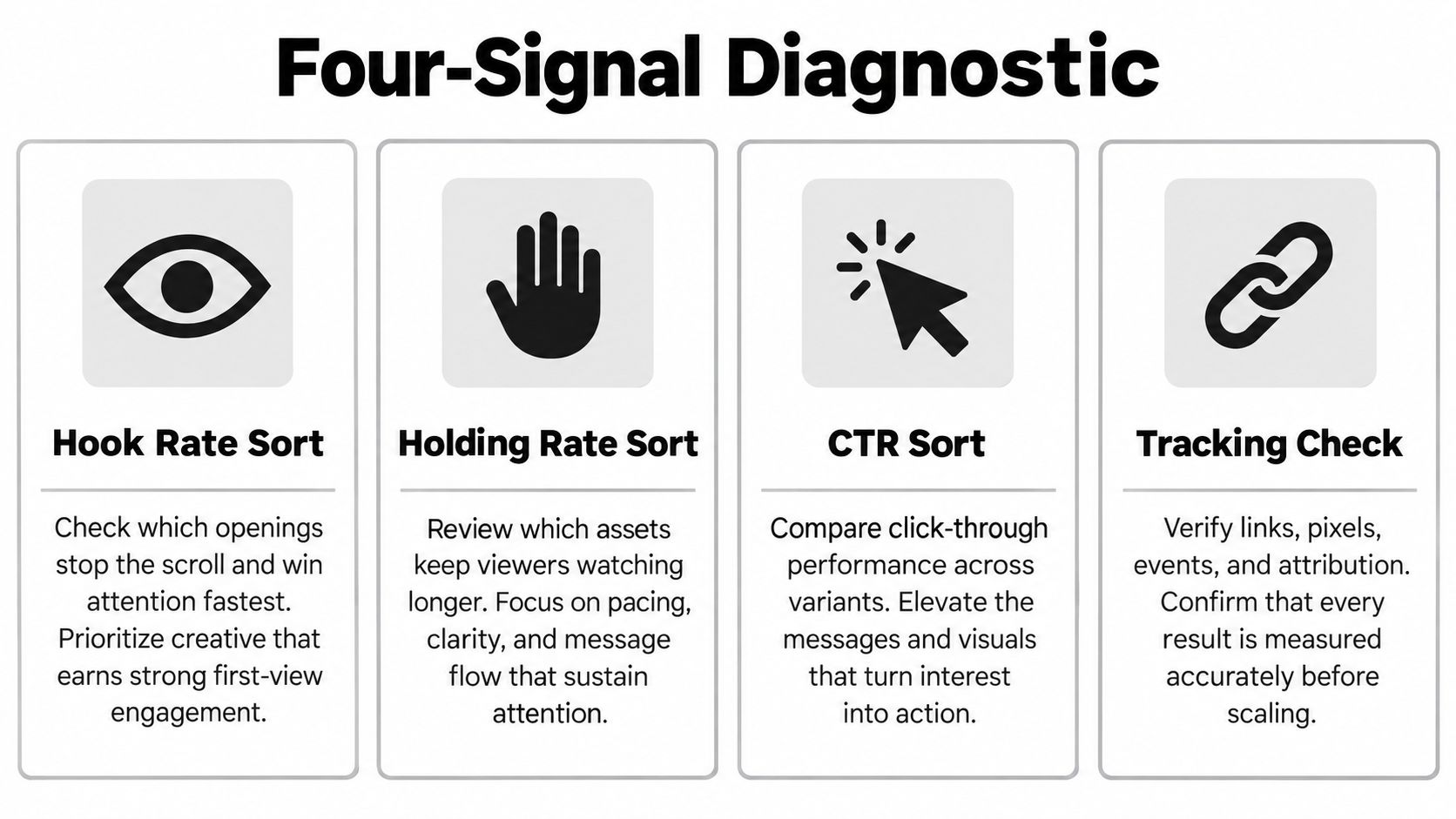
Start with a simple rule. Diagnose in sequence, then stop at the first clear failure. Until you do that, every tactic is a guess.
Sort the ad-side attention signals
Use the last 14 days and review ads, not blended campaign averages. Your job here is narrow. Figure out whether the ad is winning attention before you debate budgets or expansion.
Check these signals in order:
- Hook rate. If the opening cannot earn the first few seconds of attention, nothing else matters. Rewrite the first line, first frame, or first visual.
- Holding rate. If people start and then drop, the ad has curiosity but no payoff. Tighten pacing, move the core claim earlier, and cut throat-clearing.
- CTR. If people watch but do not click, the promise is weak, the offer is unclear, or the audience fit is off.
- CPM trend. If CPM rises while attention signals hold steady, the issue is usually auction pressure, overlap, or account structure, not the ad itself.
This is the first visual worth reviewing before anyone edits ads:
<iframe width="100%" style="aspect-ratio: 16 / 9;" src="https://www.youtube.com/embed/NfA4lAlO8IU" frameborder="0" allow="autoplay; encrypted-media" allowfullscreen></iframe>A useful diagnostic question is specific: where does performance break between impression and click? “Performance is down” is not a diagnosis. “The hook collapsed on the top-spend ad” is.
Separate attention problems from post-click problems
Do not blame creative for a landing page failure. If CTR is healthy and conversion rate falls, check message match, page speed, form friction, and whether the page still delivers the promise made in the ad.
This distinction saves a lot of wasted work. I have seen teams replace perfectly good ads because CPA rose, when the issue was a slower page, a broken form step, or an offer mismatch introduced after launch.
Verify measurement before touching spend
Bad tracking creates fake bottlenecks. If event reporting is unstable, confirm pixel firing, Conversions API coverage, and deduplication before you edit budgets or rotate ads.
A broken feedback loop poisons optimization fast. Meta will keep spending. Your team will keep reacting. Neither action improves results if conversion signals are incomplete or duplicated.
The operating rule is simple. Fix the first bottleneck the diagnostic exposes. Leave the rest alone until that constraint moves. That is how you keep tests readable, protect the learning phase, and scale without turning the account into noise.
Setting KPIs and Budgets That Survive the Learning Phase
Most KPI setups are too crowded. One account tries to optimize for CPA, ROAS, CTR, CPC, conversion rate, and volume at once. That creates panic every time one line wiggles.
A better setup uses a ladder. One primary business KPI, one secondary guardrail, and a budget that gives the ad set a fair shot to exit learning. Meta's learning phase is commonly described as ending after about 50 optimization events within a rolling 7-day window at the ad set level, according to this explanation of the learning phase. If an ad set doesn't get there, performance can stay noisy.
Build the KPI ladder
The team should define the win condition before launch. That sounds obvious, but plenty of accounts still launch with fuzzy expectations and then retrofit logic after results arrive.
| Stage | Primary KPI | Secondary KPI | Daily Budget per Ad Set | Minimum Conversions to Judge |
|---|---|---|---|---|
| Early testing | Cost per acquisition | CTR or landing-page conversion rate | Size budget to support stable delivery and enough conversion signal | Wait until the ad set has enough volume to judge beyond early volatility |
| Scale candidate | Cost per acquisition or qualified conversion volume | Frequency trend | Higher than test budgets, but only when efficiency holds | Judge after stable post-learning performance |
| Mature scaling | Margin-aware acquisition efficiency | Conversion quality or downstream revenue quality | Consolidated budgets on proven winners | Judge on sustained efficiency, not a single strong day |
A lot of teams also confuse boosted social activity with campaign testing. If the goal is social proof or validating engagement before a harder conversion push, this guide on boosting Facebook posts effectively is useful context. That's a different job from conversion optimization, and the KPI should reflect that difference.
Budget for signal, not hope
Testing budgets must support enough conversion density to generate a stable read. If the target acquisition cost is known, a useful budgeting model is to size each ad set so it has room to collect enough optimization events across the week. If that's impossible, the account is over-segmented.
A separate check matters here too. Acquisition leaders should know what counts as an acceptable target before launch. This breakdown of a good customer acquisition cost is the right kind of framing because it ties efficiency to business reality rather than ad platform vanity.
The kill rule should be tied to acquisition economics, not emotion. If the ad set never had enough signal, pausing it early isn't discipline. It's impatience.
Consolidate when signal is thin. Split when a variable needs isolation. Teams that reverse that order stay trapped in learning and call the platform unpredictable.
Running Creative and Audience Tests You Can Actually Trust
Bad testing is one of the fastest ways to waste spend in Meta. Teams change the message, the audience, the placements, and sometimes the offer, then act like the winner taught them something useful. It did not.
Testing only works when each experiment answers one question. Start with the bottleneck you diagnosed earlier. If performance is weak because click quality is poor, test creative first. If the ads are converting with one segment but not another, test audience first. Do not test both at once unless you are comfortable learning nothing.
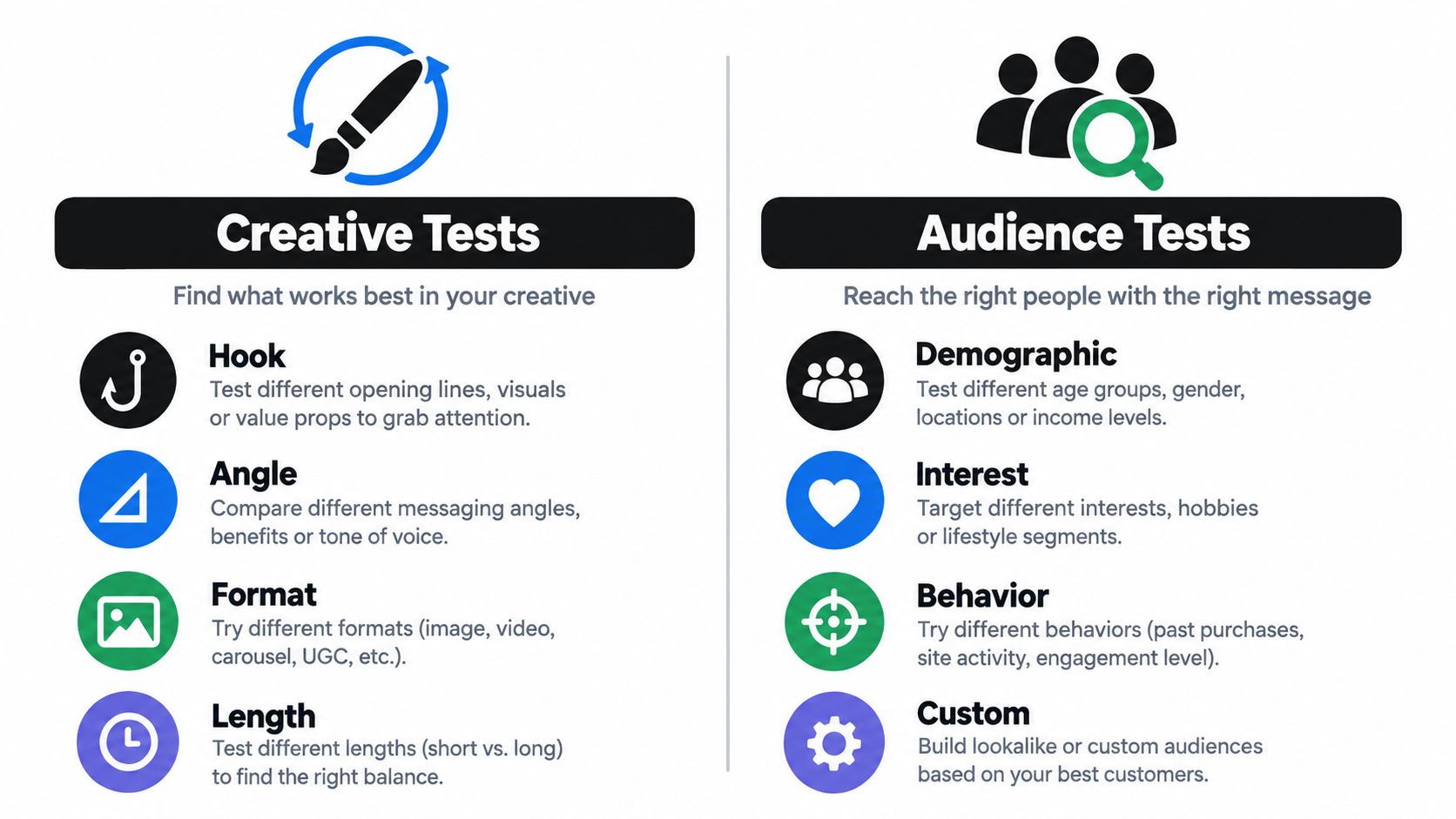
Keep creative tests and audience tests separate
Creative tests need a fixed audience. Audience tests need fixed creative. That rule sounds rigid because it is. Rigid structure is what makes the read trustworthy.
If you need a clean operating model, this guide to A/B testing for marketing is the right standard: one primary KPI, one deliberate variable, and consistent success criteria before launch.
Use a simple decision rule:
- Test creative first when CTR is weak, thumb-stop rate is soft, or landing page traffic quality is poor.
- Test audience first when one message already converts and the account needs a larger pool of qualified buyers.
- Test offer or landing page first when ads get clicks but conversion rate breaks after the click.
That sequencing matters more than any testing tactic. The wrong test on the wrong bottleneck gives you clean data on an irrelevant question.
Set test cells that can produce a real answer
A valid creative test changes one thing. The hook, the first frame, the offer framing, the format, or the CTA. Pick one. Leave the rest alone.
A valid audience test holds the ad constant and isolates targeting. Broad versus interest stack. One interest cluster versus another. Prospecting versus retargeting should not sit inside the same blended ad set if the goal is to learn which audience works.
Use these rules every time:
- Creative tests: change one variable per cell. Do not swap headline, visual, and angle together.
- Audience tests: compare clearly different segments. Do not pile multiple interests into every ad set and call it segmentation.
- Placements: keep them consistent during the test unless placement is the variable.
- Offer: freeze it. If the offer changes, restart the test.
Do not call a winner too early
Good accounts still lose money by declaring victory after one strong day. Let the test run long enough to survive normal volatility. A practical benchmark is to give each variant about 7 to 14 days and enough conversion volume to judge performance with confidence. If a variant cannot get sufficient signal, the problem is usually account structure or budget spread, not creative genius waiting to be discovered.
That creates a trade-off. Fewer cells means slower exploration, but cleaner answers. More cells means faster idea coverage, but weaker signal in each one. In most accounts, the right move is fewer cells.
One more rule. If you already have a proven control, use machine-assisted creative variations only after that control has earned the right to be multiplied. Variations can improve an established message. They do not fix a weak one.
The goal of a test is not activity. The goal is a decision you can defend with spend attached to it.
A Monday-morning testing setup is simple: one control, one challenger, one KPI, one audience per question, and a written kill rule before launch. If the result cannot tell you what to scale next, the test design is wrong.
Reading Creative Fatigue Before Your Dashboard Screams About It
Creative fatigue is usually misdiagnosed. Teams blame audiences, bids, or seasonality while the problem is simpler. People have seen the same angle too many times, response softens, and Meta keeps spending until your CPA finally gets ugly enough to force action.
If you wait for a dramatic CPA spike, you waited too long.
The job here is to catch fatigue while the account still looks acceptable at the top line. Start with trend direction, not a single metric. If frequency is climbing, click-through rate is drifting down from its recent baseline, and spend is concentrating into a shrinking set of ads, creative is your bottleneck until proven otherwise. Diagnose that first. Do not treat audience expansion as the default fix.
A practical read looks like this:
| Signal | What it usually means | First move |
|---|---|---|
| Frequency rising for several days | Delivery is pressing harder on the same pool | Check whether CTR and conversion rate are both slipping on the top-spend ads |
| CTR down versus the ad's own recent baseline | The message is losing stopping power | Replace the hook first, keep the offer and landing page constant |
| Spend consolidating into one or two old ads | The system has run out of fresh winners | Launch new variants before CPA deterioration spreads across the ad set |
| Retargeting performance softens fast | Small pools burn out quickly | Refresh faster and reduce repetition before raising budget |
Frequency still matters, but only in context. Prospecting can often tolerate more repetition than retargeting because the pool is larger. Retargeting fatigue shows up earlier because the audience is smaller and sees the same proof, offer, and framing too often. The pattern to watch is repeated exposure plus weaker response, not repeated exposure alone.
That changes what you do on Monday morning. Do not pause a whole campaign because one ad is tired. Cut the weakest high-frequency ads first. Keep the ad set or campaign structure intact unless several creatives show the same decay pattern.
Then refresh in the right order:
- Change the hook first. New opening line, first frame, headline angle, or primary visual.
- Keep the offer stable. If results recover, you confirmed a creative problem instead of creating a new variable.
- Rotate in batches, not one-off edits. Launch multiple distinct angles so the account gets real choice, not cosmetic variation.
- Build the next queue before you need it. A creative pipeline beats reactive redesigns every time.
Operating discipline matters. A team with modular concepts, clear naming, and a standing refresh calendar can replace tired ads without resetting the whole account. A documented performance creative system for paid social teams makes that process faster and cleaner.
One hard rule: if performance improves after an audience expansion but CTR keeps sliding, you did not solve fatigue. You bought extra time with a bigger pool. That trade-off can be fine for short-term volume, but call it what it is and line up fresh creative before scale stalls again.
Fatigue is usually the first bottleneck to fix because stale creative corrupts every other optimization decision after it.
Bidding, Budgets, and When to Hand Delivery to the Machine
Bidding is not the first scale lever to pull. It is the lever to adjust after you know whether the bottleneck is weak signal, tight margins, or delivery constraints. Teams that start here usually waste time tuning settings that cannot fix a diagnosis problem.
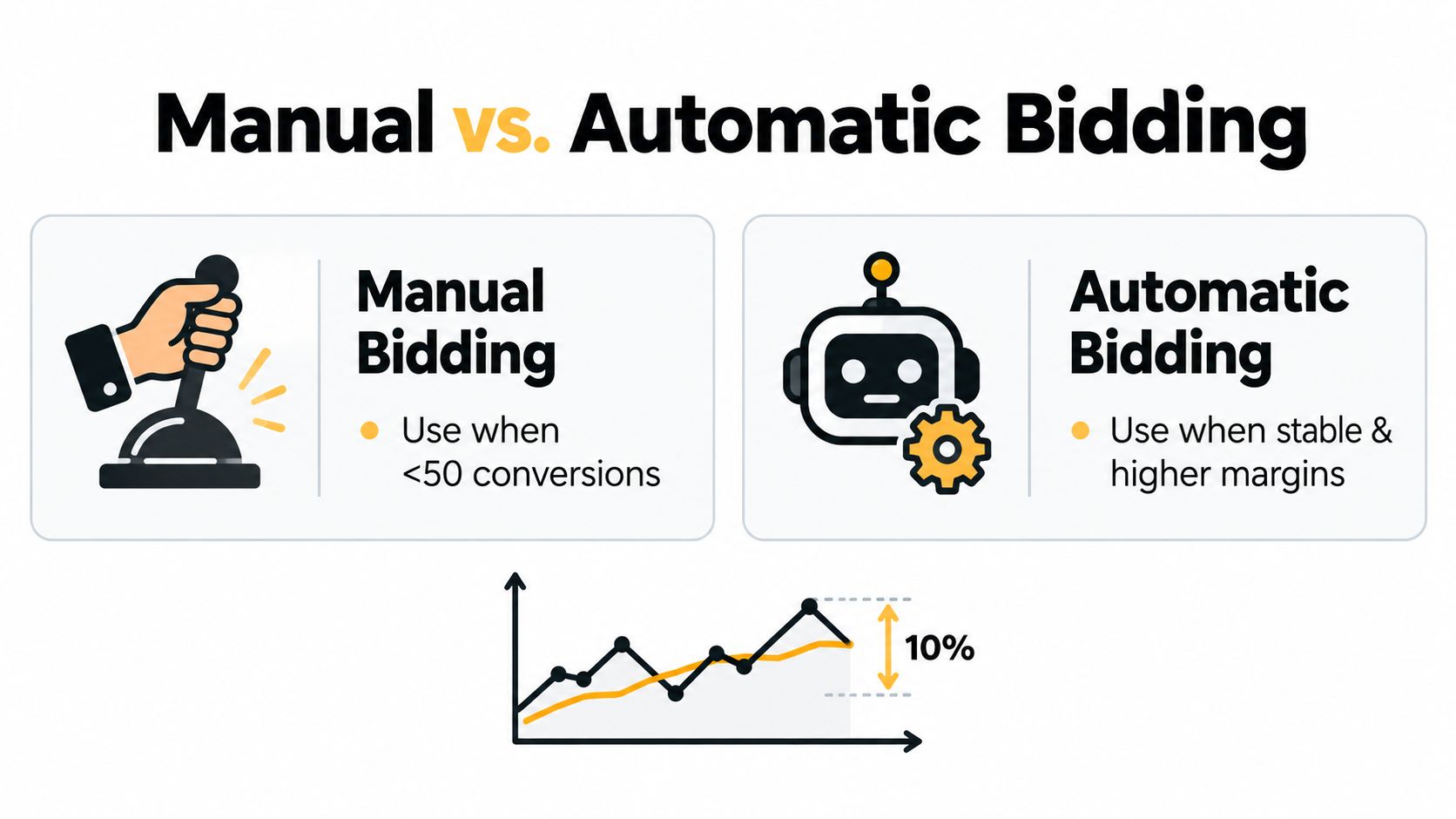
Keep manual control for thin-signal situations
Use manual bidding only when you can name the risk it is containing.
Two cases qualify. First, the campaign does not have enough conversion signal for automated delivery to price traffic well. Second, your contribution margin is tight enough that small CPM or CPA swings erase profit. In both cases, bid controls can protect downside while the account gathers cleaner feedback.
Use this decision rule:
- Keep tighter bid control if purchase volume is inconsistent, conversion quality is unstable, or recent changes reset learning.
- Relax into automated delivery once the campaign is producing repeatable results and your economics hold across several days, not one good afternoon.
- Review bid caps every week if you use them. Old caps do not preserve efficiency. They block delivery and hide demand.
Budgets need the same discipline. If you are still in a thin-signal phase, keep daily budgets high enough to buy data but low enough to limit expensive mistakes. A good operating range is about 3 to 5 times your target CPA per ad set when you are validating delivery. Below that, you starve the system. Far above that, you can burn through spend before you know whether the setup works.
Creative structure affects bidding more than many media buyers admit. Automated delivery performs better when the account has clear product signals, consistent naming, and usable asset variations. For catalog-heavy brands, dynamic ad templates for e-commerce can help standardize those inputs so automation has something useful to work with.
Hand delivery to the machine when volume is stable
Once the account has dense, trustworthy signal, manual bidding usually becomes an expensive habit.
The platform has continued to push more delivery decisions into automated ranking and optimization systems, and reported model updates have produced modest gains in click and conversion performance. The exact percentage matters less than the operating implication. If the account is already converting at stable volume, human micromanagement usually adds less than better offers, cleaner measurement, or stronger creative rotation.
Here is the Monday-morning rule. If a campaign is hitting CPA targets, conversion volume is steady, and spend can rise without immediate efficiency collapse, remove unnecessary bid constraints first. Then increase budgets in controlled steps, usually 10 to 20 percent every 24 to 48 hours for stable campaigns. If efficiency breaks after each increase, do not keep forcing spend up. That is a signal problem or a market saturation problem, not a bidding tweak problem.
Set one scaling guardrail before you open budgets. Decide the maximum CPA, minimum MER, or minimum contribution margin the campaign must hold. If performance slips past that line for multiple days, cut spend back to the last efficient level and fix the bottleneck there. That guardrail matters more than whether you picked the cleverest bid setting.
Attribution, Incrementality, and Measuring What Actually Moves
Most Facebook ads optimization breaks at the measurement layer, then gets misdiagnosed as a bidding or creative problem.
If you cannot separate reported conversions from real business lift, you will scale the wrong campaigns, pause the wrong ads, and keep arguing over numbers that answer different questions. Attribution should decide how you read performance before it influences how you increase spend.
Build a measurement system in the right order
Start with event quality. Pixel and Conversions API events need consistent naming, clean deduplication, and a clear match between what fires in the platform and what happened on the site. If purchase fires twice or lead events map to different definitions across forms, the account learns from noise.
Then add a business-side view of performance across channels. Paid social rarely creates demand in isolation. It assists branded search, email conversion, direct traffic, and return visits. Teams that need a cleaner framework for this should review this explanation of cross-channel marketing attribution, then decide which channel gets operational credit for influence versus closure.
Then run incrementality checks on a schedule.
That last step is where weak measurement gets exposed. Platform attribution can tell you which ad got credit. It cannot tell you whether the sale would have happened without the ad. You need a recurring test structure, such as holdouts by geo, controlled pauses, or a control audience that does not receive the campaign.
Attribution helps the platform optimize. Incrementality helps the business decide whether to keep spending.
Use three scoreboards, not one blended average
A single dashboard view creates false confidence. Finance sees one number. The ad account reports another. The team picks the number that supports the next budget increase.
Stop doing that.
Read performance through three separate lenses:
- Platform-reported conversions and CPA for in-platform optimization
- Business-level revenue, margin, or MER for budget allocation
- Incrementality results for scale decisions
Each one answers a different question. If platform CPA improves while blended efficiency worsens, the campaign may be capturing demand that another channel would have closed anyway. If reported return looks flat but new customer mix, order quality, or contribution margin improves, the campaign may deserve more room.
The point is simple. Do not ask one metric to do three jobs.
Reconcile disagreement before you scale
Disagreement between reporting layers is not a nuisance. It is the diagnosis.
Here is the operating rule. If platform reporting, internal reporting, and incrementality results point in different directions, freeze aggressive scaling until you know why. Usually the problem sits in one of four places:
- Broken event logic. Duplicate purchases, bad deduplication, missing values, or drifting event names
- Shallow conversion definitions. Leads or trials counted as wins before quality is known
- Channel cannibalization. Paid social gets credit for conversions that branded search, email, or direct traffic would have captured
- Weak test design. Holdouts are too short, too small, or contaminated by overlapping campaigns
A lot of teams waste a quarter by treating attribution drift as normal, keeping spending, and hoping blended revenue eventually validates the account. That is not a plan. It is avoidance.
Put a measurement gate in front of every budget increase
Do not scale off a good week of reported ROAS alone. Scale after the account clears a measurement check.
Use a simple gate:
- Event tracking is clean
- Reported conversion trends roughly match internal conversion trends
- Conversion quality holds after the click
- Incrementality checks do not show obvious overstatement
If one of those breaks, fix that bottleneck first. Do not skip to new audiences, fresh bid constraints, or another creative sprint.
One practical option for teams that need help tying media performance back to funnel outcomes is Sprints & Sneakers. The useful part is not another prettier dashboard. It is the operating discipline of forcing paid social, creative testing, attribution, and funnel analysis to use the same definition of performance.
The scaling guardrail from the previous section still applies here. Set the maximum CPA, minimum MER, or minimum contribution margin you are willing to accept, then hold spend increases to that line. Measurement tells you whether growth is real. The guardrail tells you when to stop buying it.
Related articles
Frequently asked questions
Growth marketing, AI and automation, SEO, performance marketing, retention strategies, and sustainable business practices.
Weekly. Subscribe to our newsletter to get new articles straight to your inbox.
Absolutely. Everything we publish is designed to be actionable. Take it, test it, and make it your own.
Yes. We publish experiments with real numbers. What worked, what didn't, and what we learned.
Our growth team — strategists, performance marketers, data specialists, and AI builders who work on client campaigns every day.
We're open to it. Reach out via our contact page with your topic and we'll take a look.