
Marketing Automation Workflows That Actually Convert
Build marketing automation workflows that drive real pipeline, not just opens. Practical triggers, segmentation, and measurement tactics for B2B and DTC teams.
Most marketing automation gets better results when it sends fewer messages. That sounds counterintuitive, but the evidence points to a gap between adoption and effective orchestration: in a 2023 survey of 391 marketers, only 25% rated their current automation strategy best-in-class, even as adoption and budgets rose (Ascend2's State of Marketing Automation). More sequences don't fix weak decisions. Better triggers, clearer audience priorities, and honest measurement do.
Marketing automation workflows often look impressive in a platform: branches, delays, emails, alerts. But the diagram isn't the result. A workflow earns its place when it responds to meaningful customer behavior, respects what that customer has said, and improves a business outcome without creating conflicting messages.
Table of Contents
- Why Most Marketing Automation Workflows Underperform
- What a Marketing Automation Workflow Actually Coordinates
- Triggers and Segmentation That Create Real Momentum
- The Four Workflow Archetypes That Drive Most Growth
- Consent and Personalization Without Crossing the Line
- Blueprints for DTC and B2B You Can Ship Tomorrow
- Measurement That Survives Attribution Gaps
- Your Next-Day Automation Checklist
Why Most Marketing Automation Workflows Underperform
Most marketing automation underperforms for the same three reasons: weak triggers, vague segments, and measurement that stops too early. A workflow can send every message on schedule and still fail if it starts at the wrong moment, treats unlike customers as one audience, or calls opens and clicks a win.
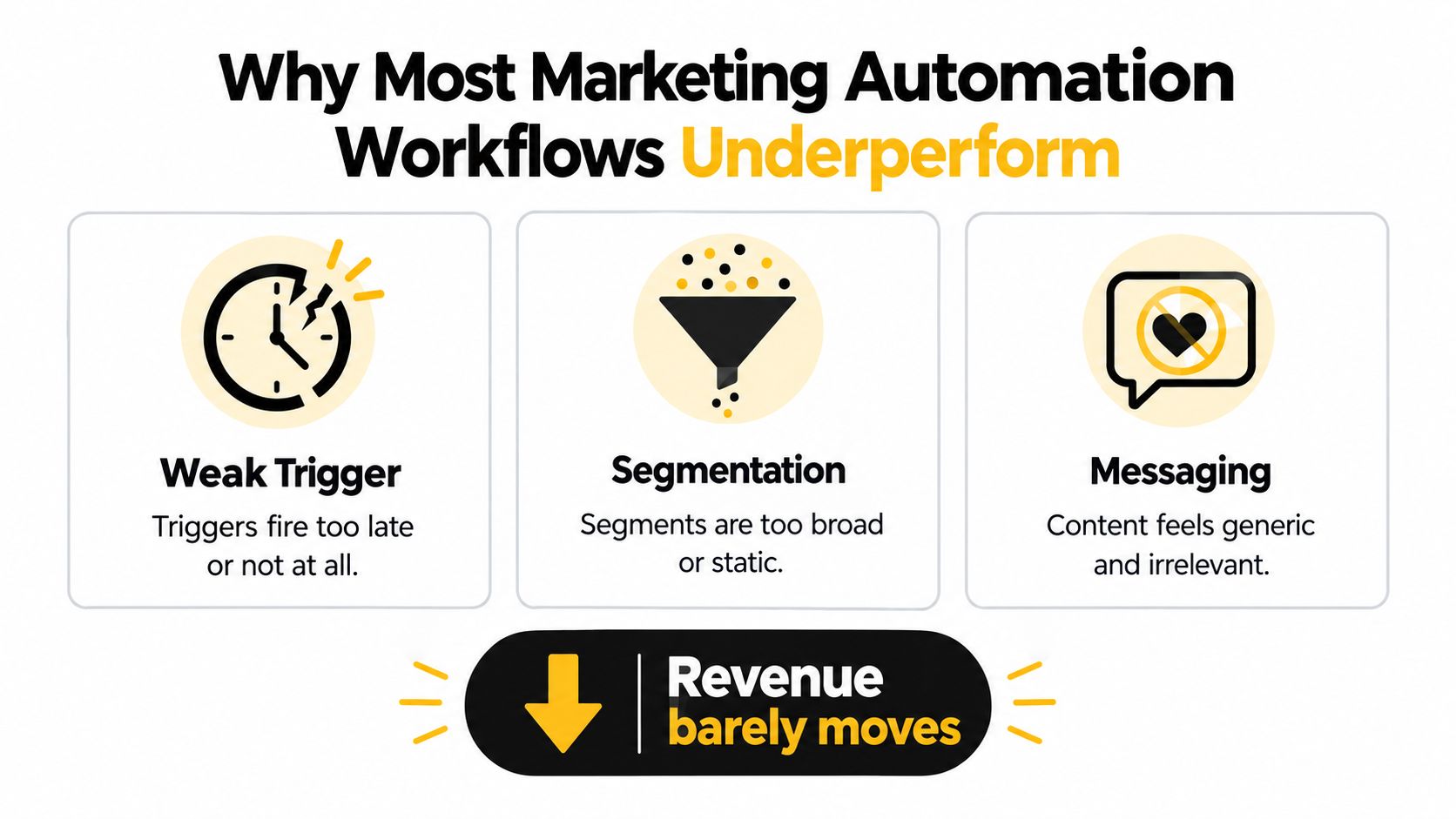
Consider a SaaS team with a dozen email sequences and no shared suppression logic. A prospect requests a demo, then keeps receiving beginner education. A new customer receives acquisition offers. A lead books a sales meeting, but the nurture emails continue. Each sequence may look reasonable by itself. Together, they make the company sound as if its teams don't know what the others are doing.
That's not a copywriting problem. It's an orchestration problem. The fix starts with three decisions: what event should start the workflow, which rule takes priority when a person fits multiple segments, and which downstream result will prove the workflow is useful?
A form submission may be a suitable trigger for a resource delivery, but it doesn't automatically justify a sales alert. A pricing-page visit may signal stronger interest, yet a declared preference for research-only communication can still take precedence. And an open rate may show that a message was seen, not that the message helped create qualified pipeline.
Working rule: Every workflow should be able to explain why it started, why it chose this path, and what outcome it's meant to change.
A workflow isn't a sequence of messages. It's a decision layer that connects customer signals, segmentation, actions, suppression, and measurement. The rest of the job is making those decisions specific enough to be useful and coordinated enough not to collide.
What a Marketing Automation Workflow Actually Coordinates
A marketing manager opens the campaign calendar and finds several email drips running at once. One welcomes new contacts, one follows up after a download, and another responds to product interest. The problem isn't that these emails are poorly written. The problem is that no shared system decides which one should run when a contact changes status.
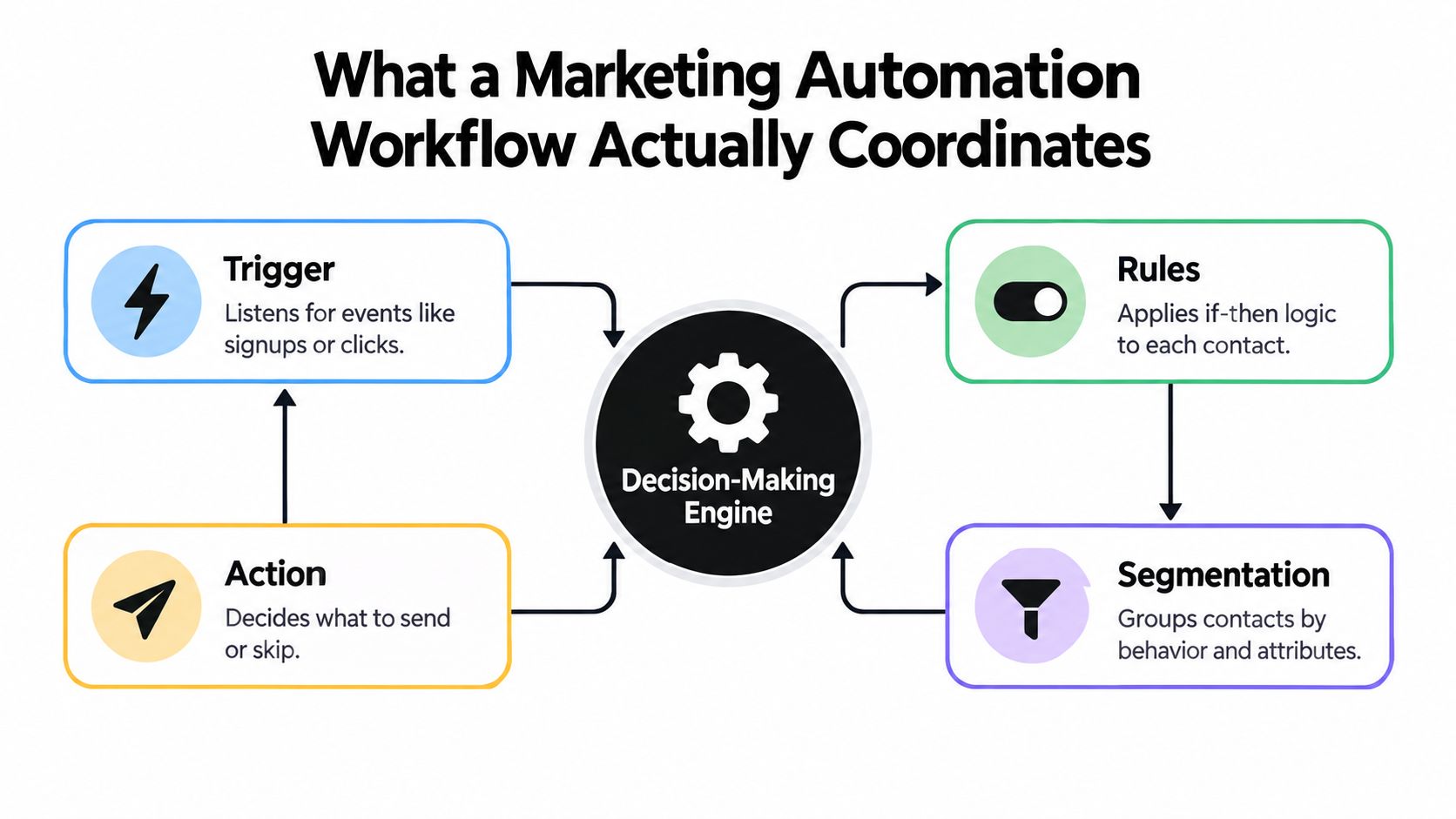
A practical way to think about a workflow is as an air-traffic controller. It receives a signal, checks the contact's context, directs the next action, and prevents two messages from trying to occupy the same moment. A campaign delivers a planned message to an audience. A workflow makes a series of decisions as the audience's circumstances change.
Three layers, one customer experience
The data layer records what's known: form submissions, product activity, lifecycle status, account details, and declared preferences. The rule layer interprets that information. It determines, for instance, whether a contact is still a prospect, has already booked a meeting, or should be excluded from promotional messaging. The activation layer carries out the decision, perhaps sending a relevant email, updating a record, or notifying a salesperson.
The same event can lead to different actions. A pricing-page visit from an unknown visitor may call for a useful return-visit experience. The same visit from an active opportunity may be a signal for the account owner. A visit from a customer who has opted out of marketing shouldn't trigger a promotional email at all.
This idea is older than the current software category. A systematic review of 31 marketing-automation studies published between 2009 and 2020 describes an established research domain, with roots in marketing decision-support systems in the 1970s and a 2001 Berkeley symposium centered on customer data, decisions, return on investment, and loyalty (the academic review of marketing automation). That history reinforces a useful principle: automation coordinates decisions; sending messages is only one possible action.
When the data, rules, and activation layers don't connect, teams get duplicate sends, missed sales handoffs, and unreliable reporting. The fix isn't necessarily another platform. It's a clear owner for the underlying decision rules and a reliable way to pass status and suppression updates across systems.
Triggers and Segmentation That Create Real Momentum
A fixed drip treats people alike because they entered a list at the same time. An event-driven workflow treats their next action as meaningful. That difference matters: a download and a pricing-page visit shouldn't automatically start the same conversation.

An early-stage download can trigger delivery of the requested material followed by relevant education. A pricing-page visit can qualify for a stronger action, such as checking whether the account matches the intended customer profile or alerting sales when other high-intent signals agree. But a single visit shouldn't override a contact's lifecycle status, declared preferences, or prior handoff.
MarketingSherpa-cited research reports that only 27% of B2B leads are ready to speak with sales when first identified, while 79% of marketing leads never convert to sales, with insufficient nurturing identified as a major cause (lead-nurturing research summarized by Rework). The lesson isn't to put every lead into a long sequence. It's to match the next step to readiness.
Choose signals that earn an action
A demo request or product comparison can be a stronger buying signal than an email open. Repeated pricing-page visits, product-webinar attendance, or a high-intent form can also support a sales handoff when the account and consent context fit. Opens and clicks still help diagnose message engagement, but they're weak substitutes for commercial intent.
Segmentation should combine behavior with relevant account attributes. For a SaaS business serving particular company types, firmographic fit can distinguish a promising account from a curious but unsuitable contact. For a practical primer on defining meaningful groups, teams can review this market segmentation strategy.
Before launch, write the stop rules in plain language: remove a lead from nurture when a meeting is booked, a reply arrives, or an opportunity is opened. For teams managing large volumes of incoming messages, an AI email organizer tool can help keep correspondence easier to sort, but workflow rules still need to determine ownership and suppress conflicting outreach.
A short video can prompt a useful review of how the team handles trigger choice and follow-up:
<iframe width="100%" style="aspect-ratio: 16 / 9;" src="https://www.youtube.com/embed/A_tXo1SHzCI" frameborder="0" allow="autoplay; encrypted-media" allowfullscreen></iframe>The Four Workflow Archetypes That Drive Most Growth
Four workflow types cover much of the work a growth team needs to coordinate: nurture, onboarding, churn prevention, and cross-sell. The useful design question isn't how many messages each contains. It's what event starts the workflow, which decision changes the path, how a person exits, and what result counts as proof.
Start with the job, not the sequence
A nurture workflow starts when a lead requests information or demonstrates early interest. It branches by fit and readiness, sends useful education, and hands off to sales only after explicit intent criteria are met. Its proof metric is progression to a qualified opportunity, not a busy engagement report.
Automated nurturing can help in the right conditions, but it isn't a universal revenue lever. An American Marketing Association summary of a Journal of Marketing study reports potential conversion gains of up to 23 percentage points in favorable situations, particularly for new leads, shorter sales cycles, and lower-value purchases. Effects were weaker for complex B2B buying, including enterprise software and industrial equipment (the AMA summary of the study). For long-cycle deals, automation should educate, capture intent, and support sales rather than pretend a string of messages can replace buyer research.
An onboarding workflow starts when a customer signs up or begins using a product. It branches based on product activity: an account that reaches a useful milestone can receive a next-step recommendation, while one that stalls can receive help. The stop rule is simple: stop introductory messages once the customer completes the relevant activation milestone. Proof should reflect activation or progression toward sustained use.
For churn prevention, a meaningful sign of declining use or a service issue should start a check-in. The workflow can route an account for human attention rather than sending a generic discount. Stop the automated path when the customer re-engages or an owner takes over; assess it against retention outcomes.
A cross-sell workflow begins when a purchase or product-usage pattern makes an adjacent offer relevant. Branch on fit and prior purchases, and stop when the recommendation is no longer appropriate or the customer converts. Proof comes from expansion, not merely a recommendation click.
| Archetype | Primary Trigger | Key Branch | Proof Metric |
|---|---|---|---|
| Nurture | New lead or meaningful interest | Fit and buying readiness | Qualified-opportunity progression |
| Onboarding | Signup or product start | Product activity | Activation or sustained use |
| Churn prevention | Declining engagement or service concern | Risk and account context | Retention |
| Cross-sell | Purchase or relevant product use | Eligibility and customer fit | Expansion |
Each archetype needs a defined customer outcome and a responsible owner. Teams can map those decisions across the broader lifecycle marketing strategy rather than building disconnected sequences for each department.
Consent and Personalization Without Crossing the Line
More personalization doesn't always make an experience better. A workflow that reacts to every behavior can feel intrusive, especially when an inferred signal conflicts with what a customer has explicitly chosen. Declared preferences should set the boundaries; behavioral data should help personalize within them.
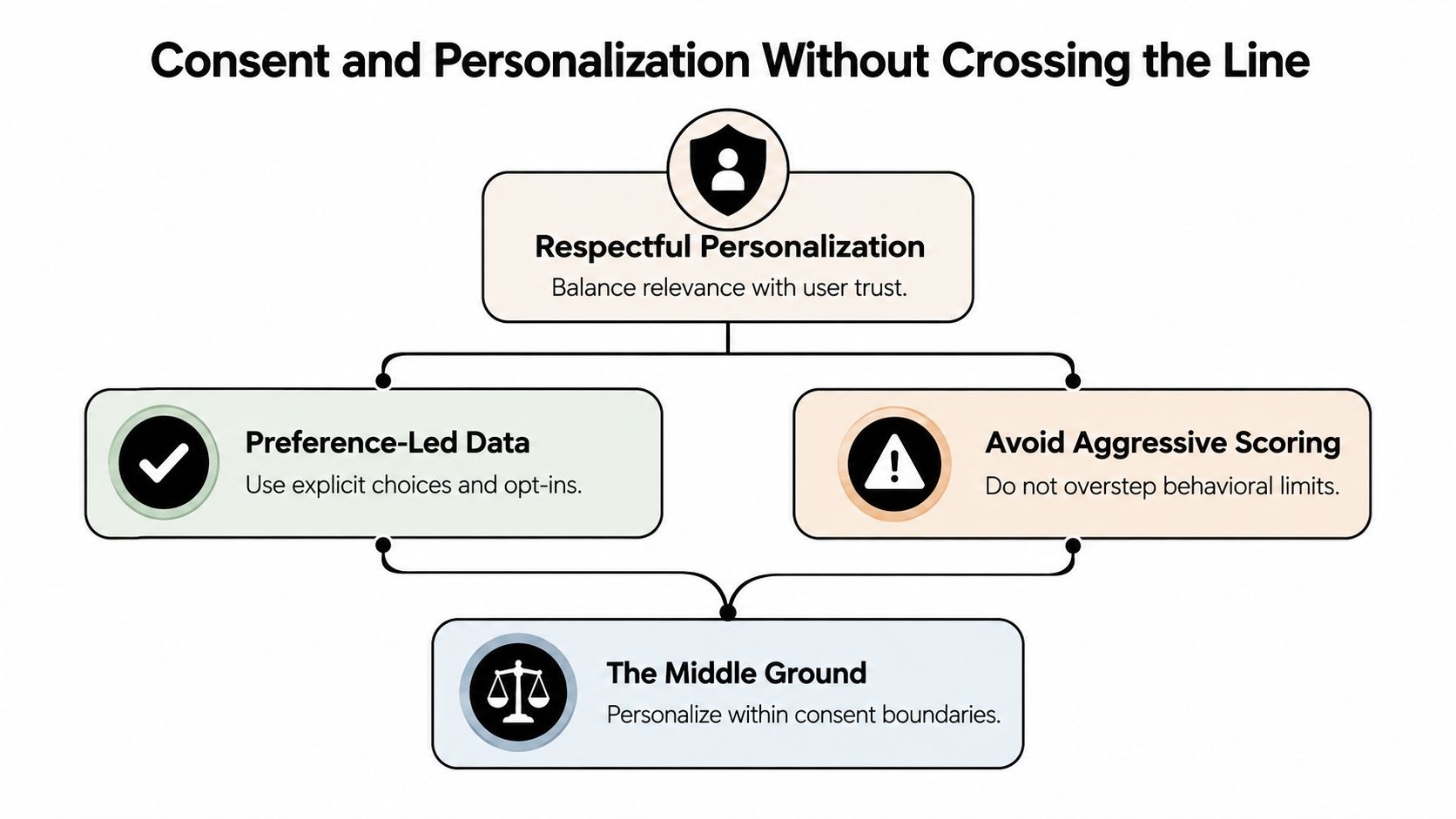
Zero-party data, information customers voluntarily provide through preference centers, onboarding, or feedback, can make those boundaries clearer. A contact who selects research-only updates shouldn't receive a high-pressure promotional sequence just because they visit a pricing page. A customer who declines promotional SMS shouldn't be routed into that channel because a score rises.
Give preference rules a clear order
A reliable workflow checks declared preferences before using inferred intent to choose a message or channel. When signals conflict, the declared choice wins. If a preference is missing, stale, or ambiguous, the workflow should use a conservative fallback rather than assume permission.
Consent needs to travel with the data. Capture the purpose, jurisdiction, timestamp, channel, and version of the notice associated with a preference. Keep permissions in a central system of record, and make downstream campaign, CRM, advertising, analytics, and personalization systems check that state before activation. When someone withdraws consent, propagate the change as a machine-readable suppression event and enforce it both when an audience is exported and just before a message is sent.
Operational controls matter as much as the preference form. Separate marketing permissions from transactional communications, restrict access to the data people need for their roles, and preserve an audit trail. These habits reduce the risk that one system records an opt-out while another keeps sending.
For teams refining how declared choices shape content and channel decisions, this guide to personalization in marketing offers a useful companion. Personalization earns trust when customers can understand and change it. If the workflow can't honor that choice across its activation paths, its targeting logic isn't ready to scale.
Blueprints for DTC and B2B You Can Ship Tomorrow
A useful workflow can be sketched in a planning document before anyone opens a builder. The first blueprint recovers abandoned carts. The second nurtures B2B leads without sending every form fill straight to sales.
DTC abandoned-cart sequence
Use three timed decisions, with a purchase stopping the sequence immediately:
- After 2–4 hours: Send a plain reminder that returns the shopper to the cart.
- Around 24 hours later: Address likely objections with relevant information about shipping, returns, or product reviews.
- Around 48 hours: Send a final message with suitable recommendations or a request for feedback.
A benchmark analysis covering more than 143,000 abandoned-cart flows reported an average placed-order rate of 3.33% and revenue of $3.65 per recipient. The top 10% of brands generated $28.89 per recipient; the analysis also recommends the timed sequence above (the abandoned-cart benchmark and guidance). These figures are comparison points, not a promise for an individual business.
Build in three safeguards: stop as soon as the purchase completes, suppress customers who have recently received a discount, and vary the message for high-value and low-value carts. Before launch, check whether each message answers a real hesitation and whether the sequence stops reliably after checkout.
B2B SaaS lead nurture
Start with a form submission or trial signup, then separate early interest from stronger intent. An early-stage download should receive the promised material and relevant education. A product comparison, repeated pricing-page activity, or demo request can move a well-matched account toward a sales alert. Add firmographic criteria when the motion depends on company fit, and make sales ownership explicit when a handoff occurs.
The stop rule should cover a booked meeting, a direct reply, and entry into an opportunity stage. At that point, end the automated nurture and let the assigned owner take over. A CRM connection is useful when it synchronizes contact matching, qualification changes, and handoff status, but the decision rules must still be clear enough to audit. Teams reviewing how records and lifecycle signals should move between systems can consult this guide to marketing automation and CRM integration.
For both blueprints, pressure-test the design with two questions: What real customer event justifies the next action? What event stops the workflow before it becomes irrelevant? If those answers aren't obvious, adding another message won't help.
Measurement That Survives Attribution Gaps
A workflow dashboard shouldn't stop at activity. Opens, clicks, and contacts created can diagnose delivery and engagement, but they don't show whether automation contributed to qualified pipeline, retention, or expansion. Teams need to connect those early signals to later commercial outcomes while acknowledging that sales cycles and self-serve research complicate attribution.
That problem is becoming more visible as teams adopt AI. A 2025 survey of 503 marketing leaders found that 63% were already using generative AI and another 27% were evaluating it, yet only 49% could measure the return on their AI investments (the 2025 State of AI Marketing survey). More automated decisions don't automatically make the result easier to measure.
Track the decision as well as the outcome
Log the trigger, the path selected, the suppression decisions, and the time of each handoff. Where feasible, compare a workflow audience with a holdout group so the team can assess incremental impact rather than crediting every conversion that happened after an automated message. When a holdout isn't practical, report the limitation clearly and compare outcomes across relevant lifecycle stages.
A useful dashboard can include time to qualified opportunity, conversion by account stage, pipeline velocity, win rate, expansion, and suppression errors. These measures expose a workflow that creates plenty of engagement but weakens lead quality, or one that routes promising accounts effectively but mishandles preferences. Teams can revisit marketing attribution to clarify how different interactions should be interpreted.
Delivery issues can also muddy results: before diagnosing weak engagement as a targeting problem, teams can check where your emails land. The more important strategic point is that a smaller set of well-orchestrated workflows often beats a sprawling portfolio. Fewer workflows mean fewer conflicting rules, clearer ownership, and better chances of understanding which decisions improve outcomes.
Your Next-Day Automation Checklist
A team can audit an existing workflow before building a new one. The aim is to catch weak decision-making early, not add more branches for their own sake.
- Triggers: Name the exact event that starts the workflow. Remove vague entry rules that treat every interaction as buying intent.
- Segmentation: Define which status or preference wins when a person fits multiple groups. Add a stop rule for meetings, replies, purchases, or lifecycle changes.
- Consent: Confirm that channel permissions and withdrawals sync to every system that can activate an audience.
- Measurement: Log triggers and decisions, then track a downstream outcome that matches the workflow's purpose.
- Red flags: Look for duplicate messages, sequences that ignore sales handoffs, repeated discount exposure, and success reports built mainly on opens or clicks.
Choose the workflow that already has revenue attached, then improve its trigger, segmentation, and measurement before adding anything new. That's a more disciplined next step than building another sequence and hoping the platform will make it effective.
Sprints & Sneakers helps B2B and B2C brands find growth bottlenecks and prioritize experiments across the funnel, including marketing automation and analytics. Visit Sprints & Sneakers to explore how its growth team can help make automation decisions more measurable and better coordinated.
Related articles

Frequently asked questions
Growth marketing, AI and automation, SEO, performance marketing, retention strategies, and sustainable business practices.
Weekly. Subscribe to our newsletter to get new articles straight to your inbox.
Absolutely. Everything we publish is designed to be actionable. Take it, test it, and make it your own.
Yes. We publish experiments with real numbers. What worked, what didn't, and what we learned.
Our growth team — strategists, performance marketers, data specialists, and AI builders who work on client campaigns every day.
We're open to it. Reach out via our contact page with your topic and we'll take a look.