
SEO and SEM Strategy: How to Combine Both in 2026
Learn how to build an SEO and SEM strategy that works together across the funnel, with KPIs, budget splits and a 90-day roadmap for 2026.
The SEO report looks healthy. The paid search report shows conversions. Yet the sales team still wants better leads, and the finance team wants to know why acquisition costs keep rising. Both channels appear to work, but nobody can explain whether the business is paying for customers it would have won anyway.
A useful SEO and SEM strategy starts with a different question: what job should each query do, and which investment produces additional business? That means sharing a keyword plan, measuring customer quality, and testing channel roles rather than defending separate budgets.
Table of Contents
- SEO vs SEM at a Glance
- Mapping SEO and SEM Across Every Funnel Stage
- Where SEO and SEM Overlap and Compete
- Setting KPIs and Splitting Budget by Channel Role
- How to Build Your 90-Day SEO and SEM Roadmap
- Measuring Results When AI Search Sends Little Traffic
- Pick Your First SEO and SEM Experiment This Week
SEO vs SEM at a Glance
SEO earns visibility in organic results by matching pages to what people search for. SEM buys placement in paid results through an auction. Here, SEM means paid search, rather than the broader definition that includes organic search.
SEO resembles opening a shop on a busy street. Establishing a desirable location takes work, but that location can keep attracting visitors for years. SEM resembles renting a billboard: placement can begin quickly, but the rented exposure ends when the spending stops.
SEO and SEM compared on the factors that decide the plan
| Factor | SEO | SEM |
|---|---|---|
| Cost model | Time and content investment | Pay per click through an auction |
| Time to first results | Usually several months | Often within days of launch |
| Traffic over time | Compounds as pages keep ranking | Stops when spending stops |
| Control over position | Earned through relevance and authority | Set by bid, ad quality and eligibility |
| Best use | Long-term discovery and category demand | Immediate reach for high-intent queries |
| Main risk | Slow to prove its value | Spend that never turns into incremental results |
These are planning expectations, not delivery guarantees. An existing page may improve sooner than a new site, while an advertising campaign can remain invisible until its targeting, approval and auction eligibility are resolved.
Compare the economics, not just the placement
Organic traffic isn't free. Someone must research, write, maintain and improve the pages. Paid traffic isn't automatically wasteful either: a commercially valuable query can justify continued spending even when an organic page also ranks.
For a concrete local-service example, Bluelight's guide to paid vs organic search for roofers provides a useful way to consider urgent lead generation alongside longer-term visibility.
The channels aren't natural rivals. Appearing in both paid and organic results occupies more of the results page and can attract clicks that a single listing wouldn't capture. Whether those clicks represent additional customers still needs testing.
A useful starting check: Search the business's most important commercial queries in a private browser window. Record the paid listings, organic listings and any competing business appearing in both.
Private browsing doesn't remove location effects. The reviewer should record the device and location too, so the exercise captures a specific buying experience rather than pretending to represent every searcher.
Mapping SEO and SEM Across Every Funnel Stage
Search volume doesn't reveal how close someone is to buying. A Journal of Marketing Research study summarized by Baylor's Keller Center examined approximately 1.63 million searches, covering 120 keywords over a month on a leading South Korean search engine, and found that lower-volume keywords generated more clicks per search and a larger share of sponsored-result clicks than highly popular keywords.
That finding supports a practical distinction: broad questions often deserve educational content, while specific commercial searches deserve a closer look at paid acquisition. It doesn't establish a universal conversion rule for every market.
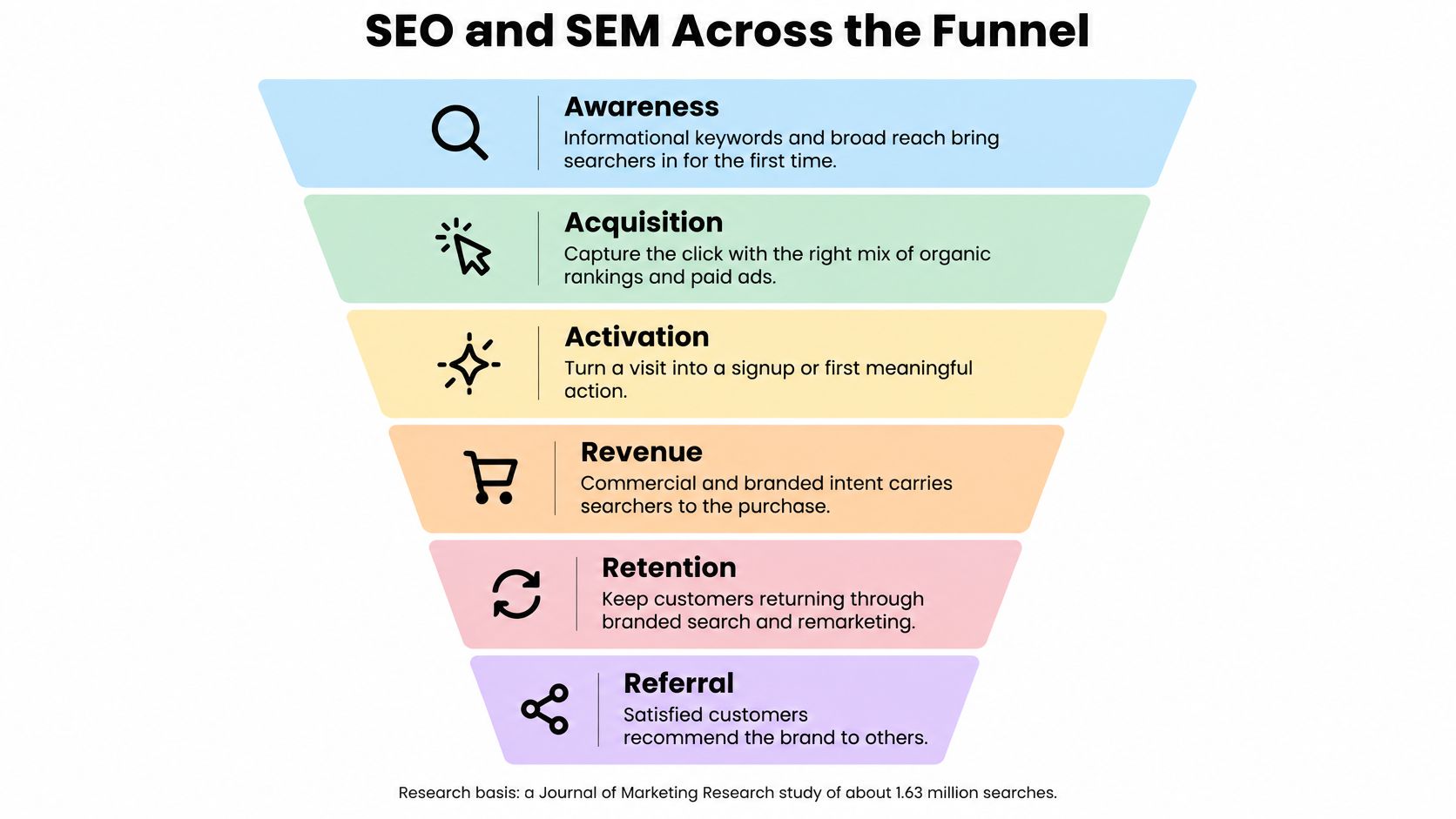
The funnel below shows how those roles extend beyond the first visit.
Give each stage a lead channel
Lead and supporting channel for each funnel stage
| Funnel stage | Lead channel | Supporting channel | Example query type |
|---|---|---|---|
| Awareness | SEO content answering category questions | Light SEM tests on broad terms | What is revenue forecasting |
| Acquisition | SEM on high-intent non-brand terms | SEO comparison pages | Revenue forecasting software for SaaS |
| Activation | SEO setup and help content | Search ads on product-specific terms | How to connect a CRM to forecasting |
| Revenue | Branded search and pricing pages | Non-brand bids on purchase-ready terms | Forecasting software pricing |
| Retention | Updated guides for returning users | Brand search protection | Forecast accuracy best practices |
| Referral | Original research and case studies | Brand search amplification | Revenue forecasting benchmark report |
At Awareness, a software buyer needs an explanation, not a demo form blocking the answer. At Acquisition, the same buyer may need comparisons, integration details and evidence that a product fits the team's workflow.
Activation requires a different page again. A setup article should help someone complete a meaningful action, such as connecting a CRM, rather than send that person back into a sales sequence. Paid support is optional here, particularly when existing users can already go directly to the answer.
At Revenue, pricing, procurement and implementation questions deserve direct answers. Retention content should address ongoing use, while Referral assets should give satisfied customers something credible to share. Neither stage automatically requires advertising.
Follow the software buyer's next question
Consider a B2B forecasting company. Its organic guide explains revenue forecasting; a paid campaign targets evaluators searching for forecasting software for SaaS teams; and an indexed setup article helps new accounts connect their CRM.
Those pages need different success criteria. The guide introduces a relevant audience, the campaign generates qualified evaluations, and the setup article helps users reach activation. A coherent SEO content strategy connects those questions without forcing every page to sell.
Assign the funnel stage before assigning the channel. Then name the next action the page should make easier. That prevents a familiar mistake: sending every searcher to the same product page because it happens to contain the keyword.
Where SEO and SEM Overlap and Compete
The claim that SEO and SEM always fight over the same clicks is too simple. Query type changes the relationship.
A University of Houston dissertation on search-engine marketing found that paid ads increased clicks on the same firm's organic result for unbranded searches, but reduced organic clicks for branded searches. Those are different mechanisms: spillover in the former case, substitution in the latter.
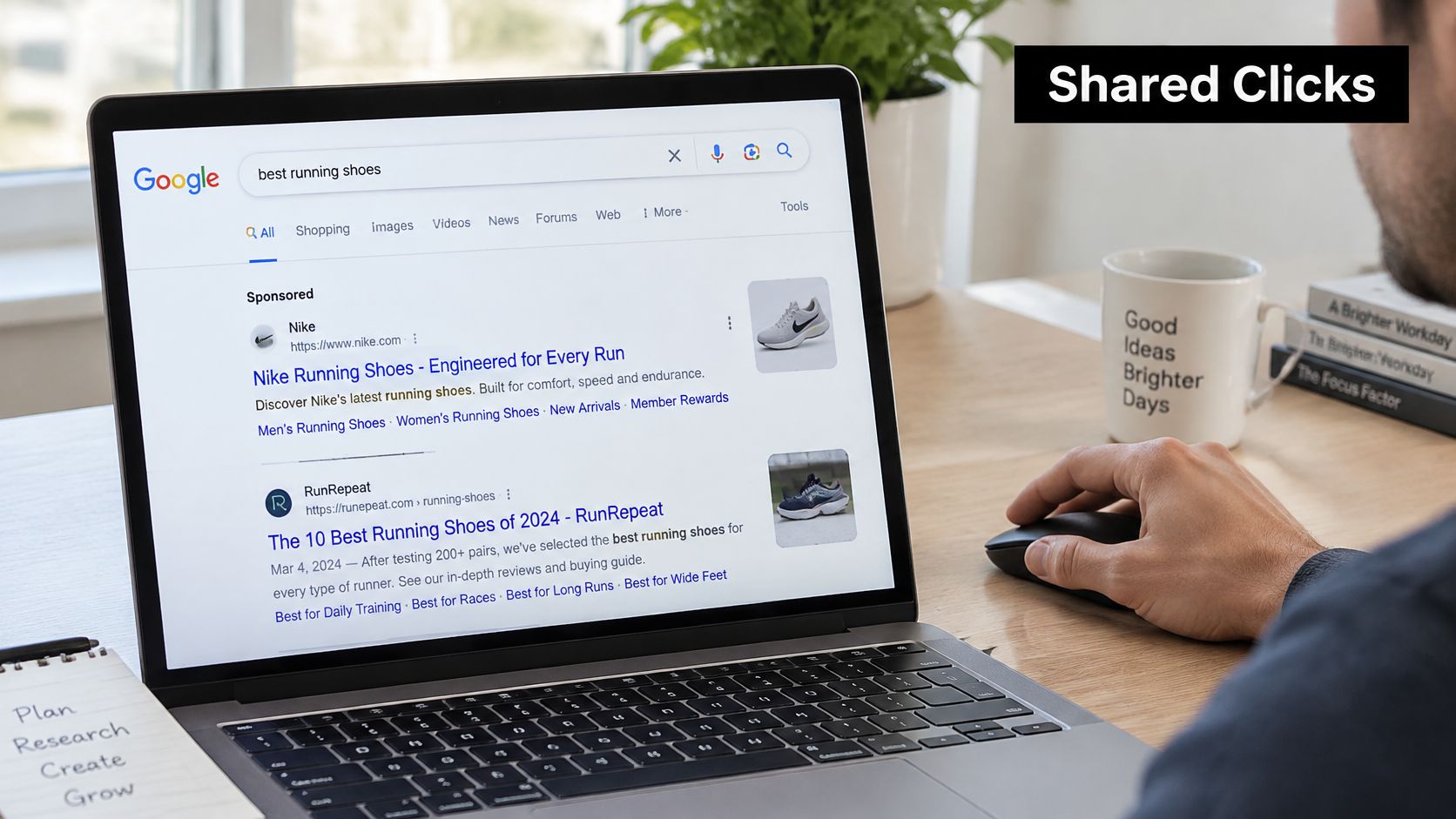
A results-page review makes that distinction tangible.
Apply different rules to different searches
- Generic category queries: Test paid and organic coverage together when the business has a relevant offer and a useful ranking page. Evaluate combined customer acquisition, not which team receives the click.
- Branded queries: Keep bidding conditional. Competitor activity or a valuable position can justify protection, but a paid listing shouldn't remain active merely because its reported conversion rate looks strong.
- Device segments: Inspect mobile and desktop results separately before changing bids or landing pages. A desktop screenshot doesn't describe the mobile buying experience.
The same dissertation reported device differences: tablet users were more likely than desktop users to click the top ad for branded and unbranded searches, while smartphone users showed that pattern for unbranded searches only. It also found greater sensitivity to ad position on unbranded searches among smartphone and tablet users.
Those findings are reasons to segment a test, not permanent bidding instructions. Search layouts, audiences and commercial conditions differ.
Inspect ownership before changing spend
A practical review can start with the brand name and a small set of category searches. The reviewer should capture each results page and mark the business's paid listing, organic page, competing ads and destination URLs.
Then compare the promise in each listing. If the organic result already answers a navigational request, a paid ad repeating the same message may add little. If a competing ad introduces a comparison offer, the brand campaign may have a defensible role.
Disciplined Google Ads optimization proves more useful than a blanket instruction to increase coverage.
A strong branded campaign report can describe efficient demand capture without proving additional demand.
The costly traps sit at opposite extremes: paying indefinitely for visits that would have arrived organically, and removing brand protection just as a competitor starts intercepting valuable searches.
Setting KPIs and Splitting Budget by Channel Role
A pricing-page ad and a technical explainer draw from the same budget, so they answer to the same question: did this spend produce customers that would not have arrived otherwise? What differs is the job each asset does, and the KPI should match that job. A page introducing a technical problem earns its keep on coverage and assisted pipeline. An ad on a pricing query earns its keep on qualified conversions per unit of spend.
For organic discovery, track coverage across target queries, relevant non-brand clicks and assisted pipeline from landing pages. For paid acquisition, track customer quality and contribution after advertising costs. Revenue alone can conceal unprofitable orders or leads that never progress.
Separate diagnostic metrics from business outcomes
Google's Auction Insights guidance cautions against optimizing to chase a Quality Score number. Auction Insights can reveal overlap and competitive pressure, while campaign impression-share reporting distinguishes losses caused by budget from losses caused by rank.
Those diagnostics point to different fixes. A budget-constrained campaign producing profitable customers may deserve more funding. A rank-constrained campaign with weak relevance needs a better ad and a better page first.
Neither conclusion follows from impression share alone.
A shared scorecard keeps both channels accountable to the same standard:
- Demand coverage: Target-query visibility and relevant organic landing-page traffic.
- Acquisition quality: Qualified leads, verified purchases and new-customer outcomes.
- Commercial return: Gross margin, opportunity value or customer-acquisition payback.
- Additional business: Conversions that would not have occurred without the investment.
Use query classes to set initial bidding rules
Bidding rule and KPI for each query class
| Query class | Example | Bidding rule | KPI to watch |
|---|---|---|---|
| Brand terms | Brand name | Keep bids low and test whether paid clicks add anything | Holdout lift in branded conversions |
| Category terms | Best revenue forecasting software | Bid for share and pair with SEO content | Impression share and new customer rate |
| Competitor terms | Competitor name alternative | Bid selectively where margin supports it | Cost per qualified lead |
| Problem-aware terms | How to reduce forecast errors | Lead with SEO content, test SEM on top queries | Assisted pipeline and organic click-through rate |
These are starting rules, and each one earns its budget again at the next review. Google's explanation of incrementality testing distinguishes conversions caused by advertising from responses that would have happened anyway.
The wider search mix is shifting under both channels. Multi-site analyses report Google organic clicks declining year over year, and separate datasets show paid search gaining a larger share of total sessions over the same period. Trends like these justify re-testing channel roles; they cannot fix the allocation for any single business.
A holdout test gives a firmer basis. Keep comparable regions or audiences untreated, hold measurement consistent, and allow for the sales cycle before judging conversion differences. Check whether lead quality changes alongside volume.
Attribution and incrementality answer different questions. Cross-channel marketing attribution describes the journey a customer took. Controlled experiments establish whether the spending changed the outcome.
Budget moves when the evidence supports additional valuable customers, regardless of which channel reports the conversions.
How to Build Your 90-Day SEO and SEM Roadmap
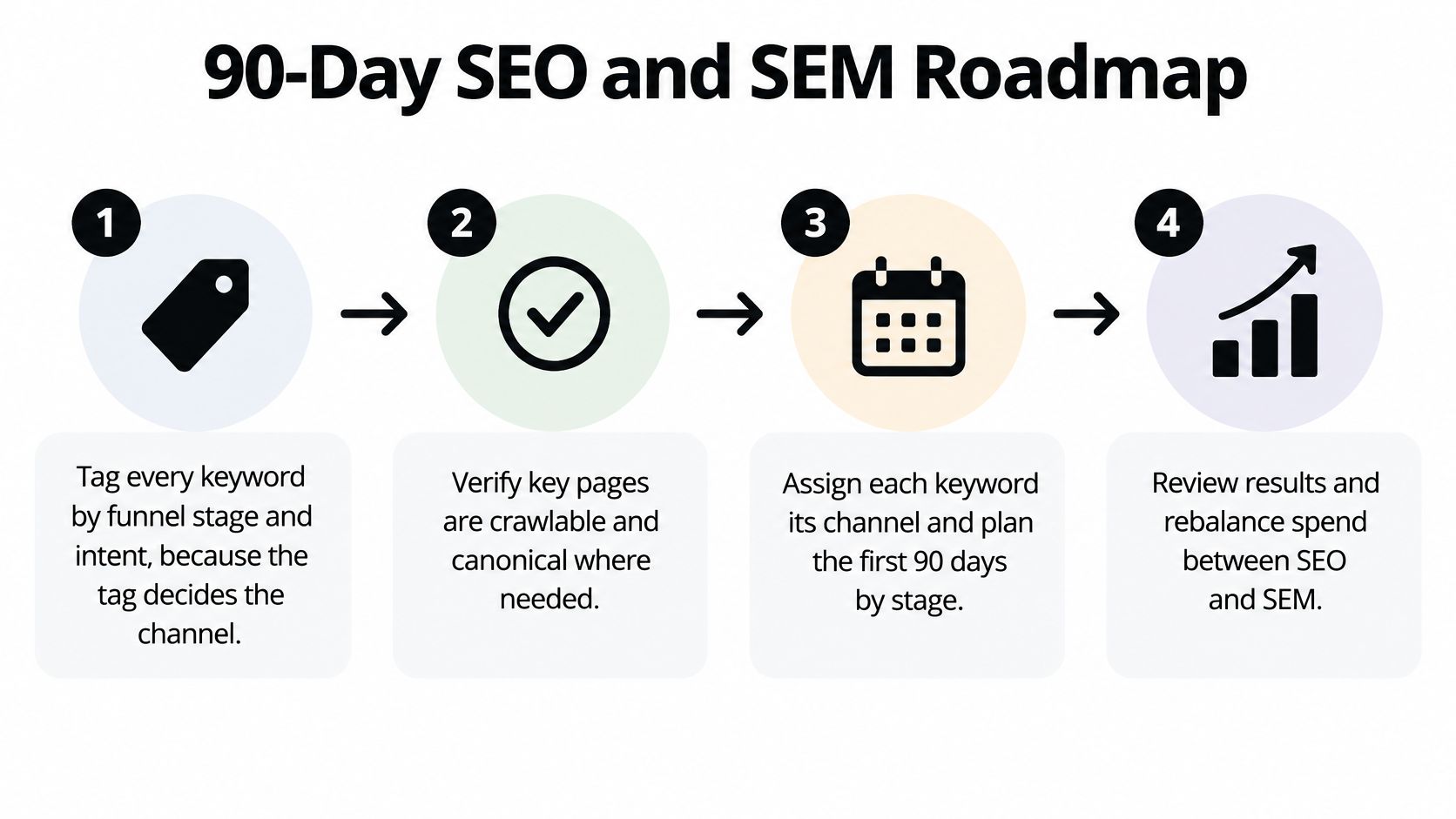
Start with three things: a prioritized backlog, named owners and decision dates. Resist the urge to schedule every technical fix and every missing page before you have tested demand.
Establish the foundations before expanding
-
Tag keywords by stage and intent. Add informational, commercial or branded intent alongside the funnel stage, destination page and proposed channel role. Assigning channels from search volume alone skips the question that matters: what does this searcher need next?
-
Check discovery and indexation. Confirm that important pages and the resources they depend on are accessible, canonical signals are deliberate, and suitable URLs appear in the sitemap. New content rarely pays off while commercially important pages stay blocked, duplicated or hard to discover.
-
Rewrite commercial search-result promises. Start with the highest-value commercial pages and state the audience, outcome and differentiator in clear titles and descriptions. A title such as “Revenue Forecasting Software for SaaS Teams” tells a buyer far more than “Platform,” but the opening page copy must fulfill that promise because search snippets may come from the content itself.
-
Build tightly themed paid tests. Group closely related high-intent searches, reflect their meaning in the ad, and deliver the same promise above the fold. Google's ad-auction explanation makes clear that bids aren't the only consideration, so treat a generic landing page as a page problem, not a budget problem.
Make conversion quality and diagnosis routine
-
Choose a primary business conversion. Use a qualified demo request or completed purchase, and keep form views, downloads and other diagnostic events out of the bidding objective. Look at the full conversion path before assuming the final ad interaction earned all the credit.
-
Investigate lost impressions in the right order. Check policy status and targeting first, then Ad Rank and relevance, and only then bids and budget; Google's auction eligibility guidance explains that ads must meet eligibility and Ad Rank thresholds before they can appear. Raising bids while a location exclusion or approval issue remains unresolved buys you the same problem at a higher price.
-
Review and reprioritize weekly. Compare search terms, qualified outcomes and downstream value, then add the next useful content gap to the calendar. Queries that outgrow their original channel role get re-tagged and re-tested, and a weekly review is an operating rhythm, not permission to declare a winner before enough conversions have matured.
The diagnostic order deserves particular care. When impressions fall, compare location, device, schedule, search terms and landing-page changes before assuming the campaign needs more money. Increasing a bid can't repair incorrect targeting, and it can make an otherwise fixable relevance problem more expensive.
Keep the backlog commercial: Every proposed task should name the affected page or query, the expected customer benefit and the evidence needed to keep investing.
A sensible schedule reserves the opening phase for measurement and access checks, the middle phase for focused page and campaign tests, and the final phase for evaluating mature outcomes. Unfinished tests should remain open rather than being forced into a positive story at the reporting deadline.
Use the accompanying video to run the planning discussion with your team.
<iframe width="100%" style="aspect-ratio: 16 / 9;" src="https://www.youtube.com/embed/xsVTqzratPs" frameborder="0" allow="autoplay; encrypted-media" allowfullscreen></iframe>Measuring Results When AI Search Sends Little Traffic
AI referral growth can sound more commercially significant than its starting volume warrants. A press release published by KTBS describing a multi-site analysis reported that AI assistants generated 1.25 visits for every 100 Google organic visits across more than 16,000 websites between March and August 2026, despite AI referrals growing about 45% year over year.
The same release described another dataset in which ChatGPT referrals equaled 0.62% of Google organic volume, and tests across 12 sites found no reliable relationship between AI visibility and later branded search or direct traffic. These are observations from the analyzed sites, not a forecast for every business.
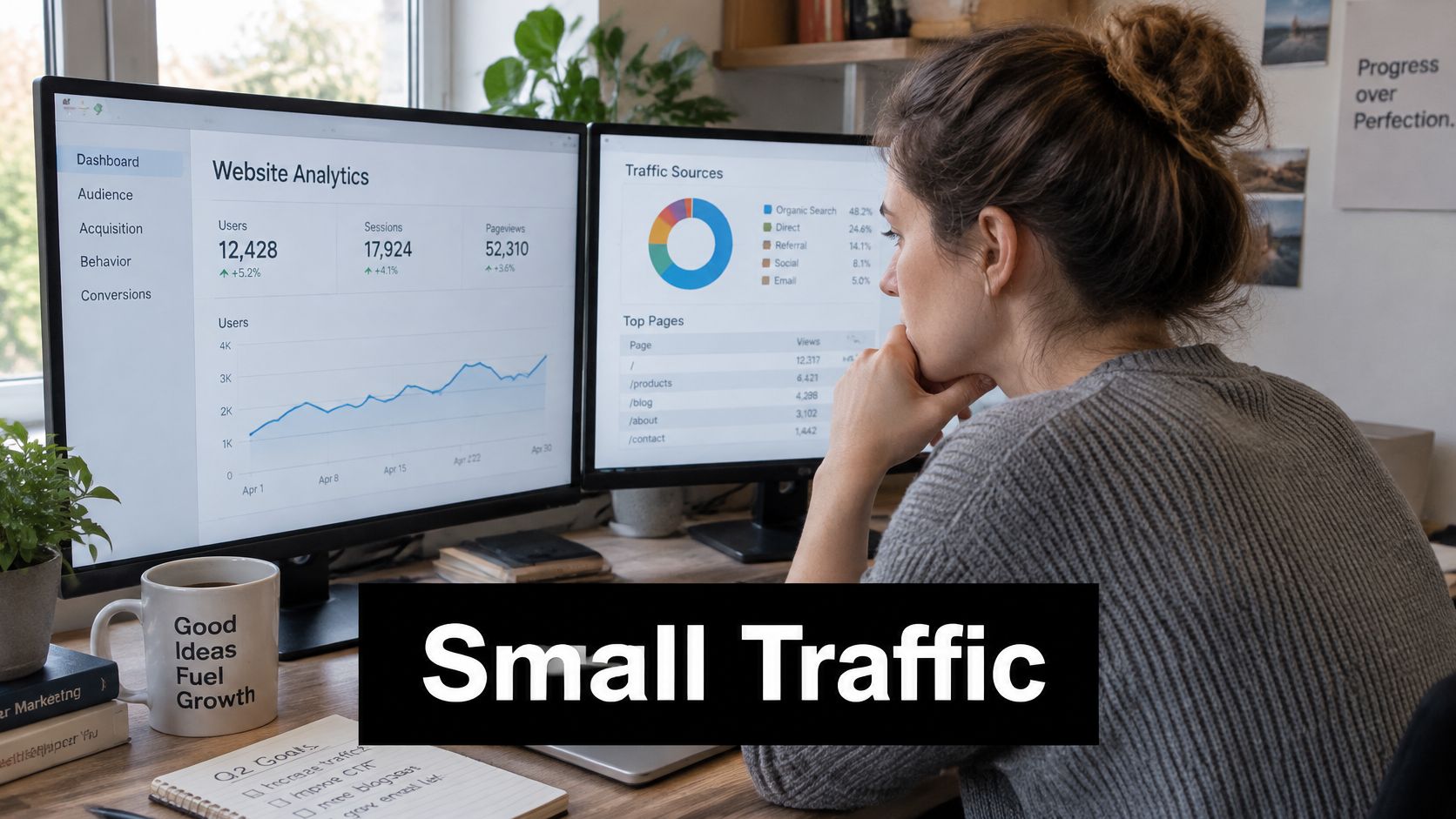
An analytics review should separate measurable visits from possible influence.
Distinguish visits, influence and causation
There are three measurement layers: direct referrals, assisted influence and incrementality. Assisted influence needs separate behavioral and self-reported views, which creates the following working scorecard.
Three AI-search measures and what each decides
| Measure | What it tells the business | How to collect it |
|---|---|---|
| Direct AI referrals | Visits from AI assistants that reach the site | AI referrer segment in analytics |
| AI-assisted branded search | Whether AI answers may lead to later brand demand | Branded search trend compared with AI referral trend |
| Self-reported influence | Whether buyers name an AI assistant as a source | A source-discovery question on forms and demo requests |
| Incrementality | Whether AI visibility causes conversions | Geo or audience holdout experiments |
Branded-search movement is a clue, not proof. A product launch, event or advertising campaign can produce the same pattern. Self-reported answers add context but shouldn't be treated as complete journey records either.
Set a spending threshold before commissioning content
A high-consideration B2B company may reasonably test research-stage citations even when few readers click through. The evaluation should include sales conversations, qualified opportunities and whether buyers mention discovering the business through an AI answer.
A low-margin retailer needs a stricter commercial threshold. Compare attributable gross profit with production and maintenance costs, rather than approving investment because mentions increased.
An integrated SEO and GEO strategy should preserve useful, accessible source pages instead of replacing established search measurement with a citation count.
The next practical action is small: create an AI-referrer segment and add an optional source-discovery question to lead forms. Keep the original response in the customer record so sales feedback can be compared with analytics without claiming more certainty than either measure supports.
Pick Your First SEO and SEM Experiment This Week
Start with a high-intent non-brand query whose relevant page already ranks on the second organic results page. That creates a specific decision: whether paid placement deserves funding while the organic page improves.
Build a themed ad group, send visitors to a page that fulfills the same promise as the organic listing, and select a qualified business conversion. A proposed two-week test can provide an initial reading, provided a comparable region or eligible audience remains without ads.
Record the decision before launching
- Organic baseline: Save the query's clicks, ranking position and destination page.
- Paid efficiency: Track qualified conversions per unit of spend, not form interactions.
- Holdout difference: Compare conversion outcomes between treated and untreated groups, allowing for differences in traffic and customer mix.
If paid exposure produces additional qualified conversions, retain the test budget and prioritize the query's organic page. If the holdout performs similarly, investigate shifting spending toward the content gap. Sparse results or a long sales cycle mean the test needs more time, not a confident verdict.
Useful marketing experiments end with a decision rule. At Sprints & Sneakers, a strategist selects keywords and pages for their expected effect on traffic and revenue rather than tackling everything at once.
Log the query, test window, result and budget decision in the roadmap spreadsheet. Then select the next promising page for testing.
Sprints & Sneakers combines SEO and paid search in one growth plan, with priorities tied to traffic, qualified demand and revenue. Visit Sprints & Sneakers to book a free SEO session and discuss which keywords, pages and paid-search tests deserve attention first.
Related articles

Frequently asked questions
Growth marketing, AI and automation, SEO, performance marketing, retention strategies, and sustainable business practices.
Weekly. Subscribe to our newsletter to get new articles straight to your inbox.
Absolutely. Everything we publish is designed to be actionable. Take it, test it, and make it your own.
Yes. We publish experiments with real numbers. What worked, what didn't, and what we learned.
Our growth team — strategists, performance marketers, data specialists, and AI builders who work on client campaigns every day.
We're open to it. Reach out via our contact page with your topic and we'll take a look.