
What Is B2B Lead Generation? a Practical Guide for 2026
What is B2B lead generation? Learn which channels work, how leads move to sales, and how to measure real pipeline, with examples to use next week.
It's Monday morning, the dashboard is green, and the form count looks like a win. Then sales opens the shared inbox and finds names with no company context, no problem, and no next step. Nobody is being difficult. The team counted contacts, not conversations that can become revenue.
A useful lead is an account moving toward a deal, not a row in a spreadsheet. Treat volume as noise until someone can say which company it is, what problem they have, and what happens next.
Table of Contents
- What B2B Lead Generation Actually Means
- Core Channels and Where Each One Fits
- Why Buyers Research Before They Call
- Metrics That Separate Real Leads From Noise
- How to Build a Lead Record Sales Can Use
- Examples You Can Apply the Next Day
- Limits, Misconceptions and AI Search
- Pick One Channel and Measure It This Quarter
What B2B Lead Generation Actually Means
Say a stranger lingers at your stand at a trade event, asks a sharp question about implementation, and later takes a follow-up call. That person is a warm prospect. A name pulled from a list you bought, never spoken to and never matched to a problem, is only a contact. One offered interest. The other is a name collected.
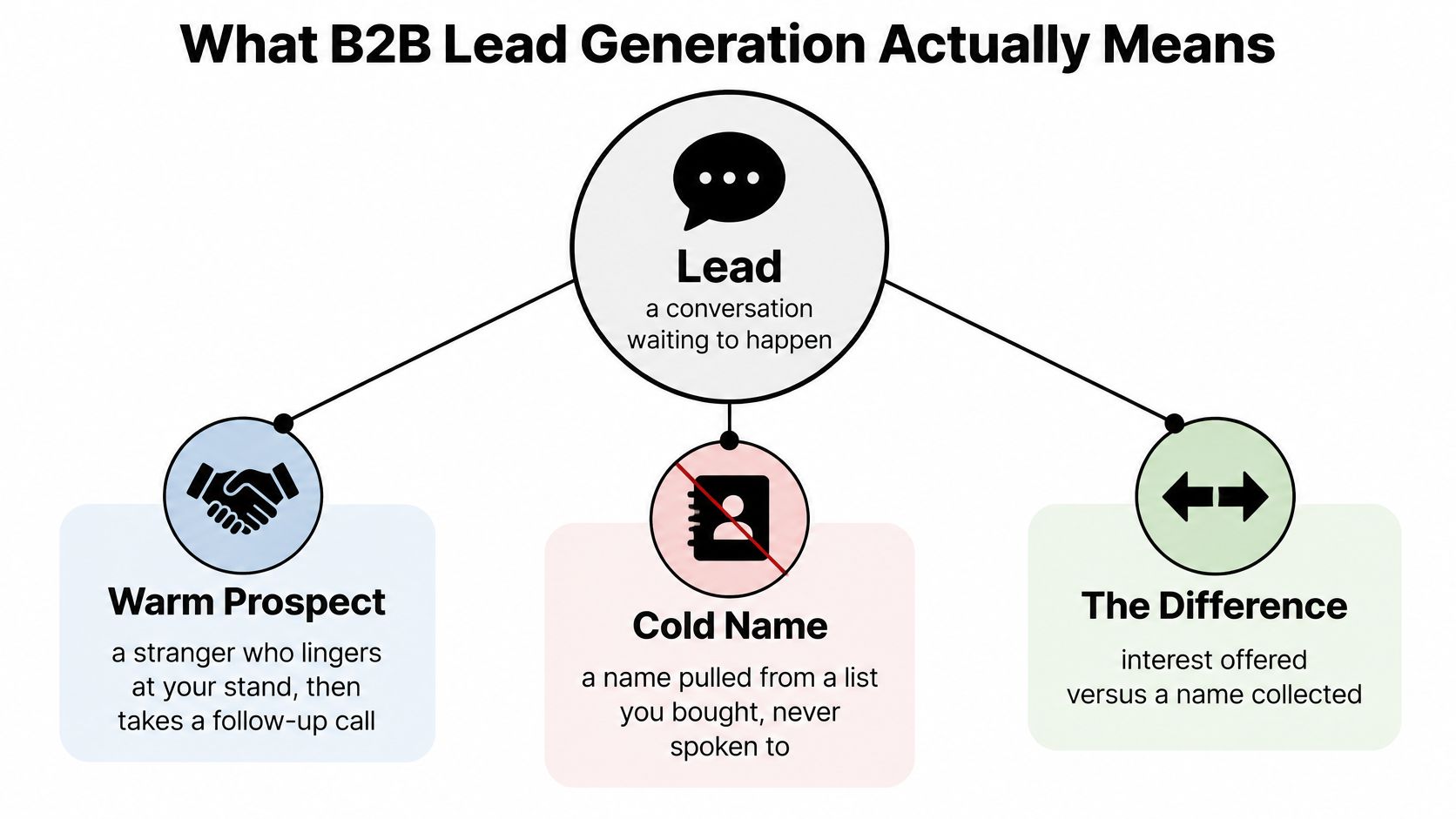
What is B2B lead generation? It's the structured process of attracting potential business customers, identifying the right people or organizations, capturing their contact details or declared interest, and developing that interest toward a sales conversation. The work splits in two.
Inbound covers search visibility, educational content, social media, webinars, and the paths on your website that turn visitors into conversations. Outbound covers targeted email, calling, paid ads, events, and account-based outreach. Together they build a measurable link between market attention and the revenue pipeline. A pile of names doesn't do that.
Quality, buying relevance, timing, and consent decide whether sales can use a contact. 85% of B2B marketers name lead generation as their most important content-marketing goal, according to lead generation benchmark coverage from Statistics Fundamentals. The same coverage notes that only about 27% of marketing leads are sales-ready when first generated. Most responses need qualification, nurturing, scoring, and follow-up. For scale-ups and SaaS teams, buying committees and longer consideration periods make progression matter more than raw volume.
Three-question test: Which company is it, what problem do they have, and what happens next? If you can't answer all three today, it isn't a lead yet.
Core Channels and Where Each One Fits
Read the table as a map. Each row names a channel, whether it pulls people in or reaches out, the buying stage it serves best, and the signal that shows it's working. Pick the row that matches what the buyer is doing this week, not the channel that is easiest to launch.
| Channel | Direction | Best for | Signal to track |
|---|---|---|---|
| SEO and search content | Inbound | Buyers researching a problem | Organic visits to solution pages and form starts |
| Educational content and webinars | Inbound | Early and mid-stage research | Downloads and webinar attendees per target account |
| Google Search ads on buying-intent keywords | Inbound (paid) | Buyers comparing vendors now | Qualified leads per dollar spent |
| LinkedIn ads by job title, industry and company | Outbound (paid) | Reaching named decision-makers | Engagement and lead form submissions by role |
| Targeted email outreach | Outbound | Accounts that match your profile | Replies and meetings booked |
| Cold calling | Outbound | High-value accounts with a known problem | Conversations held and meetings booked |
| Account-based marketing | Outbound and inbound | Named target accounts | Size of the engaged buying group per account |
| Events and partner referrals | Mixed | Trusted introductions | Opportunities created per event or partner |
Search and content catch people already trying to solve a problem. Someone searching for a compliance checklist they need this week is telling you the job. Judge that row by visits to solution pages and form starts, not by blog traffic alone.
Paid search on buying-intent keywords reaches people comparing vendors right now. The honest signal is qualified leads per dollar spent. A cheap click that never becomes a meeting is an expensive click.
LinkedIn ads and cold outreach reach named decision-makers by job title, industry, and company. That suits a shortlist you've already built. Judge them by replies and meetings booked, and by role, not by impressions. A practical setup for role targeting, lead forms, and account campaigns sits in this guide to LinkedIn ads for B2B.
Higher-value and first-time purchases usually need a human voice earlier than a repeat order does. Pair every self-serve asset with a clear route to a call. New sites also get found faster when teams submit your website to relevant directories that buyers and partners already trust, then point those listings at a specific offer rather than a generic homepage.
Which channels to run this quarter is a later decision. The table only answers what each one is for.
Why Buyers Research Before They Call
A plant manager is still at the kitchen table at 11 p.m., comparing three suppliers. Case studies sit in one tab, comparison pages in another. No salesperson has been called. The shortlist is almost finished before anyone on your team knows the account exists.
Buyers often complete a large share of the purchase on their own before they contact a supplier. Internet research is the usual path: product pages, peer stories, and an AI answer that names two vendors and skips the third. That answer can move an account toward revenue, or away from it, without ever counting as a lead. No form. No chat. No record in the CRM. The account is already in motion.
Lead generation has to work across search, content, landing pages, automation, analytics, and sales development, and it has to start before any form appears. A form fill is one visible event on a longer path.
Match the offer to the stage
Early readers need a checklist that names the problem in their words. It works like a parts list: they can see whether the job fits before they spend political capital internally. People weighing options need a comparison or a calculator they can take to a colleague. People ready to talk need a consultation with a named owner and a time. One generic "contact sales" page flattens all three into the same dead end.
Build that ladder into a B2B content marketing strategy so each asset has a job, not just a publish date.
Where consent allows, connect anonymous page views to an identifiable contact and to the account. The goal is to earn consideration, win permission to keep talking, and hand sales a buying group that is already informed.
A company can shape the decision long before anyone requests a meeting. If the useful answer isn't findable at 11 p.m., another supplier writes the shortlist.
Metrics That Separate Real Leads From Noise
A spike in form fills can look like growth while sales sees few viable opportunities. Track how accounts progress toward revenue, not just how many people submit a form. In 2025, 29% of surveyed B2B marketers used MQLs as a KPI, compared with 39% using bottom-funnel sales-qualified leads, according to the Pipeline360 report covered by Chief Marketer. The same report found 75% sales-marketing alignment among high-performing organizations, versus 24% among low performers. When teams define qualification differently, they can't reliably tell whether a lead is ready for sales.
Use shared evidence to track each account's progress. That way, a weekly report reflects meaningful movement, not just activity.
| Stage | Evidence required | Metric to track |
|---|---|---|
| Inquiry | Consented contact through a form, chat or download | Inquiries by channel |
| Qualified account | Matches the target profile and states a real problem | Qualified accounts per month |
| Active buying group | Two or more stakeholders engage with the content or sales | Engaged accounts per month |
| Sales opportunity | Sales accepts and books a discovery call | Opportunities created by source |
| Revenue | Closed deal traced back to its first touch | Pipeline and revenue by channel |
The stages run from a permitted first contact to a closed deal. To understand how credit is assigned across the journey, see this guide to measuring marketing attribution.
Agree on the definitions with sales, record them in the CRM, and review them monthly. A growing count of inquiries matters less than accounts that fit your target and show buying-group engagement. For Monday's report, track qualified accounts with an active buying group this month.
How to Build a Lead Record Sales Can Use
A name and an email are a sticky note on a monitor. Sales needs the account itself, moving toward revenue the way a parcel moves through a warehouse: which company it belongs to, who handled it, which shelf it left, and who signs for the next stop.
The record should show the company, the contact's role, the problem in their words, the stage, what they engaged with, and the next action. It has to survive a committee, not a single click.
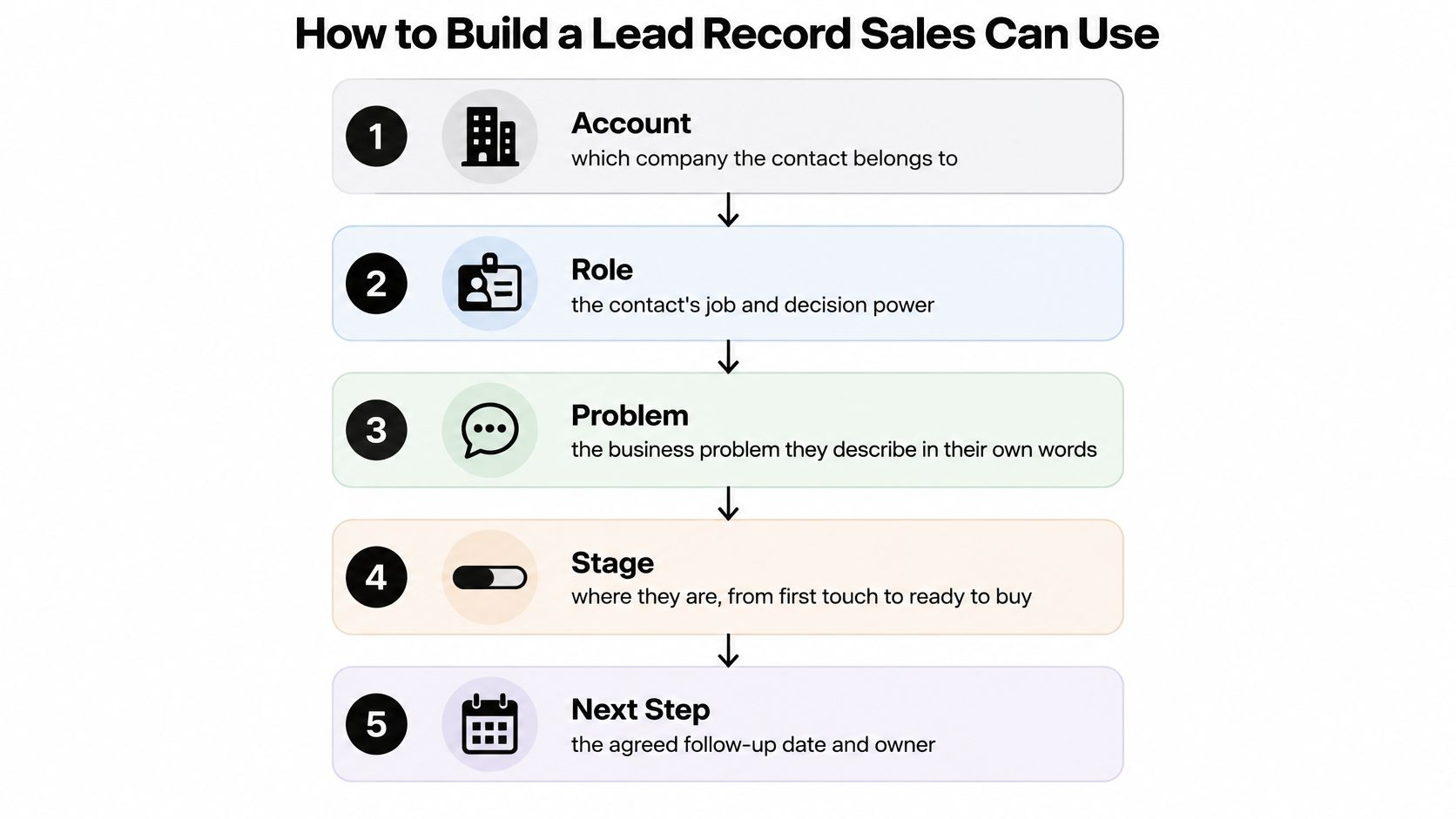
- Create the account first. Match every contact to that company so duplicates don't split one buying group into three lonely people.
- Record the role. Champion, budget owner, or technical evaluator changes who you invite to the next call. A title without decision power only tells you who to note, not who to invite.
- Write the problem in their words. Pull it from the form field, the call notes, or the page they read. Your category language can wait.
- Log the events. Pricing-page visits, technical downloads, webinar attendance, and replies show timing better than a single score.
- Set the stage from the latest evidence. The first download doesn't freeze the account in "early" if three colleagues later opened pricing.
- Assign one next action. Name an owner and a date. A lead with no date goes quiet, and nobody owns the silence.
A buyer who only reads an AI answer never creates a row. That research can shape the shortlist, yet it does not count as a lead until a consented contact or a logged event appears on the account.
Wiring those events into routing is the job of marketing automation and CRM integration. Keep the fields few enough that reps will fill them. A short card gets updated. A long form gets skipped.
A finished record for a 40-person SaaS team looks plain on purpose. One account. Three roles. A stated problem. A stage. A call booked for Thursday. Sales can open it and know what to say.
Examples You Can Apply the Next Day
A SaaS scale-up's demo requests arrive in a shared inbox. By the time anyone checks it, a buyer may have arranged calls with other providers. A better handoff can start with a few practical changes.

- Link a privacy policy to the Google Ads lead form. Google's lead-form guidance requires a linked privacy policy before the form can collect user information.
- Route each submission into the CRM through a webhook or an integration such as Zapier. Google stores lead data for 60 days, while manual CSV downloads cover only the most recent 30 days, according to Google's lead-form guidance. Treat exports as a backup and route leads through the CRM.
- Set a routing rule that assigns each lead to an owner by company size and region, with the submission history available for follow-up.
Watch the handoff from form to owner in this short walkthrough, then compare it with your own process.
<iframe width="100%" style="aspect-ratio: 16 / 9;" src="https://www.youtube.com/embed/-GkvjdzTZLQ" frameborder="0" allow="autoplay; encrypted-media" allowfullscreen></iframe>An industrial manufacturer can apply the same idea to content. Create one useful asset for each early buying question: a cost calculator for purchasing managers, an implementation checklist for operations leads, or a comparison guide for engineers. Give each asset its own form and follow-up sequence, then track which one contributes to meetings and progress through the B2B sales pipeline.
A one-day outbound check
Send a short, personal LinkedIn note to decision-makers in three named industries. Before sending any follow-up email, review the CAN-SPAM compliance guide. Commercial email needs accurate From, To, and Reply-To details, a non-deceptive subject line, a clear label identifying the message as an advertisement, and a valid physical postal address. Include a plainly labeled unsubscribe link that can process requests for at least 30 days after sending, and honor opt-outs within 10 business days. Add every opt-out to an automated suppression list.
Send yourself a test email, click unsubscribe, and confirm the address enters that list. Then choose one change to have in place by tomorrow morning.
Limits, Misconceptions and AI Search
A buying group spends an afternoon asking a generative AI tool to compare three vendors already on a shortlist. They argue about implementation risk, then book a meeting with the name they trust. The CRM shows a direct visit and a branded search. No form, no campaign ID. The account still moved toward revenue, and that influence never became a lead record.
Two beliefs keep that gap hidden.
"More leads always means more pipeline" fails when the extra names never join a buying group. Extra rows are activity. Pipeline is an account progressing toward a deal.
"AI tools create leads on their own" fails because the tool usually shapes the choice without a click. No click means nothing for the CRM to store. An AI answer works like a recommendation at an industry dinner: it can change who gets the meeting, and it still is not a sourced lead.
A 2026 buyer study, covered by MarketScale's write-up of that buyer research, reports that 55% of enterprise buyers began supplier research in generative-AI platforms, compared with 45% who began in conventional search. Buyers often use those tools to check vendors already on a shortlist rather than to find new providers. The answer can sway the decision and leave no referral to report. Keep AI answers off the channel map as if they were a media buy, and do not replace search or paid media with generic AI-written pages.
What to track instead
- Mentions: your brand and category inside AI answers.
- Citations: whether your pages are the source being summarized.
- Demand signals: direct traffic, branded search, and assisted conversions.
- Outcomes: win rates among accounts that already know your name, plus the language buyers use on sales calls.
Set those signals beside sourced pipeline so a channel only gets credit for accounts it moved. Lead generation cannot rescue a weak offer. Review the offer and the sales follow-up before you add volume.
Pick One Channel and Measure It This Quarter
Make one decision. Choose one inbound channel and one outbound channel from the channel map, adopt the stage definitions, and set a 30-day review. An internal review is enough when the data is clean and the team already agrees on what a lead is.
- List 20 accounts you most want to win, plus the job titles that matter inside each one. Twenty is small enough to know by name.
- Match the channels. Pick the inbound place where those buyers search, and the outbound path that reaches them by role.
- Write the stages with sales in one meeting and put them in the CRM, including the evidence required to move an account.
- Review at day 30. Look at qualified accounts, buying-group breadth, and first-meeting rate. Drop the weaker channel.
If the team can't see where leads stall, an outside growth diagnostic is one option. Sprints & Sneakers starts by spotting bottlenecks with a full-funnel diagnostic across acquisition, conversion, and retention, run on a B2B funnel rather than a consumer one, because a different business needs a different funnel.
Start with the list of 20 accounts before you open another ad account.
Sprints & Sneakers builds B2B lead generation as targeted outreach that turns named accounts into a predictable pipeline, from first signal through to the deals your team closes. If form fills are piling up and sales still can't see a buying group, the next step is a full-funnel look at where accounts stall. Visit Sprints & Sneakers and book a conversation about the quarter's one bottleneck.
Related articles
Frequently asked questions
Growth marketing, AI and automation, SEO, performance marketing, retention strategies, and sustainable business practices.
Weekly. Subscribe to our newsletter to get new articles straight to your inbox.
Absolutely. Everything we publish is designed to be actionable. Take it, test it, and make it your own.
Yes. We publish experiments with real numbers. What worked, what didn't, and what we learned.
Our growth team — strategists, performance marketers, data specialists, and AI builders who work on client campaigns every day.
We're open to it. Reach out via our contact page with your topic and we'll take a look.