75% of B2B buyers preferred a rep-free sales experience, according to Gartner's buying-journey research. A CRM organized around seller activity therefore captures only part of the purchase. A demo completed, proposal sent, or follow-up logged doesn't prove that the buying group has moved closer to a decision.
A useful B2B sales pipeline separates buyer progress from seller effort. It also keeps forecastable opportunities apart from demand that marketing can detect but sales can't yet qualify. That distinction makes a smaller, defensible forecast more useful than a large board full of hopeful close dates.
Table of Contents
Why the Pipeline Starts Before the First Call
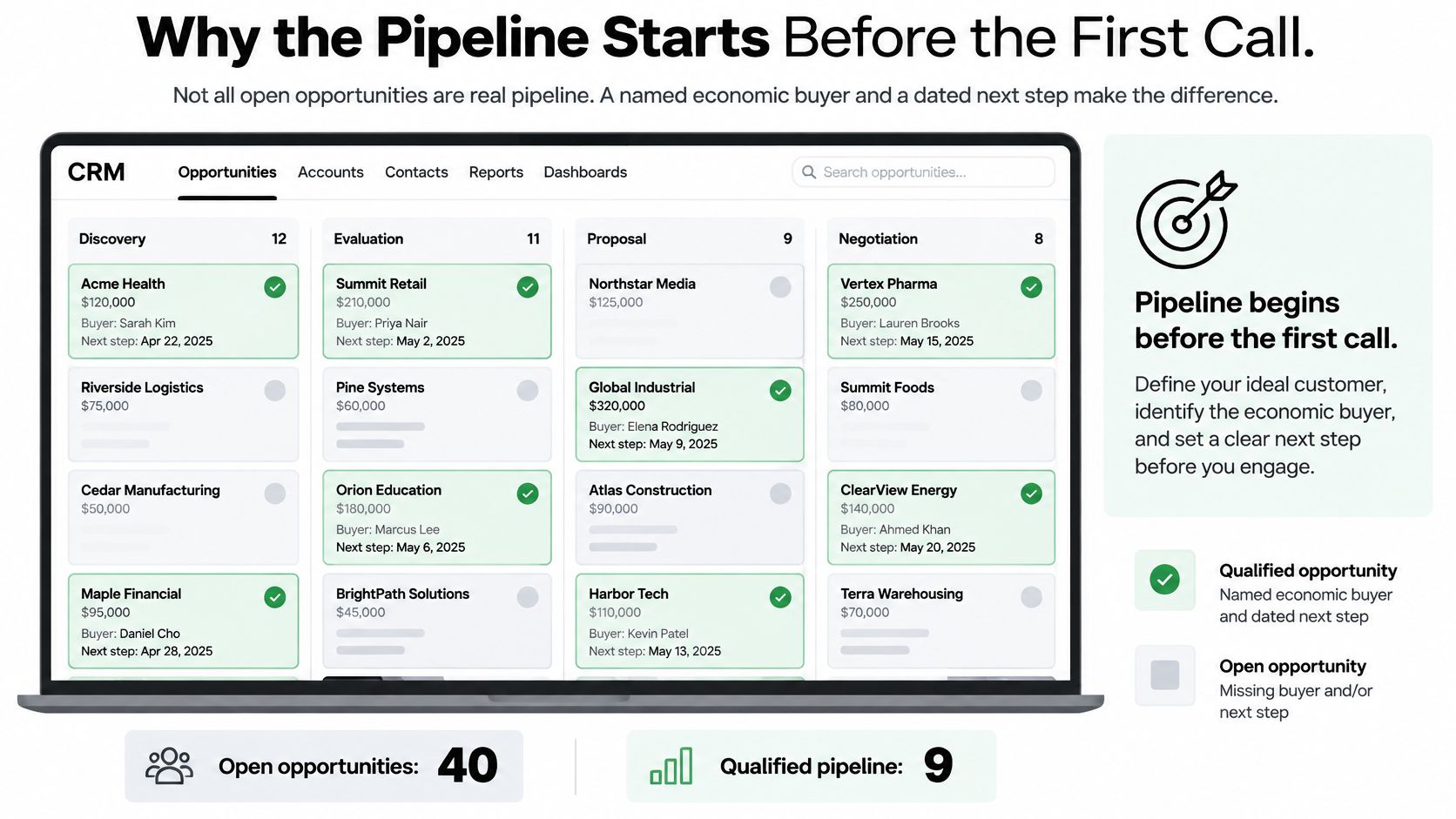
Consider a hypothetical scale-up with 40 open opportunities, but only nine with a named economic buyer and a dated next step. Those nine deserve serious pipeline attention. The remaining records need qualification, not another optimistic close date.
Late seller involvement makes that distinction important. G2's 2025 survey of 1,169 B2B decision-makers found that nearly two-thirds preferred engaging vendor salespeople only in later buying stages, an increase of 17 percentage points from the prior year; Demandbase findings included in the report put complex, multi-stakeholder purchases at 72% and buyers prioritizing integration over standalone features at 77%.
The dashboard distinction is straightforward.
Follow the buying group's work
Buyers revisit problems, requirements, supplier choices, validation, and internal agreement. A technical objection can reopen requirements after a commercial conversation. An enthusiastic champion can still lack executive support.
The useful checkpoints are problem alignment, stakeholder coverage, technical fit, business-case agreement, procurement readiness, and executive sponsorship. These are buying jobs, not a demand for more CRM columns.
A qualified opportunity is a buying group making progress, not a contact attached to a sales activity.
Early content should help that group work without forcing a conversation. An inbound lead generation strategy should connect educational material to a clear route for requesting help. For teams using expert conversations to build familiarity before that request, Podmuse's guide to podcast lead generation offers a useful channel-specific resource.
Operationally, this calls for evidence-based exit tests, prompt responses to explicit requests, a forecast that excludes verbal interest, and a weekly review focused on the weakest handoff.
Stage Gates and the Rates Worth Using
B2B stage gates and conversion bands
| Stage | Exit test | Converts to next | If you miss the band |
|---|
| Inquiry | Source, campaign, company, role, consent, and timestamp captured; ICP fit met | 25–35% to MQL | Tighten targeting before adding volume |
| MQL | Named business problem, not a content click alone | 13–26% to SQL | Rewrite score and first-touch quality |
| SQL | Problem, influencer role, and scheduled next step confirmed live | 50–62% to opportunity | Fix discovery, not the proposal deck |
| Opportunity | Pain, decision process, criteria, value, and next meeting documented | Enters validation; no separate published rate | Leave it out of the forecast until commit fields exist |
| Validation | Technical fit, business case, and procurement path agreed | 15–30% of opportunities close | Check stakeholders, commercial fit, and timing |
| Closed-won | Signed order or equivalent commercial commitment | Not a conversion band | Remove from open pipeline the day it signs |
The published conversion bands in this table come from SyncGTM's B2B sales funnel benchmark, which reports 25–35% lead-to-MQL, 13–26% MQL-to-SQL, 50–62% SQL-to-opportunity, and 15–30% opportunity-to-closed. These are diagnostic reference ranges, not targets every business must hit.
Make the exit test observable
An inquiry enters when the required capture fields exist. Firmographic fit determines whether it belongs in the addressable pool. A newsletter download alone doesn't establish a business problem, even when the contact works at an attractive account.
The live SQL check should establish what needs to change and whether the contact can influence that change. Authority to influence isn't the same as authority to sign. Recording both prevents a helpful evaluator from being mistaken for the economic buyer.
An opportunity needs written evidence, not a representative's summary that the conversation went well. Decision criteria might include integration compatibility, implementation constraints, security requirements, and a commercial ceiling. The record should identify who supplied those criteria.
Validation isn't another name for sending a proposal. Technical acceptance, a shared business case, and a workable procurement path must exist together. Executive sponsorship should be recorded where the purchase requires it, rather than inferred from a senior person attending a call.
Check the multiplication before buying volume
A hypothetical cohort of 200 leads, applying the midpoint of each published band, produces about 60 MQLs, 12 SQLs, seven opportunities, and one or two wins. That's near a 1% end-to-end result, calculated from the table's ranges rather than offered as a separate benchmark.
The example exposes why a crowded database can coexist with weak bookings. Small losses at successive handoffs multiply. Increasing acquisition won't repair a qualification handoff that consistently rejects the wrong accounts.
Keep self-serve, partner, and enterprise cohorts separate. Partner introductions may arrive with established trust; enterprise opportunities may need extensive validation. Combining them can make an underperforming motion appear healthy.
Monday's CRM changes should include:
- Entry and exit timestamps for each stage, preserved rather than overwritten.
- Evidence fields for the problem, stakeholder roles, decision criteria, and next meeting.
- Cohort labels covering source, segment, and sales motion.
- A consistent denominator so the weekly report compares records from the same entering cohort.
A shared method for calculating conversion rate keeps reports comparable. Stage names matter less than whether marketing, sales, and finance count the same transition the same way.
How to Score Route and Reply the Same Day
A same-day response policy needs a routing mechanism, an available owner, and an exception path. Without those, the service-level agreement is just a sentence in a sales handbook.
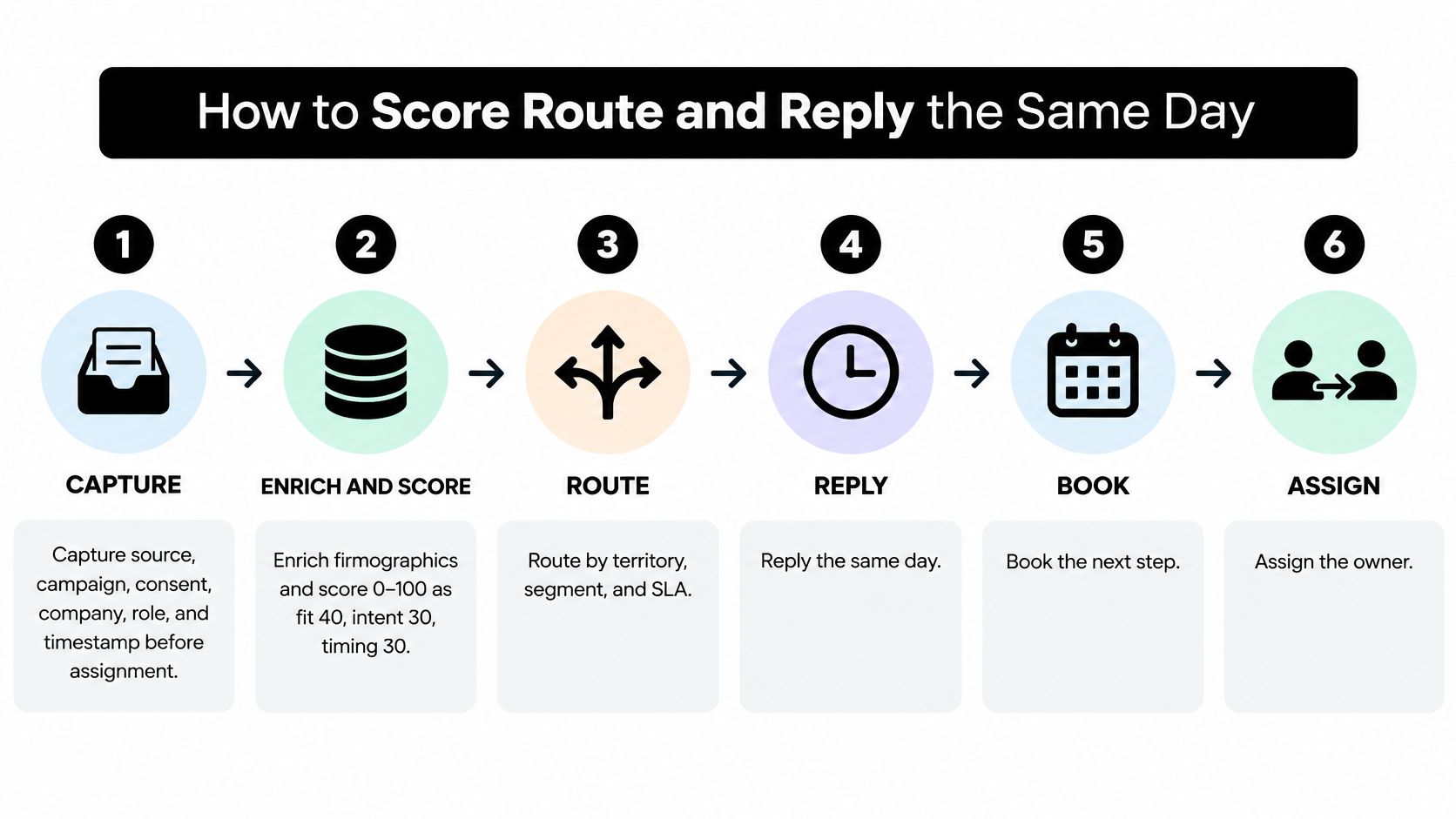
This workflow shows where capture, routing, and ownership belong.
Move the request without losing context
-
Capture before assignment. Save source, campaign, consent, company, role, and submission timestamp on the record. Preserve the prospect's actual message. A rep shouldn't need to reconstruct the request from an alert.
-
Enrich and score. As an initial operating design, use a 0–100 score, with 40 points for fit, 30 for intent, and 30 for engagement, routing at 70 or above. These are proposed configuration values, not benchmark findings. Cap passive engagement so repeated newsletter clicks can't compensate for poor fit or missing intent.
-
Assign an available owner. Route eligible requests by territory and segment, then check capacity. Lower-priority records enter a named nurture track with a re-entry condition. A lead shouldn't disappear into an unowned list because it missed the threshold.
-
Send a useful human reply. During business hours, target a response inside five minutes for qualified high-intent requests. Research summarized by Make It Loud's lead-response review found that contact odds fell 100-fold and qualification odds 21-fold when the first call occurred at 30 minutes rather than five; its separate audit of 2,241 U.S. companies reported a 42-hour average response, 23% receiving no response, and approximately seven times greater qualification likelihood for responses within an hour versus waits of two hours or longer. Separately, Sales.co's summary of 6sense's 2025 buyer survey reports that the vendor contacted first won eight out of ten deals, an association that supports making the first interaction useful, not claiming that speed alone causes wins.
-
Log every attempt. Record the channel, timestamp, outcome, and next action. An automated receipt and a personalized reply should have different activity types.
-
Recycle silence deliberately. After the defined multi-touch sequence ends, remove unresponsive records from active selling and return them to an appropriate nurture track. Retain their history and the reason for recycling.
Make the reply worth answering
For a hypothetical industrial RFQ, the reply can acknowledge the required application, attach an approved proof point from a comparable job, ask which integration constraint is essential, and offer a calendar option. A generic company introduction wastes the information already supplied.
After hours, automation should acknowledge receipt, alert the backup, and assign a morning owner. It shouldn't imply that a salesperson has reviewed the request.
The workflow walkthrough provides another way to review the handoff.
<iframe width="100%" style="aspect-ratio: 16 / 9;" src="https://www.youtube.com/embed/sZgcg8h4W9k" frameborder="0" allow="autoplay; encrypted-media" allowfullscreen></iframe>
Implementation teams can use The Social Search's sales pipeline automation best practices to examine handoffs, alongside guidance on marketing automation in CRM. Automation should carry context and enforce ownership, not manufacture sales readiness.
The operating dashboard needs median first-response time, share contacted within the response target, contact rate, and MQL-to-SQL conversion by source. Start with the RFQ or demo-request path, not every ebook download.
Forecast Only the Deals That Clear the Gate
A flat win rate doesn't belong across the entire pipeline. It treats a partner introduction, a self-serve buyer, and an enterprise evaluation as equivalent commercial situations.
The qualification gap is substantial: Trumpet's sales-conversion review summarizes close rates of 8% for poorly qualified deals versus 50% for highly qualified deals, alongside Ebsta and Pavilion benchmarks of 18% for new business and 45% for expansion. Those figures describe different populations, not interchangeable probabilities for individual opportunities.
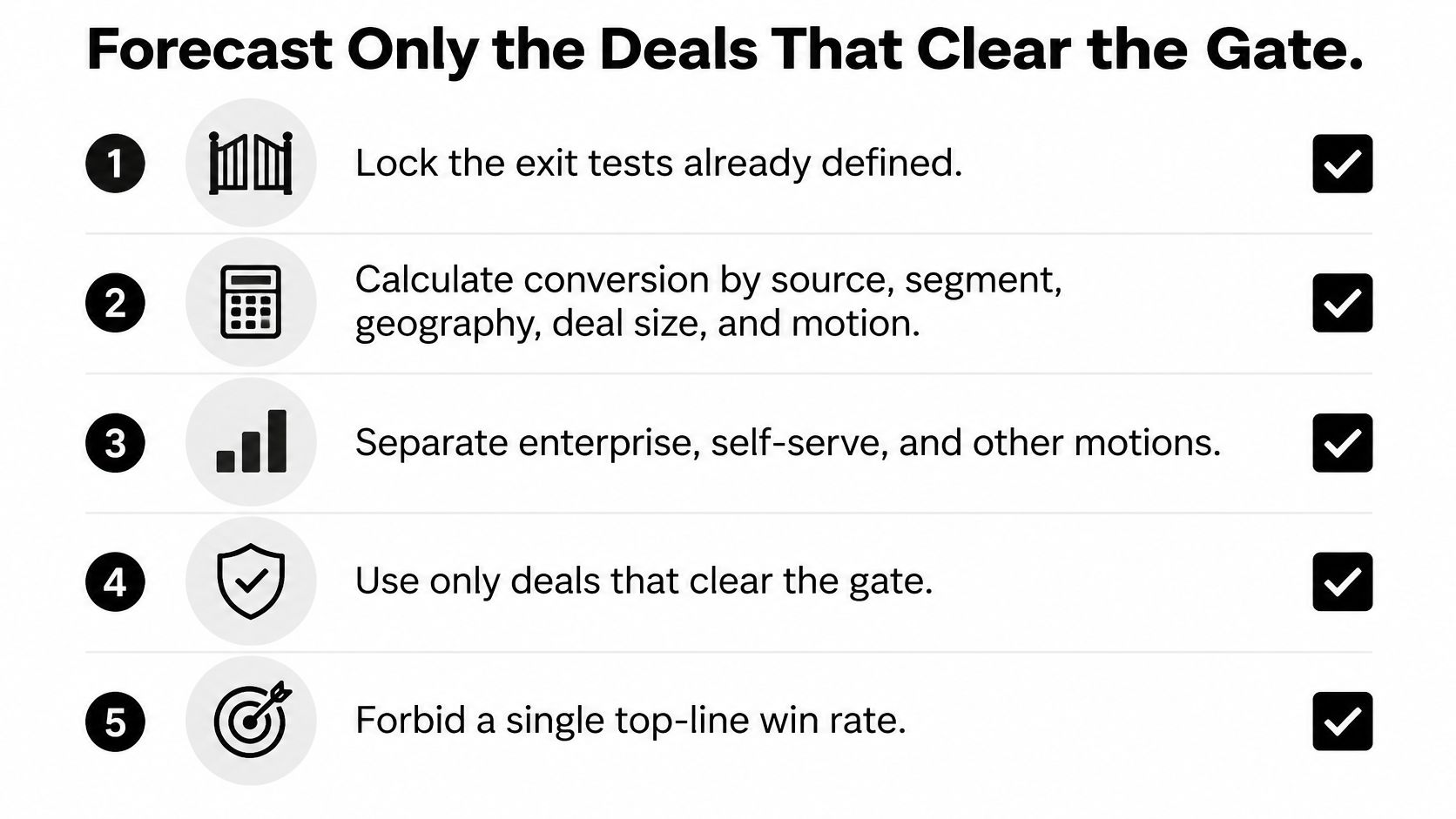
The forecast checklist makes the required discipline explicit.
Build probabilities from comparable deals
A defensible process follows the cohort-based method described in LeadRiver's conversion-benchmark guide:
- Lock the exit tests. A stage change requires evidence, not permission from a hopeful manager.
- Segment historical conversion. Separate source, segment, geography, deal size, and sales motion.
- Inspect stage aging. Flag deals beyond the cohort median for review, then assess the actual blocker.
- Weight only supported cohorts. When history is insufficient, disclose uncertainty rather than borrowing a confident-looking probability.
- Back-test against bookings. Compare the forecast with actual outcomes monthly and investigate systematic misses.
A high close rate doesn't solve a timing problem. If validation regularly finishes after the expected booking date, the quarter's forecast remains overstated.
Keep observed opportunities separate from inferred demand
Gartner's buyer findings, reported in a Business Wire announcement, found 45% of B2B buyers used generative AI during a recent purchase, buyers consulted an average of seven information sources, 67% preferred a rep-free experience, and 70% preferred fully digital self-service purchasing. A form submission can therefore be a late observable event, not the start of consideration.
Leadership needs distinct views:
| View | Evidence | Forecast treatment |
|---|
| Observable pipeline | Qualified CRM records, documented buyer actions, scheduled meetings | Eligible for cohort-based forecasting |
| Estimated pre-pipeline demand | Branded-search movement, content-assisted account engagement, reported champion forwards | Separate low-confidence range, excluded from commit |
Anonymous interest shouldn't become a fictional opportunity. Estimated demand can inform staffing and marketing investment, but its assumptions need a written confidence note.
Win-loss interviews and self-reported attribution help test those assumptions. A form or meeting confirms visible engagement, not automatic qualification; commit still requires documented pain, an identified decision process, a target outcome, and a dated next meeting.
Forecast discipline: Uncertainty belongs in the explanation, not hidden inside an inflated opportunity total.
Marketing Tests That Refill a Thin Pipeline
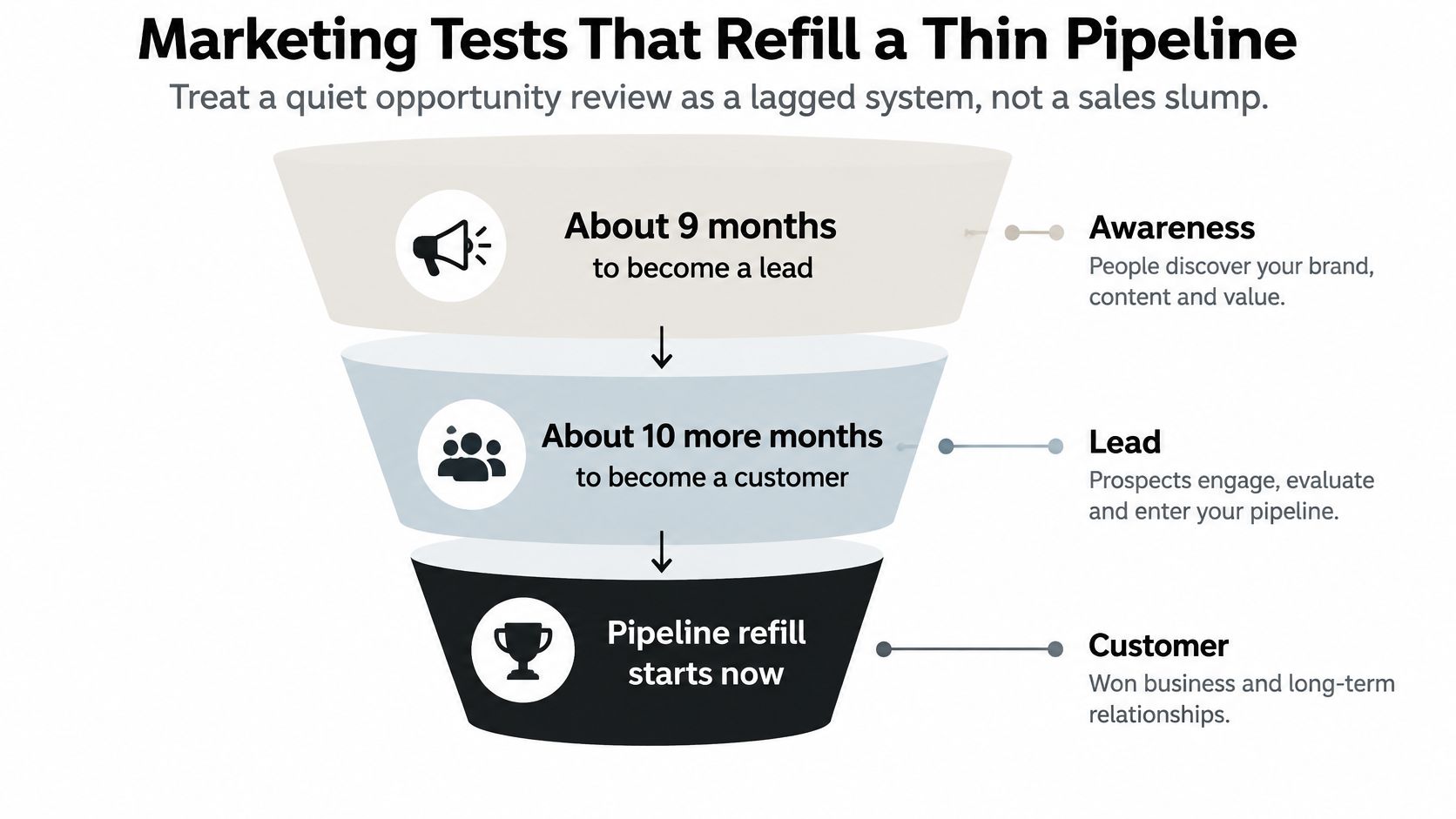
An Adobe-hosted Forrester Consulting analysis summarized by Market Intelligence Tools reports averages of about nine months from prospect to lead, another ten months to sales qualification, and a further ten months to closed sale, approximately 29 months across the measured stages. These aren't universal planning deadlines, but they explain why a quiet opportunity review can reflect much earlier demand-generation decisions.
Budget pressure makes indiscriminate acquisition hard to defend. Pipeline360's 2025 survey of 534 B2B marketing professionals found 63% of organizations had stagnant or shrinking marketing budgets; a separate 2025 B2B sales survey summarized by SME Today found nearly three-quarters of sellers said at least 21% of their pipeline came from inbound leads.
The funnel visual emphasizes the lag; the measured progression includes separate qualification and closing intervals.
Match the experiment to the leak
Awareness needs proof, not more publishing. Build a substantial asset around a problem the target account already recognizes: an implementation teardown, integration checklist, or buying guide. Use content-assisted opportunities as the primary outcome, with branded-search movement as a directional check. Impressions alone can't establish buying progress.
Acquisition needs a qualified offer. Test an offer such as an implementation assessment against the existing conversion path. Judge it on MQL-to-SQL progression rather than form volume. If submissions increase while qualification deteriorates, stop expanding the campaign and inspect the promise made in the offer.
Activation needs internal selling material. Give the champion a concise business case, integration proof, and an internal FAQ. Measure progression into validation. The material should answer finance, technical, and operational objections without requiring the champion to rewrite a sales presentation.
Preserve the connection to revenue
A source report should follow entering cohorts through qualification and closure. Comparing this month's campaign spend with this month's bookings can credit the wrong activity when buying cycles are long.
Marketing and sales need a shared SQL definition and an agreed review cadence. A practical starting format is a 30-minute weekly meeting, proposed as an operating choice rather than a research benchmark.
- Marketing owns the hypothesis. State which handoff the experiment should improve.
- Sales supplies rejection reasons. Record missing fit, unclear problem, timing, or absent influence separately.
- RevOps preserves the cohort. Keep the original source and experiment label through stage changes.
- The revenue lead makes the decision. Continue, revise, or stop based on qualified progression.
A focused set of B2B demand-generation tactics should follow that diagnosis. More forms aren't the objective. More suitable buying groups reaching a verified next step are.
When the Pipeline Stalls and What to Change
Healthy lead volume paired with weak sales qualification usually warrants an inspection of scoring and first-touch handling before more traffic is purchased. The weekly review should identify a failed handoff, then assign a specific control change.
The thresholds below are proposed intervention rules, not additional industry benchmarks. The MQL-to-SQL trigger uses the lower edge of the published band already attached to that handoff.
Pipeline symptoms and the change to make
| What you see | Usual cause | Change this week |
|---|
| Lead volume is fine and MQL-to-SQL is under 13% | Score or first touch treats every form as ready | Raise the route line and audit five-minute replies |
| Opportunities sit past twice the median stage age | No real next step | Recycle at a proposed 14 or 30 days and drop them from forecast |
| Bookings miss the forecast by more than 20% | Unqualified deals sit in commit | Require pain, process, outcome, and a meeting |
| Champion goes quiet after the demo | No internal selling asset | Send a one-page case, integration proof, and FAQ |
| A competitor is already in the deal | Slow or hidden high-intent path | Surface one conversion path and cover after hours |
Treat aging as a question, not an automatic loss
For an initial policy, transactional motions can use the shorter recycling window and enterprise motions the longer window shown in the table. Cohort history should eventually replace those defaults.
A documented procurement delay isn't equivalent to silence. The owner should record the buyer-confirmed dependency and a dated checkpoint. Without either, the opportunity shouldn't retain its forecast position because its potential value is attractive.
If forecast error exceeds the proposed tolerance for consecutive monthly reviews, the forecast owner should inspect commit eligibility before changing every probability. Missing qualification evidence is a process failure; a delayed signature on an otherwise validated deal is a timing issue.
Change the control that matches the cause
A quiet champion may need material colleagues can understand, but silence can also mean the project lost priority. The next message should test the blocker rather than assume another demonstration will help.
A competitor's earlier involvement warrants a review of the conversion path and routing coverage. It doesn't justify sending aggressive sequences to every passive visitor.
Velocity matters as much as win rate, because a slow, pretty pipeline still misses the quarter.
Teams can apply A/B testing for marketing to the offer, response, or enablement asset while keeping unrelated controls stable. Changing targeting, scoring, messaging, and follow-up together prevents a useful diagnosis.
The revenue lead should select the single worst row and authorize only the corresponding change for the coming week.
Commit Only the Pipeline You Can Defend
A defensible pipeline is buying-group evidence already recorded in the CRM, not a larger pile of form fills. Making that standard operational requires named owners and deadlines, not another presentation about alignment.
Give each change an owner
- RevOps owns the stage definitions. By Tuesday, paste the exit tests into the CRM, make evidence fields visible, and retire activity-count stages. Preserve historical timestamps so reporting survives the change.
- The inbound owner owns response coverage. Enable rapid routing for a high-intent form and name an after-hours backup. Friday's report should show the share of human replies that met the agreed response target, with failed assignments called out separately.
- The forecast owner owns commit integrity. Remove deals missing qualification evidence. Leadership should see the observable opportunity total beside a separate low-confidence demand range, never a blended number presented as equally reliable.
- Marketing and the sales lead own the experiment. Select the weakest stage handoff, launch a focused test, and meet the following week to continue, revise, or stop it. The decision should use buyer progression rather than activity counts.
Keep the review narrow enough to produce action
The weekly meeting should finish with a bottleneck, an owner, and an observable change. A tour through every open deal makes it too easy to substitute explanations for decisions.
If nobody can identify the bottleneck, the team needs an internal review across awareness, acquisition, activation, revenue, retention, and referral before bringing in outside help. Existing-customer expansion and referrals deserve examination alongside acquisition, particularly when replacing opportunities requires substantial buyer education.
The standard is simple: every forecasted deal must withstand a direct question about what the buying group has confirmed. Anything else belongs in qualification, nurture, or an explicitly uncertain demand estimate.
Sprints & Sneakers offers a personalized growth scan and full-funnel experiments to identify pipeline bottlenecks, improve conversion, and connect marketing activity to qualified progression. Revenue teams seeking support with that diagnosis can visit Sprints & Sneakers to discuss a focused starting point across demand generation, CRM automation, and sales enablement.