
What Is Performance Media? a Practical Growth Guide
What is performance media? Learn how paid search, social, and programmatic drive measurable outcomes, plus KPIs, attribution, and AI optimization tips.
Performance media is paid marketing optimized against measurable business outcomes, such as clicks, qualified leads, purchases, revenue, or customer acquisition cost, rather than exposure alone. That definition only holds when measurement can show the outcome was incremental, meaning it would not have happened without the advertising.
That's the point most popular advice skips. Teams get told to chase the cheapest click or the highest platform-reported return, then scale whatever the dashboard rewards. A stronger approach asks a less comfortable question first: did the spend actually create new demand, pipeline, or profit?
Table of Contents
- What Performance Media Really Means
- The Core Channels Behind Performance Media
- The KPIs That Actually Matter
- Attribution, Incrementality, and Business Impact
- How Performance Media Fits Full-Funnel Growth
- Performance Media for B2B and B2C Teams
- Using AI and Experiments to Improve Media ROI
- Your Next Step Toward Predictable Performance
What Performance Media Really Means
A campaign can report excellent return on ad spend and still create almost no new business. It may harvest branded searches from people already planning to buy, retarget recent visitors, or take credit for a sale influenced by several earlier touches. The dashboard looks efficient. The business result stays flat.
That gap is central to what is performance media in practical terms. It isn't any paid campaign with tracking attached. It's a management discipline that connects spend to effectiveness, efficiency, and adaptability, then moves budget when evidence changes.
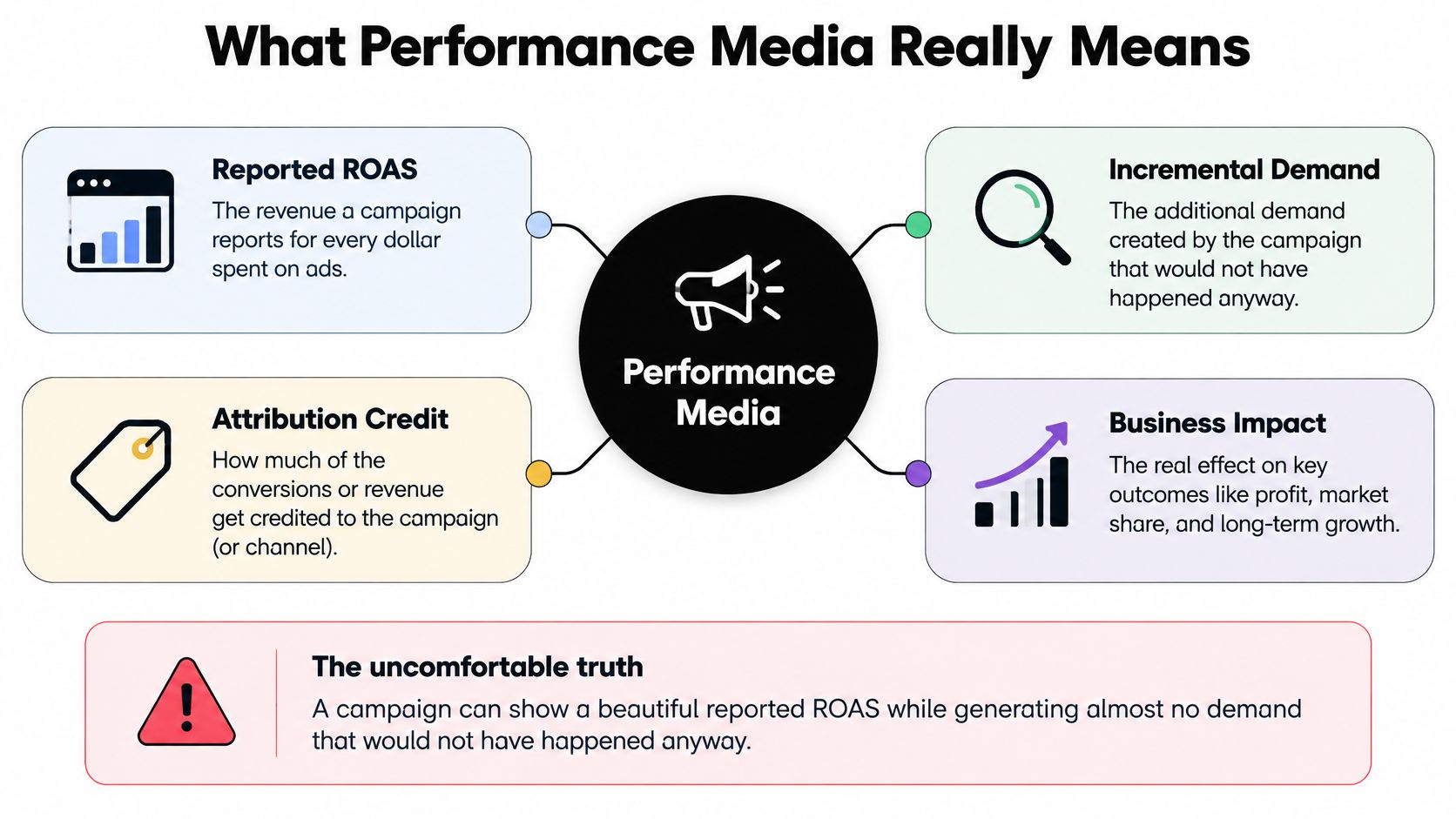
A working definition
Traditional brand advertising often judges success through reach, awareness, or attention. Performance media ties investment to actions and commercial outcomes. Academic work frames marketing performance through both effectiveness and efficiency against revenue, growth, and market share objectives.
Performance media connects paid investment to trackable actions, then tests whether those actions produce incremental pipeline, revenue, margin, retention, or lifetime value.
Three questions keep that definition honest:
- Attribution: Which touchpoint receives credit for a conversion?
- Incrementality: What changed because the advertising ran?
- Business impact: Did qualified pipeline, profit, customer quality, or retention improve?
Those questions aren't interchangeable. Attribution is a credit rule. Incrementality is a causal question. Business impact is the commercial consequence.
Why the distinction matters
A campaign can be effective because it generates demand, efficient because it does so at an acceptable cost, and adaptable because it improves as audiences or market conditions shift. Judging only one dimension leads to bad decisions. Cheap leads that never become opportunities aren't efficient in any meaningful sense. Expensive conversions may still be valuable when retention and customer quality are strong.
This is why performance media matters so much for SaaS, B2B, and e-commerce teams. Each model needs a credible line between media activity and commercial results, but none should accept platform credit as proof. Trackable campaigns, clear conversion events, audience targeting, experimentation, and ongoing budget reallocation provide the mechanism. Reliable definitions and incremental results provide the discipline.
The next-day test is simple. Pick one supposedly strong campaign and ask what credible evidence shows it caused new outcomes. If the only answer is a platform conversion count, that's attribution, not yet performance.
The Core Channels Behind Performance Media
Channel choice should follow the job, not the available budget. Search captures existing demand. Paid social and video can introduce a need or offer to people who are not actively searching. Programmatic and commerce placements extend reach or bring an offer closer to a purchase. Each job calls for different creative, conversion events, and expectations.
The scale reflects how many different behaviors digital media can reach. United States internet advertising revenue reached approximately $258.6 billion in 2024, up 14.9% year over year, while retail media grew 23% to $53.7 billion, according to IAB and PwC digital advertising revenue results for 2024. Campaigns now reach people through searches, social interactions, video, commerce activity, and conversion events, not only display exposure.
Capture, create, extend
Paid search fits active intent, such as a prospect searching for a specific solution and requesting a demo. Higher bids will not repair weak relevance. Align the query, ad promise, and landing-page headline around the same problem and next step. Teams can use this practical guide to match search campaigns to intent and conversion experience.
Search auctions assess expected click-through rate, ad relevance, and landing-page experience. That quality assessment informs ad rank, but a diagnostic score should not become the campaign's final KPI. A high score does not establish that the campaign is bringing in qualified customers or producing business impact.
Paid social can find and persuade audiences before they begin searching. A retailer might introduce a product through short creative, then optimize toward purchases once enough conversion events are available. Creative quality matters, as does audience structure: fragmented campaigns divide the learning signal and make comparisons less reliable.
Programmatic placements buy inventory at scale for awareness or consideration. Cheap delivery can look efficient in a dashboard while producing little value. Check placement quality, meaningful visits, and later assisted conversions before increasing spend.
| Channel | Primary Job | Metric to Watch | Common Pitfall |
|---|---|---|---|
| Paid search | Capture existing intent | Qualified conversion rate | Raising bids before fixing relevance |
| Paid social | Create demand | Cost per qualified action | Splitting budgets across overlapping audiences |
| Programmatic | Extend relevant reach | Engaged visits and assists | Buying impressions with no outcome signal |
| Commerce media | Influence purchase decisions | Incremental sales and revenue | Treating proximity to purchase as proof of causation |
Match budget decisions to the channel's job and conversion event. A prospect researching a complex B2B problem needs a different evaluation window and evidence from a shopper completing checkout. The same spend can serve different purposes, so judge each against the outcome it was set up to influence.
The KPIs That Actually Matter
A high click-through rate can coexist with weak sales, poor lead quality, or shrinking margins. Treating it as a success metric on its own can send budget toward attention that never becomes business value. A useful KPI stack connects the first interaction to outcomes that can guide spending.
The pyramid below places early signals beneath the business outcomes that should shape budget decisions.
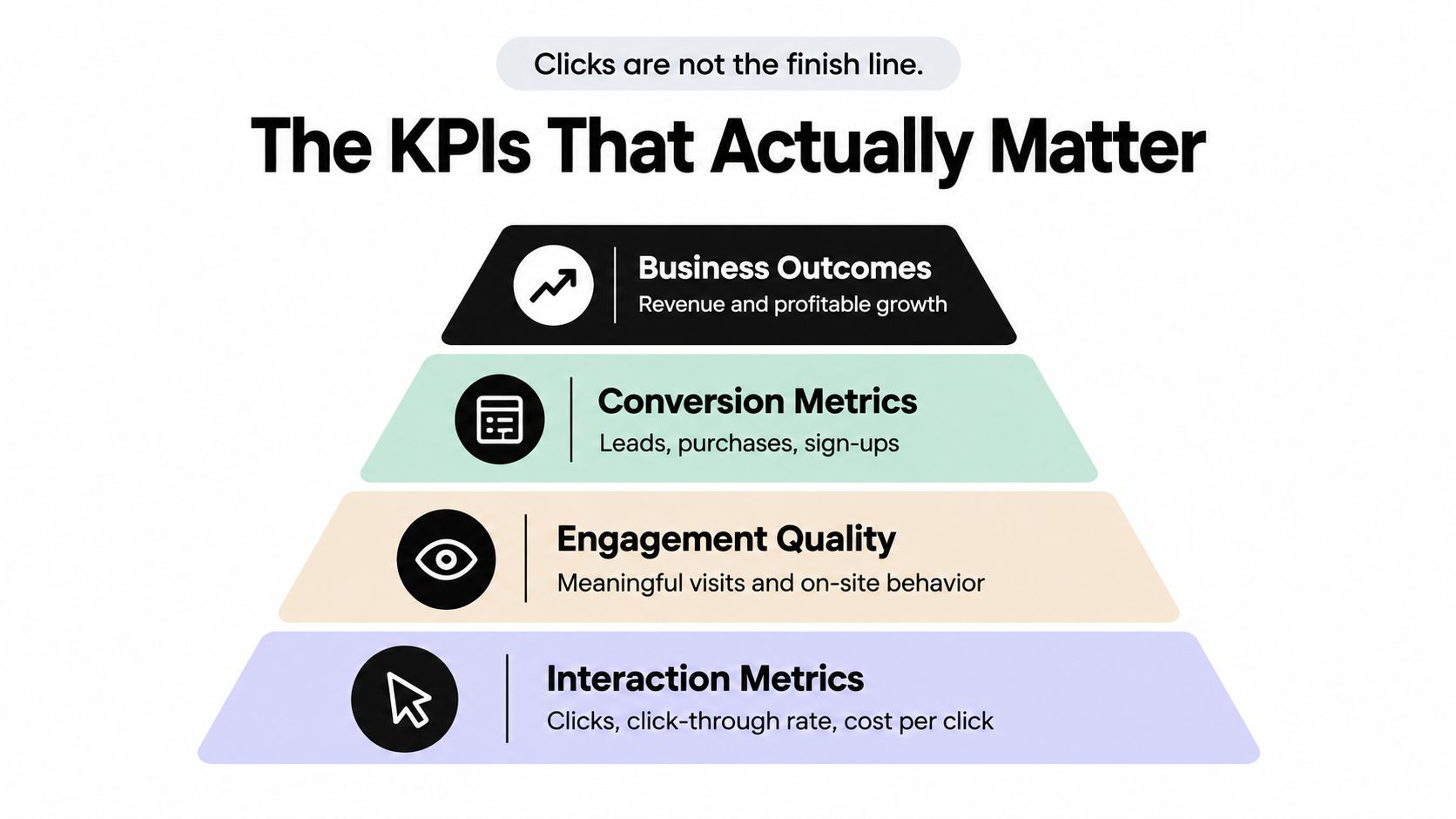
Build from interaction to impact
- Interaction metrics: Clicks, click-through rate, and cost per click help diagnose attention and auction pressure.
- Engagement quality: Meaningful visits, form starts, and relevant on-site behavior indicate whether traffic has substance.
- Conversion metrics: Cost per qualified lead, cost per acquisition, purchases, and return on ad spend connect media costs with actions.
- Business outcomes: Revenue, margin, retention, customer quality, and lifetime value show whether growth merits further investment.
Pair financial measures with quality signals. A low lead cost can conceal weak qualification, close rates, or retention. A higher acquisition cost may be acceptable if customers stay longer, expand, or produce stronger margins. Assess return on ad spend alongside downstream value, rather than treating ROAS as a standalone verdict.
Video needs the same discipline. Views measure exposure; qualified actions and revenue offer evidence of contribution. Use the embedded walkthrough to review how those signals connect.
<iframe width="100%" style="aspect-ratio: 16 / 9;" src="https://www.youtube.com/embed/mPiWWnJsVGw" frameborder="0" allow="autoplay; encrypted-media" allowfullscreen></iframe>For a format-specific perspective, Klap's video ROI measurement guide explains how to connect video activity to business return instead of stopping at playback counts.
Choose events with intent
Choose a primary conversion that is close enough to revenue to guide optimization and happens often enough to support learning. A B2B team might optimize toward completed demo requests. A secondary event, such as a qualified content action or form start, can help diagnose performance without becoming the bidding target.
Attribution models answer different questions about credit. Data-driven attribution distributes credit across interactions in a historical conversion path, while last-click attribution assigns all credit to the final clicked ad. Neither model alone shows whether the advertising caused the conversion.
Next-day audit: Compare both models for one major conversion. Check whether campaigns gaining credit under the broader model are assisting demand that last click misses.
Attribution, Incrementality, and Business Impact
Most measurement arguments happen because three separate questions get collapsed into one report. A platform assigns credit, a manager treats that credit as causation, and finance then asks why pipeline or profit hasn't moved. Separating the layers prevents that chain reaction.
The flow below shows the distinction in the order teams should discuss it.
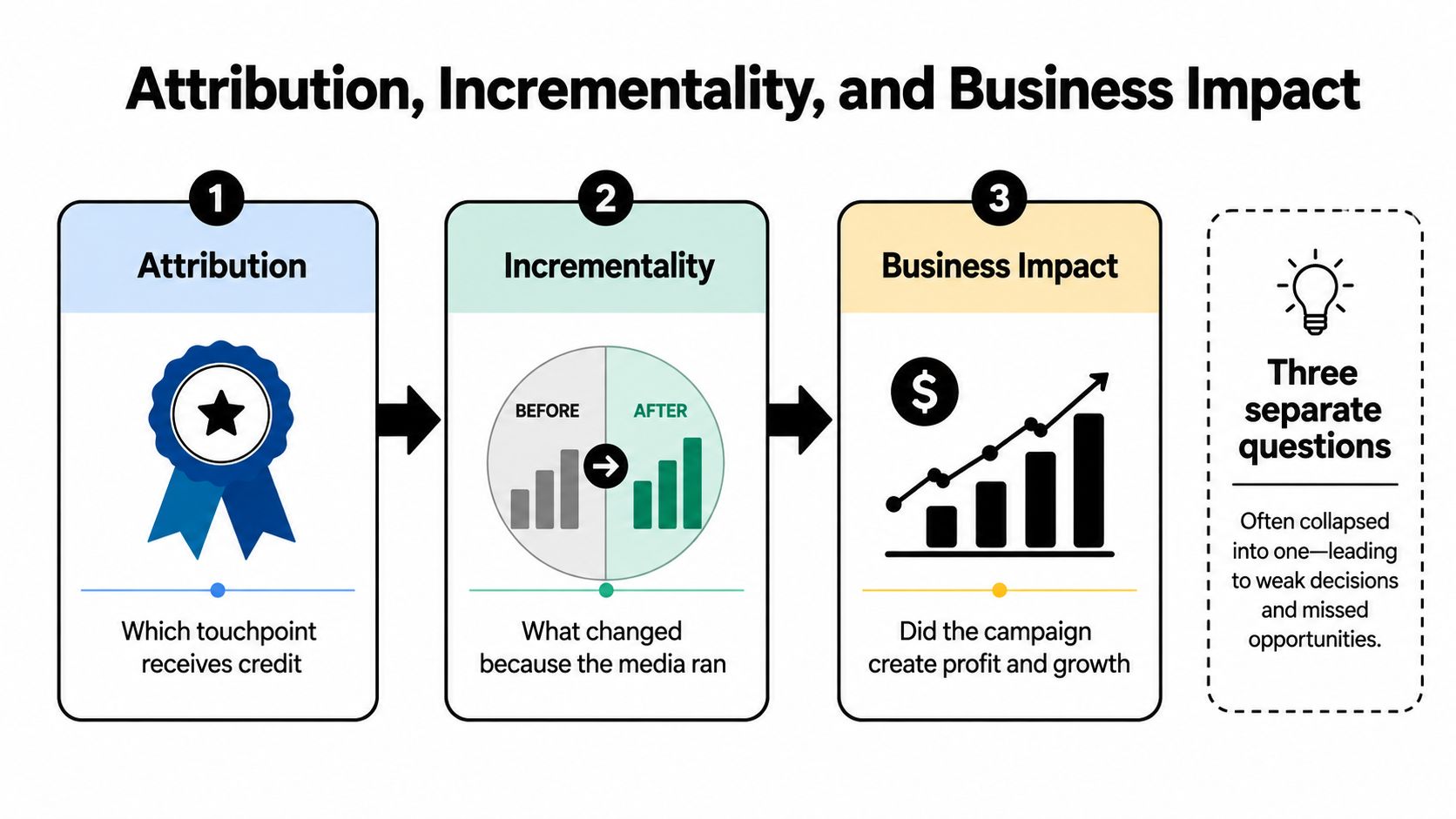
Three layers, three different answers
Attribution decides which touchpoint receives credit. It's useful for operational reporting, especially when paths include several ads before conversion. It doesn't prove the winning touchpoint caused the result.
Incrementality asks what would not have happened without the media. That requires a counterfactual, usually through a controlled test or a model designed to estimate contribution across channels.
Business impact asks whether the incremental result changed pipeline, margin, retention, or lifetime value. A real lift in low-quality leads can still fail this test.
Recent measurement guidance points to growing use of marketing experiments and marketing-mix modeling, approaches once mainly available to advanced advertisers, as noted in WARC guidance on the future of measurement. The important shift isn't adopting a fashionable method. It's matching the method to the decision.
Pick the test that fits the decision
- Holdout test: Best for a clean causal read when an audience can be split and one group can be withheld.
- Geo experiment: Useful when regions can receive different exposure and outcomes can be compared credibly.
- Marketing-mix modeling: Better for portfolio questions, offline influence, and channels that don't produce neat user-level paths.
B2B measurement is structurally harder. Long sales cycles, offline conversations, multiple CRM stages, and small samples weaken last-click and platform views. A prospect may see social creative, attend an event, consult colleagues, and convert much later through branded search. Crediting only the final click therefore understates earlier work and overstates capture activity.
Other channels face the same credit problem in shorter journeys. An attribution guide for Shopify SMS marketers offers a helpful example of how last-touch thinking can distort decisions even when conversions happen faster.
Teams joining several channels need consistent event definitions before comparing models. A shared framework for cross-channel attribution and conversion paths helps prevent every platform from telling a different story.
Tomorrow, compare data-driven and last-click results for one important conversion. Note which campaigns gain or lose value. That comparison won't prove incrementality, but it will show where a holdout or geo test deserves priority.
How Performance Media Fits Full-Funnel Growth
Performance media isn't only bottom-funnel harvesting. Used properly, it introduces a brand, moves prospects toward a first meaningful action, supports purchase, and brings existing customers back. The metrics change by stage because the human decision changes by stage.
The funnel below maps those jobs without pretending every stage should produce the same immediate conversion.
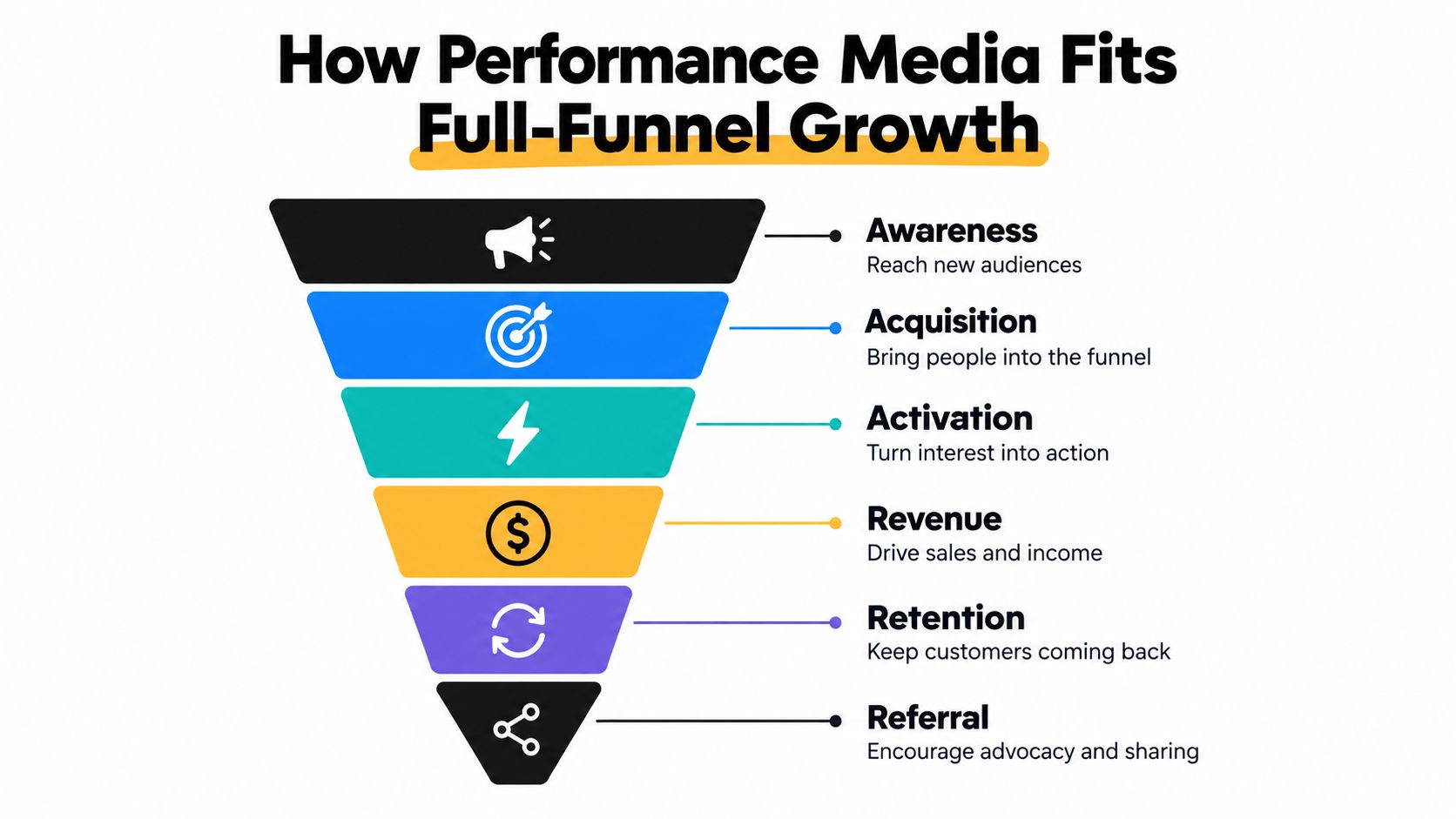
A different job at each stage
Awareness reaches people who don't yet know the category solution or brand. Relevant reach, attention quality, and later branded demand matter more than instant purchases.
Acquisition brings interested people into an owned journey. The goal is a useful visit, signup, or lead action, not raw traffic.
Activation turns interest into a meaningful first step. Examples include a completed demo request, product trial start, or first purchase, depending on the business model.
Later stages need a different discipline:
- Revenue: Connect conversion value to margin and acquisition cost, not just gross sales.
- Retention: Use media selectively for replenishment, renewal, education, or reactivation where paid exposure adds something owned channels can't.
- Referral: Amplify customer proof and advocacy prompts, while recognizing that product experience does most of the persuasive work.
The expensive pause
Pausing an awareness or consideration campaign because it produces few last-click conversions can shrink future demand. Its contribution may appear later as branded search, direct visits, or assisted conversions through another channel. That doesn't give upper-funnel spend immunity. It means the evidence standard should fit the stage.
A campaign should be judged against the funnel job it was funded to do, then checked for downstream contribution before budget moves.
The same channel can serve several stages. Social video might create awareness with a problem story, drive acquisition with a lead offer, and support retention with customer education. Search might capture new demand or intercept returning customers. The selected audience, message, landing page, and conversion event define the job.
A practical mapping exercise takes one live campaign and answers four points: intended stage, actual audience, primary event, and downstream business signal. Mismatches surface fast. A campaign labeled awareness but optimized for cheap clicks and judged on purchases is serving no stage well.
Performance Media for B2B and B2C Teams
B2B and B2C teams can buy similar placements and still need opposite setups. The difference isn't taste. It's sales cycle length, conversion volume, buying group size, and the distance between an ad click and revenue.
B2B needs pipeline evidence
For a B2B company, a click from the wrong company has little value. The primary event should reflect qualification, such as a completed demo request or another action sales agrees represents real intent. Media reporting then needs CRM stages, opportunity creation, and deal quality, not only form submissions.
Small samples also change testing. Teams can't slice a narrow account list into endless variants and expect reliable reads. Campaigns need broader hypotheses, longer evaluation windows, and sales feedback on account fit. A focused approach to B2B paid social for pipeline generation reflects that need for audience quality over lead volume alone.
B2C needs volume with control
E-commerce and consumer teams usually get faster purchase feedback. That makes creative testing, audience consolidation, merchandising, and checkout quality central. Social and commerce placements can move from discovery to transaction quickly, but fast feedback can also create false confidence when discounts or existing demand drive the sale.
Retention matters earlier in the analysis. A campaign acquiring one-time bargain hunters may look cheaper than one bringing repeat buyers. Margin, repeat behavior, and customer quality should therefore enter budget decisions before scale.
In-house, agency, or hybrid
- In-house: Offers speed, product knowledge, and direct data control, but can lack specialist depth or testing capacity.
- Agency: Adds channel expertise, creative range, and experimentation bandwidth, but needs clear commercial targets and access to downstream data.
- Hybrid: Keeps strategy and customer knowledge internal while external specialists support execution, analysis, or testing.
Sprints & Sneakers operates as a B Corp-certified growth marketing agency that starts with a personalized growth scan, identifies the single bottleneck limiting performance, and prioritizes experiments across the full funnel for B2B and B2C brands. That model fits the hybrid category when internal teams need sharper diagnosis and additional testing capacity.
The right choice depends on the bottleneck. Weak measurement won't be solved by adding media buyers. Weak creative volume won't be solved by another dashboard. Diagnosis should come before structure.
Using AI and Experiments to Improve Media ROI
AI doesn't automatically make performance media smarter. It makes the existing system faster. Clean conversion data and clear constraints become more valuable. Flawed attribution and weak creative just scale faster.
Only 30% of agencies, brands, and publishers had fully integrated AI across media planning, activation, and analysis in 2025, while nearly two-thirds identified data quality, data protection, and fragmented tools as major barriers, according to IAB State of Data findings on AI integration. That's an operating-model warning, not a software shopping list.
Build a controlled learning system
Humans should define the commercial constraint, acceptable acquisition cost, audience boundaries, and experiment priorities. AI can then help generate variants, build audiences, support attribution analysis, or assist marketing-mix modeling. CRM and revenue outcomes provide feedback. Incrementality tests verify whether reported gains are real.
That division prevents automation from optimizing toward easy conversions. It also creates accountability for model bias, consent, invented insights, privacy, and budget decisions. Someone needs authority to stop a model-assisted campaign when business quality deteriorates, even if platform efficiency improves.
A weekly cadence keeps testing manageable:
- State one hypothesis: Name the audience, message or landing page change, expected action, and business reason.
- Check event volume: Confirm the test can produce enough meaningful outcomes to interpret.
- Run one clear change: Avoid changing audience, creative, budget, and page at the same time.
- Review quality: Compare qualified outcomes and downstream value, not only click cost.
- Verify before scaling: Use a holdout or another incrementality check for major budget moves.
Structured A/B testing for marketing decisions gives that cadence a repeatable base. AI can propose and optimize variants, but transparent validation still decides whether a result deserves more money.
Governance check: If nobody can explain the objective, data source, consent basis, and stopping rule, the setup is an autopilot rather than a learning system.
Your Next Step Toward Predictable Performance
A dashboard can show efficient spend while the business gets little incremental value. Start with one conversion that matters to revenue or retention. Compare last-click with data-driven attribution for that action, then note which campaigns gain or lose credit when assisted interactions count. Treat the comparison as a way to form an incrementality question, not as a reason to shift the whole budget.
Next, check whether overlapping audiences are splitting the available conversion signal. When each ad set receives too few meaningful outcomes, learning becomes less reliable. Consolidate audiences first, then estimate whether the test can generate a steady flow of qualified conversions across its evaluation window.
A one-week sequence
- Day one: Confirm the primary conversion, counting rule, and connection to CRM or revenue data.
- Day two: Compare attribution models and flag campaigns whose assisted value may be hidden.
- Day three: Consolidate audiences and assess whether meaningful outcomes will arrive consistently enough to evaluate the test.
- Day four: Audit one weak keyword or ad set. Match the query, ad promise, and landing-page headline before increasing bids.
- Day five: Reconcile reported clicks with analytics sessions, engaged visits, form starts, and qualified leads.
Clicks need checking before they guide budget. The IAB's guidance on click measurement and fraud definitions explains click origin, counting rules, and the distinction between valid and fraudulent clicks. A discrepancy alone does not establish fraud. Consent settings and tracking loss can also explain the gap, so investigate the source before increasing spend.
If measurement is the bottleneck, clarify definitions and test design before opening another channel. Predictable performance depends on evidence that connects media activity to business outcomes.
Ready to connect paid spend with pipeline, revenue, and retention? Sprints & Sneakers starts with a personalized growth scan to identify performance bottlenecks, then prioritizes full-funnel experiments across media, creative, conversion, and analytics. Contact the team to discuss a practical next step for growth.
Related articles

Frequently asked questions
Growth marketing, AI and automation, SEO, performance marketing, retention strategies, and sustainable business practices.
Weekly. Subscribe to our newsletter to get new articles straight to your inbox.
Absolutely. Everything we publish is designed to be actionable. Take it, test it, and make it your own.
Yes. We publish experiments with real numbers. What worked, what didn't, and what we learned.
Our growth team — strategists, performance marketers, data specialists, and AI builders who work on client campaigns every day.
We're open to it. Reach out via our contact page with your topic and we'll take a look.